What Are the Standards for Golden Cup Extraction? How Should Coffee Extraction Yield and Concentration Be Calculated?
What is Golden Cup Extraction?
"Golden Cup Extraction" is a phrase that comes up constantly in the world of pour-over coffee, and many brewing tutorials reference it. Most beginners find it unfamiliar, often running into confusing numbers and diagrams when they search for it. That is why FrontStreet Coffee is here to walk you through what Golden Cup Extraction really is.
The Origin of Golden Cup Extraction
Golden Cup Extraction, as we have said, is a concept conveying that coffee has a most desirable extraction range. As long as our brewed coffee falls within that range, its flavor will be acceptable, even enjoyable, to the vast majority of people. The concept grew out of a research effort in the United States in the twentieth century. In 1952, the American coffee association, together with Dr. Lockhart, a chemistry professor at MIT, established a Coffee Brewing Committee aimed at researching and promoting the coffee industry. The finding we often cite, that "one coffee bean contains 30% soluble substances," was published by them in 1957.
The Science Behind Coffee Extraction
Dr. Lockhart and his team analyzed the structure of coffee beans and found that a single bean contains 30% soluble substances, with the remaining 70% made up of insoluble fiber. The soluble substances are what water can extract, while the insoluble fiber is essentially the "coffee grounds" that cannot dissolve or be extracted and must ultimately be discarded or repurposed, for fertilizer or as a deodorizer, for instance. They quickly realized, however, that not all of that 30% should be extracted. At different extraction levels, the flavor of coffee changes accordingly. So they ran a dedicated preference survey, giving random American passersby coffee brewed to different extraction levels and asking them to pick their favorite.
Defining the Golden Cup Standard
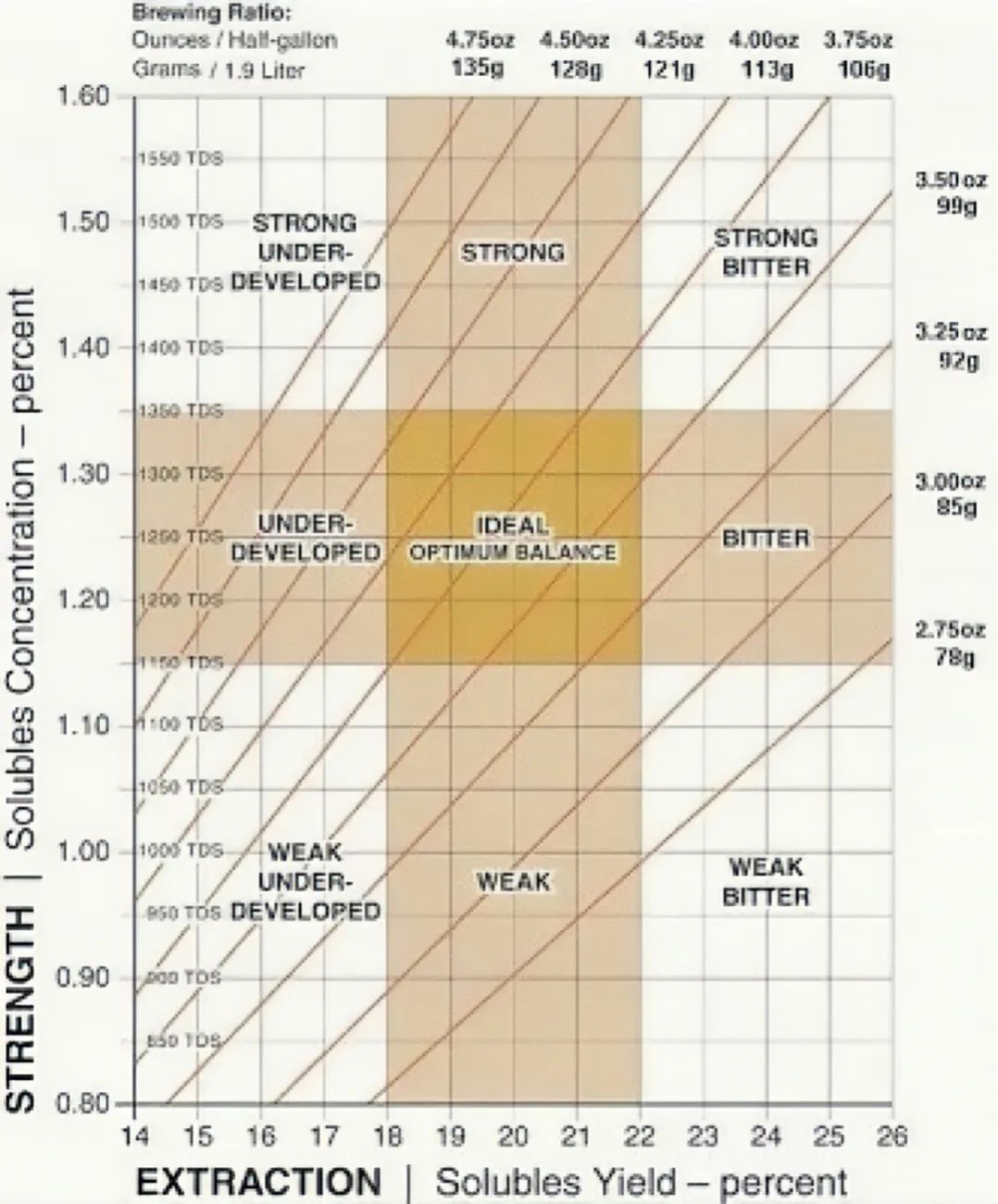
After the survey, they compiled the data and found that people preferred coffee with an extraction rate between 17.5% and 21.2% and a concentration between 1.04% and 1.39%. These parameters, favored by American passersby, became the initial "Golden Cup Standard." To explain briefly: extraction rate refers to how much soluble substance has been pulled from a coffee bean, while concentration refers to the amount of coffee substance in the brewed cup. The range was still too broad, however, so the committee later reran the experiment. This time the subjects were coffee industry experts, and through more rigorous tasting and research, the Golden Cup range was eventually revised: extraction rate adjusted to 18%-22%, and concentration tightened to 1.15%-1.35%. That data represents the final version. The diagram below is the Golden Cup Extraction chart, showing what flavors arise from different combinations of concentration and extraction rate.
Reading the Extraction Chart
The horizontal axis represents extraction rate, the vertical axis concentration, and the diagonal lines the coffee-to-water ratio. Calculating extraction rate is simple: just use the formula below. (Note that measuring concentration requires a refractometer.) The formula is: coffee liquid weight (ml) x coffee concentration (TDS) / coffee grounds weight (g). In the image we can see many differently colored blocks. The darkest area at the center of the chart represents the Golden Cup Extraction range. Beyond that range, coffee is classified as over-extracted, with varying degrees of bitterness depending on concentration. Below the range, coffee is classified as under-extracted, with varying degrees of sourness depending on concentration. This is why many enthusiasts work to keep their coffee within the Golden Cup range, treating cups that fall outside it, whether by extraction rate or concentration, as less enjoyable.
The Personal Nature of Coffee
Still, FrontStreet Coffee wants to stress that Golden Cup Extraction is only a concept, a standard established from the preferences of a specific group of people. Different countries have different dietary habits, and we cannot assume everyone will prefer the same standard. Golden Cup Extraction should therefore serve only as a reference. We can use it to better understand coffee extraction, but we should not apply the theory to every coffee. Coffee within the Golden Cup range is not necessarily delicious, and coffee outside it is not necessarily unpleasant. As long as the brewed coffee tastes good to you, it is your "Golden Cup Coffee," whether or not it falls within the range.
- END -
FrontStreet Coffee Recommendation
Since Golden Cup thinking is really about hitting a balanced, well-extracted cup on pour-over, the beans you choose matter as much as the numbers. FrontStreet Coffee Yirgacheffe Gordin Cooperative is a washed Ethiopia G1 with elegant white florals and a bright citrus and lemon profile over a tea-like body, a forgiving and classic pour-over choice that reliably lands in a sweet, clean zone.
If you like your pour-over on the brighter side, FrontStreet Coffee Kenya Little Tomato, from Kenya's Thika region at 1,550-1,750 meters, is a light-roasted washed coffee built on the classic SL28 and SL34 varieties and a 72-hour double-wash process. It shows cherry tomato and smoked plum on the nose, vivid fruit acidity with prominent mid-palate sweetness, and a clean, long finish of yellow sugar sweetness and a hint of green tea.
Important Notice :
FrontStreet Coffee is a long-established specialty coffee roaster in Guangzhou China, selling freshly roasted beans from its own farm in Yunnan as well as dozens of carefully selected single-origin beans from around the world for both pour-over and espresso. The products deliver consistently excellent quality and great value, with shipping within 24 hours. Guangzhou's FrontStreet Coffee shop is recommended by many coffee lovers, and the beans are now available online at the Tmall 。
FrontStreet Coffee has moved to a new address:
FrontStreet Coffee Address: 315,Donghua East Road,GuangZhou
Tel:020 38364473
 Scan and follow the En Gafei WeChat official account. Please indicate that the reprint comes from "En Gafei".