Ethiopian Coffee Beans | Introduction to Bench Maji Zone Gesha Village Gold Label Coffee Beans

Ethiopia: The Sacred Land of Coffee
For coffee enthusiasts, Ethiopia is a sacred destination. The country is the birthplace of coffee and today is Africa's largest producer of Arabica coffee. It also holds the world's largest coffee gene bank, with countless varieties, including the renowned Geisha, which originated in its primeval forests.
Most coffee lovers know the Geisha origin story and the famous estates of Panama, but when it comes to Ethiopian Geisha, many have only heard of "Gesha Village" and a place called Bench Maji, with little knowledge of the details. Today, FrontStreet Coffee walks you through this growing region to show what makes Ethiopian Geisha special.

Ethiopia
Ethiopia sits in northeastern Africa, bordering Djibouti, Somalia, Sudan, South Sudan, Kenya, and Eritrea. It is dominated by mountainous plateaus, mostly part of the Ethiopian Plateau, with the central and western areas forming the main plateau that makes up two-thirds of the country. The Great Rift Valley runs through the entire territory, with mountains averaging nearly 3,000 meters in elevation.
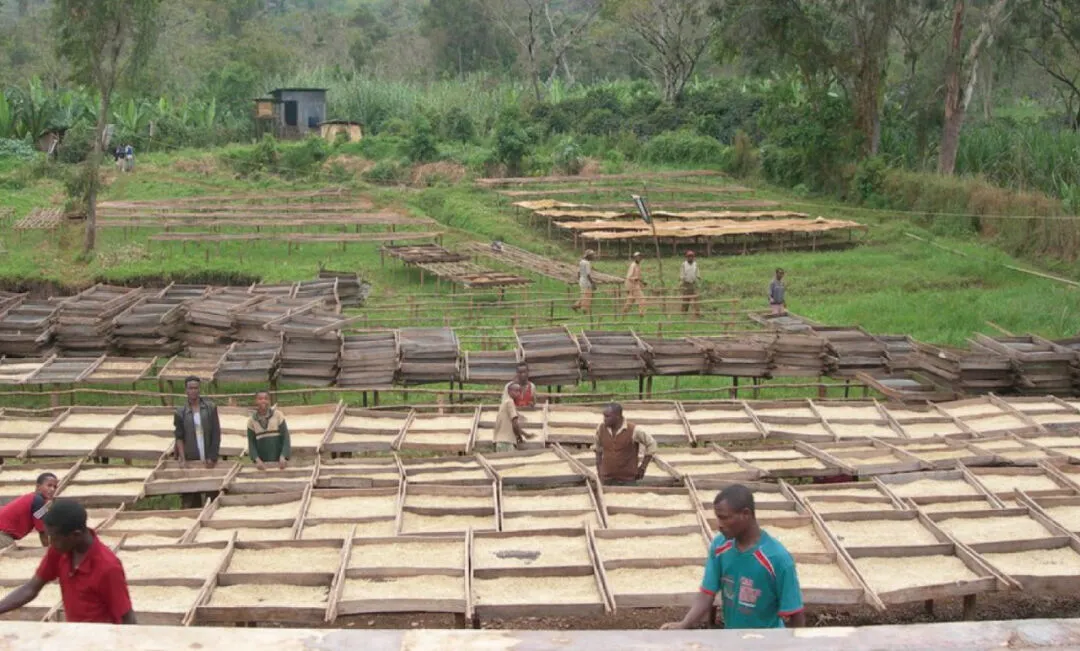
Because of the high altitude, the climate is pleasant, with an average annual temperature of 16°C. The plateau has a tropical savanna climate, while the mountainous areas have a highland mountain climate, and the eastern and northern lowlands a tropical desert climate. The year is roughly divided into dry and rainy seasons, with annual rainfall of 1,237 millimeters. The country is rich in water resources, with many lakes and rivers, earning it the nickname "East Africa's Water Tower." With nearly 50 volcanoes, abundant water, diverse climates, and high-altitude mountains, it is an ideal region for coffee cultivation.
Ethiopia's coffee growing regions can be roughly divided into three main parts: eastern, southern, and western. FrontStreet Coffee's research shows that the eastern region, centered on Harar, primarily exports coffee to Middle Eastern countries. The southern region includes many of Ethiopia's specialty representatives, such as Yirgacheffe, Sidamo, and Guji, and is widely recognized as the main producer of high-quality coffee. The western region mainly covers the relatively lower-altitude areas of Jimma, Limmu, Kaffa, and Bench Maji, known for forest cultivation methods.

Bench Maji
Administratively, Bench Maji is a zone belonging to the Southwest Ethiopia Region, on the country's western border near South Sudan. It is named after its largest ethnic group, the Bench people, who are known for advanced agricultural techniques, most notably their cultivation of local staple crops such as Teff.
The Bench Maji growing region, also known as the Bebeka region (Bebeka is the capital of Bench Maji Zone), lies in southwestern Ethiopia as a zone under the Southern Nations, Nationalities, and Peoples' Region, only a few kilometers from South Sudan. Here sits the renowned Gesha Village Coffee Estate, where the Geisha variety trees of Gesha Village were found in the wild forests of Bench Maji.

Unlike the central and southern regions famous for specialty coffee, the western highlands consist of vast primeval forests. Bench Maji was originally protected more for its biodiversity as a forest, with few people cultivating coffee in earlier years. In recent years, however, as Gesha Village and Bench Maji grew famous, more and more farmers began to switch to coffee cultivation.
Compared with other western growing regions, Bench Maji borders Kaffa, the birthplace of coffee, and its most significant feature is extremely high forest coverage. Coffee production in Bench Maji is supervised by farmers who, out of respect for the natural ecosystem, take steps to minimize intervention in the forest, such as occasionally removing old or poorly growing coffee trees and replacing them with new seedlings grown in the same wild forest.

As the region where Geisha originated, Bench Maji also has its own coffee farmers' cooperative union, the Bench Maji Coffee Farmers' Cooperative Union, a large coffee production organization of 65 cooperatives serving 130,000 small-scale farmers. Here, coffee trees are typically intercropped with other crops among the tall plants of the original forest. To secure steadier income, farmers also plant spices such as ginger. This semi-forest cultivation model lets the coffee trees thrive under the shade and natural soil and water conservation of the original forest, without extra pesticides or fertilizers, achieving mutual benefit between the ecosystem and the economy.
Gesha Village Coffee Estate
Gesha Village Coffee Estate is located in the Bench Maji growing region and spans 471 hectares. It was founded by documentary filmmaker Adam Overton and his photographer wife Rachel Samuel. In 2007, while filming a documentary about coffee for the Ethiopian government, the couple discovered the Gori Gesha Forest in Bench Maji and began to consider establishing their own coffee estate. In 2009, they met Willem, owner of Panama's Don Pachi Estate, and returned to Ethiopia together to search for Geisha. They reached a place in Bench Maji called Gesha Village, found what was most likely the original Geisha area, collected seeds from the original Geisha trees, and after screening, planted them at Gesha Village. They decided to establish the estate there and named it Gesha Village Coffee Estate.

Cultivated Varieties and Plots
Gesha Village Coffee Estate currently cultivates three coffee varieties: Gesha 1931, Gori Gesha, and Illubabor Forest 1974. The estate is divided into 8 plots, each growing only one variety. The Oma, Surma, and Narsha plots grow Gesha 1931; the Bangi, Shewa-Jibabu, and Shaya plots grow Gori Gesha; and the Gaylee and Dimma plots grow Illubabor. Cherries harvested from each block are labeled to indicate their origin, and an internal tracking system monitors their entire path from the factory to export.
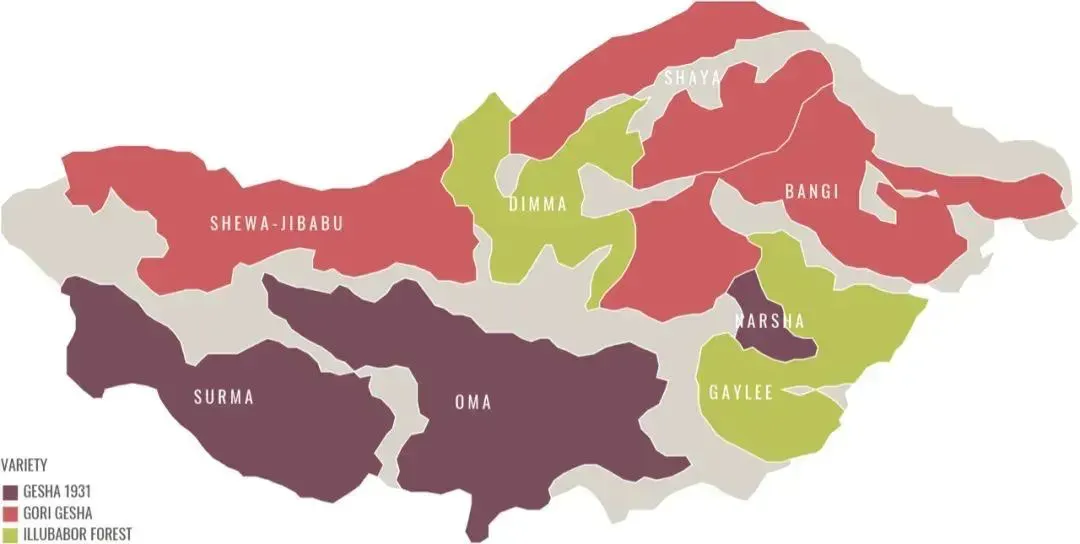
Gesha 1931: The Geisha variety was first found in Ethiopia's coffee forests in 1931. Because of its resistance to leaf rust, it traveled through multiple countries before eventually becoming famous in Panama.
Compared with Panama's Geisha, the Gesha 1931 here is confirmed through plant morphology, bean shape and size, and cupping results to be the closest to the mother plant of Panama's Geisha. Through cupping comparisons, FrontStreet Coffee found that the new harvest's Gesha Village Gold Label beans show intense berry aroma, full-bodied cantaloupe, citrus-like bright acidity, chamomile-like florals, and a tea-like aftertaste.

Gori Gesha: In 2011, after Gesha Village was established, the estate owners discovered a native Geisha variety in the Gori forest, 12 miles from the estate, hence the name Gori Gesha.
Illubabor Forest 1974: Discovered during a 1974 expedition in the Illubabor forest, it was later developed by the Ethiopian Research Center into a variety with resistance properties. It is currently cultivated only at Gesha Village.
Gesha Village Grading
The coffee classification at Gesha Village Coffee Estate takes inspiration from the business models of some Panamanian estates and differs from traditional Ethiopian grading. Gesha Village is divided into five categories: Auction Lots, Gold Label, Red Label, Green Label, and Chaka.
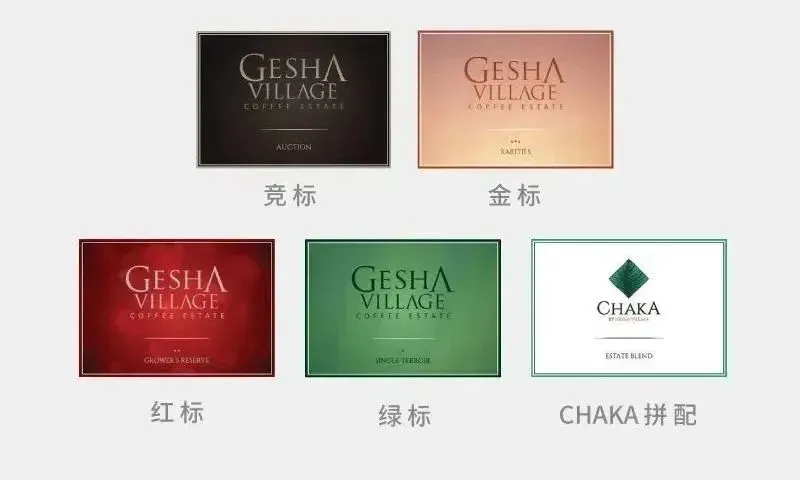
Champion's Reserve/Farm Reserve: This category accounts for only 3.7% of Gesha Village's annual production and represents the most carefully selected top-tier lots from the estate. Auction lots are further divided into Champion's Reserve and Farm Reserve, currently available only through the global auctions at Gesha Village Coffee Estate.
Rarities (Gold Label): This category represents the highest quality among non-auction lots at Gesha Village. Gold Label accounts for only 10% of the entire estate's production, making it the most expensive Gesha Village product outside of auctions. FrontStreet Coffee's new harvest Gold Label Geisha beans this year come from the Oma plot, processed using a 32-day natural drying method, with the variety being the exclusive Gesha 1931 from the Oma plot.

Growers Reserve (Red Label): Red Label accounts for 15% of Gesha Village Coffee Estate's production. Beans in this category must score above 88 points on SCA cupping.
Single-Terroir (Green Label): Green Label has no cupping score requirement but can be traced back to information about plot, variety, processing method, and time.
Chaka: Chaka is a category that mixes all plots and varieties from the entire estate, without emphasizing subdivision.

FrontStreet Coffee: Ethiopia Gesha Village Gold Label Coffee Beans
Region: Bench Maji Growing Region
Estate/Processing Station: Gesha Village Coffee Estate
Altitude: 1931-2040 meters
Variety: Gesha 1931
Processing Method: Natural
Flavor: Citrus, Berries, Chamomile, Cantaloupe, Tea-like Sensation
Below, FrontStreet Coffee demonstrates the brewing steps for Gesha Village Gold Label as served in its stores. You can compare it with your own approach.
Pour-over Recommendations for Gesha Village Gold Label Coffee:
Dripper: V60
Water Temperature: 91-92°C
Coffee Dose: 15g
Coffee-to-Water Ratio: 1:15
Grind Size: Fine sugar consistency (80% passing through #20 sieve)

Three-stage extraction: first, pour 15 g of coffee grounds into the dripper and reset the scale. For stage one, pour 30 g of water for a 30-second bloom while starting the timer. Use a small stream, pouring from the center outward in a circle so the entire coffee bed is moistened.
For stage two, use a slightly larger stream to pour 120 g of water, aiming to lift the whole coffee bed. The stream should be poured vertically and evenly. At this point the scale should read 150 g, and the pour should be complete at about 55 seconds.

When the liquid level drops to about halfway, begin stage three by pouring 90 g of water in a small stream with small circular motions. Try to keep the circles from growing too large, which could disperse the grounds and cause under-extraction. The final pour total should be 240 g, with drip filtration completing in about 2 minutes 10 seconds. After removing the dripper, shake the coffee in the sharing pot evenly before tasting.
FrontStreet Coffee Recommendation
This article features the Gold Label, and if that is the tier you want, FrontStreet Coffee's Ethiopia Gesha Village Gold Label is exactly it: grown in the Bench Maji region at 1,931-2,040 meters, from the Oma plot, the exclusive Gesha 1931 variety, and processed with a 32-day natural dry. It offers citrus, berries, chamomile, cantaloupe, and a tea-like body, and makes up only about 10% of the estate's production.
For a more accessible look at Gesha Village, FrontStreet's Red Label Geisha belongs to the Gori Gesha variety and accounts for 15% of production. It must score 88 points or above on the SCA 100-point scale, and as a single-terroir series every lot carries full traceability - farm block name, variety, and processing date.
If you want to taste Ethiopian Geisha beyond Bench Maji, FrontStreet's Grana Geisha comes from the Grana Gesha farm near the border of Ethiopia's Kochere and Grana Abaya areas. The station, established in 2014 and run by Mr. Israel Degefa, sits in a region of up to 700 hectares, mostly uncultivated. Hand-picked whole ripe cherries and 14-20 days of raised-bed drying produce a cup with bright citrus acidity, elegant ginger-flower aroma, ripe-fruit sweetness, and the fine, silky finish that marks the Geisha variety.
Important Notice :
FrontStreet Coffee is a long-established specialty coffee roaster in Guangzhou China, selling freshly roasted beans from its own farm in Yunnan as well as dozens of carefully selected single-origin beans from around the world for both pour-over and espresso. The products deliver consistently excellent quality and great value, with shipping within 24 hours. Guangzhou's FrontStreet Coffee shop is recommended by many coffee lovers, and the beans are now available online at the Tmall 。
FrontStreet Coffee has moved to a new address:
FrontStreet Coffee Address: 315,Donghua East Road,GuangZhou
Tel:020 38364473
 Scan and follow the En Gafei WeChat official account. Please indicate that the reprint comes from "En Gafei".