Brazil Coffee Regions, Coffee History, Coffee Varieties, and Brazil Queen's Estate Coffee Beans Introduction
Brazil is the largest country in South America, bordering ten countries including Uruguay, Peru, Bolivia, and Colombia. Its coffee industry is enormously developed: Brazil is the world's largest producer and exporter of coffee, with its exports accounting for one-third of global coffee exports.
Coffee, however, isn't native to Brazil. In 1727, Sergeant Major Francisco de Mello Palheta was dispatched to French Guiana. France strictly restricted coffee bean exports at the time, so to succeed, the sergeant major won the trust of the wife of the governor of French Guiana's capital — and at his departure, she handed him an Arabica coffee seed, which he carried back to Brazil's state of Pará. With Brazil's climate so well suited to coffee, cultivation quickly spread to other states. By 1830, coffee had become Brazil's main export, making up 30% of world production. Coffee powered Brazil's economic development, especially in São Paulo state, where new railways were built to haul goods to the port of Santos. In 1965, during the Cold War era, coffee became severely oversupplied and prices collapsed, prompting Brazil to sign International Coffee Agreements with multiple countries to restrict exports. Not until 1989 did Brazil withdraw from those agreements, and in 1991 the Brazilian Specialty Coffee Association (BSCA) was founded.

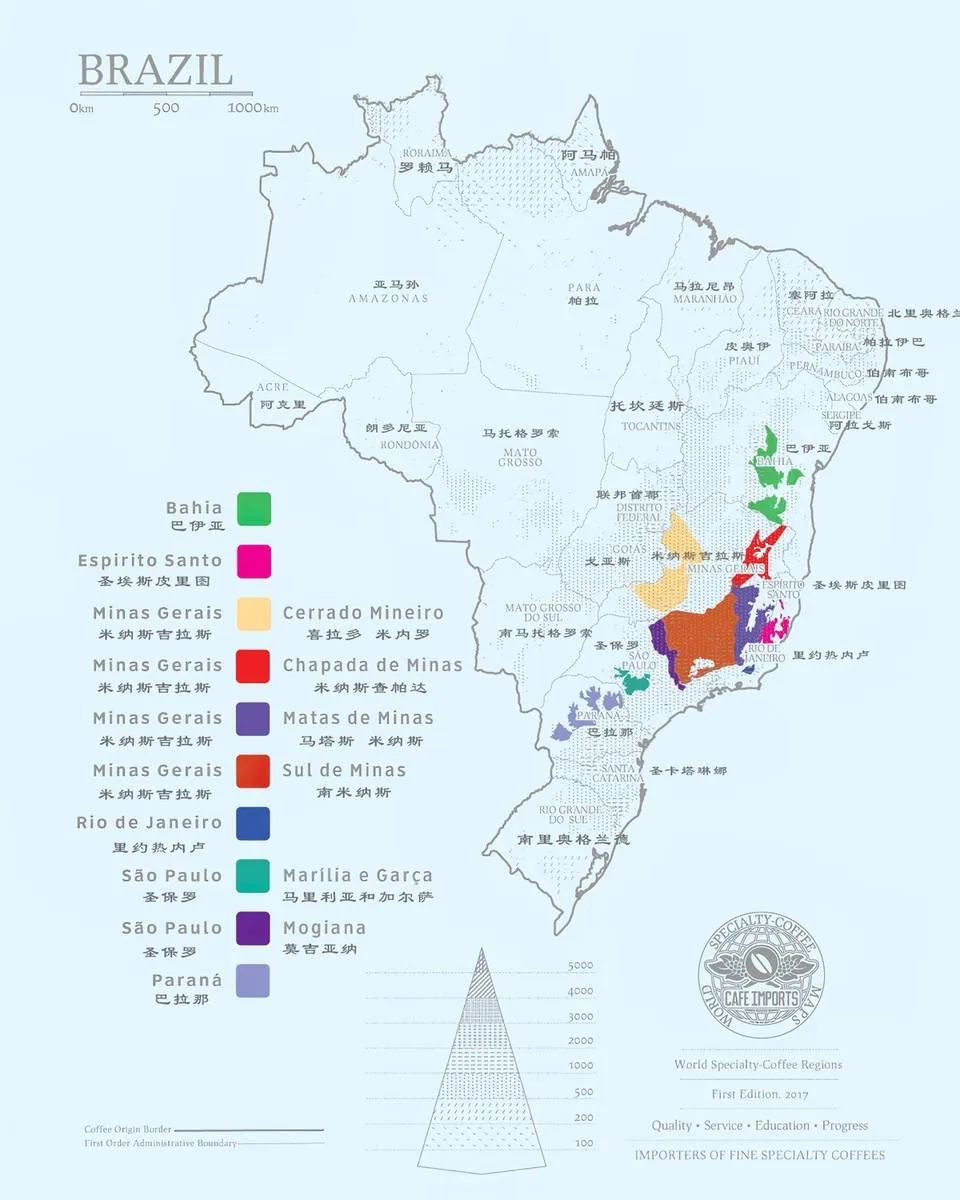
Brazil has 26 states, 17 of which grow coffee. Four of those — Paraná, São Paulo, Minas Gerais, and Espírito Santo — account for 80% of total production, with Minas Gerais leading at 30%. Arabica makes up 80% of Brazil's output, with Robusta at 20%. The main cultivated varieties are Bourbon, Catuaí, Typica, and Mundo Novo, harvested from May to September.
Bahia
Many consider Bahia the world's southernmost coffee-producing region. Though the state covers only 2.5% of Brazil's area, it produces nearly 25% of the country's agricultural crops. But it lacks high-altitude terrain — the highest elevation is just 950 meters — so truly fine coffees are rare here.
São Paulo
This state is home to Mogiana, one of Brazil's most storied coffee regions, with elevations of 900 to 1,100 meters. The rolling terrain and mineral-rich red sandy soil are ideal for coffee. FrontStreet Coffee's Queen's Estate (Fazenda Rainha) coffee comes from Mogiana — a Yellow Bourbon variety processed by the pulped natural method. Brewed on a V60 at 1:15, it shows fresh sugarcane sweetness alongside black tea, nut, and chocolate flavors, with a bright, smooth, delicate texture.
Minas Gerais
Located in southeastern Brazil, Minas Gerais boasts several of the country's highest mountains. The well-known regions of Cerrado and Sul de Minas both lie here. Many farms are very large, so mechanical cultivation and harvesting predominate. Elevations range from 700 to 1,350 meters.

Espírito Santo
Compared with other coffee regions, this one is smaller, with the capital Victoria serving as the main export port. The state grows 80% Robusta; only farmers in the southern parts lean toward Arabica. Elevations run from 900 to 1,200 meters.
FrontStreet Coffee Recommendation
Brazilian coffee shines for its moderate acidity, excellent balance of sweetness, bitterness, and body, and a rich nutty aroma in a medium roast — great as single origin or blend base. If you want a first taste of Brazil, FrontStreet Coffee's pulped natural Cerrado Red Bourbon is a classic: medium roasted, it offers cream, peanut, toasted bread, caramel, and hazelnut aromas in a rounded, non-acidic cup with a light bitter edge — at home in pour-over, moka pot, siphon, French press, or as an espresso SOE.
For something rarer, the Queen's Estate Yellow Bourbon from Mogiana — a natural mutation of Red Bourbon with cleaner fruit character — delivers a sugarcane sweetness plus fruit and chocolate notes that other origins can't quite match. And thanks to their low acidity and balanced profile, Brazilian beans anchor many of FrontStreet Coffee's espresso blends, from the crema-rich Classic Blend to the nut-forward Premium Blend, adding chocolate and cream aromas while keeping extraction rock-steady.
Important Notice :
FrontStreet Coffee is a long-established specialty coffee roaster in Guangzhou China, selling freshly roasted beans from its own farm in Yunnan as well as dozens of carefully selected single-origin beans from around the world for both pour-over and espresso. The products deliver consistently excellent quality and great value, with shipping within 24 hours. Guangzhou's FrontStreet Coffee shop is recommended by many coffee lovers, and the beans are now available online at the Tmall 。
FrontStreet Coffee has moved to a new address:
FrontStreet Coffee Address: 315,Donghua East Road,GuangZhou
Tel:020 38364473
 Scan and follow the En Gafei WeChat official account. Please indicate that the reprint comes from "En Gafei".