
Geisha Selection: Blue Label, Green Label, or Red Label? A Detailed Guide to Panama Esmeralda Estate's Geisha Coffee Lots and Grading

Hacienda La Esmeralda is where Gesha coffee was discovered. Without that one small decision to separate the variety, the Gesha boom that has swept the world for more than twenty years might never have happened. As a name synonymous with the Gesha experience, what do the plots, grades, auctions, and batches of Hacienda La Esmeralda actually tell us? Today, FrontStreet Coffee walks through this celebrated Panamanian estate.
Esmeralda's Farms and Plots
Originally a single estate, Hacienda La Esmeralda kept acquiring surrounding coffee farms to expand production as its fame grew. Today it comprises four farms (or estates): Cañas Verdes, El Velo, Jaramillo, and Palmira. Each farm is further divided into smaller named plots. Esmeralda's grading system is built on the single or mixed harvests of 22 small plots across three of these farms. Why only three?

Palmira is a newly added farm with no production or plot information yet. Once coffee trees are planted, they need three to eight years to complete their growth cycle, flowering, fruiting, and flavor development.
Jaramillo Farm

Annual rainfall of 4000ml, average daytime temperatures of 19–25°C, nighttime temperatures of 11–15°C, and an average altitude of 1600–1700m. Jaramillo is subdivided into five small plots: Mario, Noria, Reina, Bosque, and Buenos Aires.
Cañas Verdes Farm

Annual rainfall of 3500ml, average daytime temperatures of 16–23°C, nighttime temperatures of 10–15°C, and an average altitude of 1600–1800m. Cañas Verdes contains nine small plots in total: Lino, Coronado, Fundador, León, Montaña, Trapiche, Chinta, Cabaña, and Tumaco.
El Velo Farm

El Velo is Hacienda La Esmeralda's most recently acquired farm, with an average altitude of 1700–1900m. In addition to Gesha and Catuai, it grows small amounts of other exotic varieties such as Laurina, Pacamara, Mocha, and SL28. El Velo is divided into seven small plots: Guabo, Portón, Durazno, Higuerón, Higo, Buena Vista, and Águila.
Satellite Map Comparison
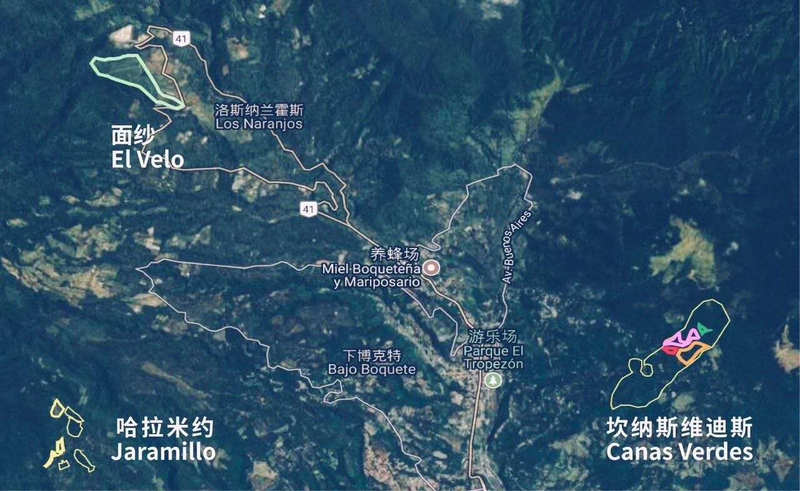
How Esmeralda's Grading Has Evolved
In 2020, Hacienda La Esmeralda's Gesha beans were still split into three grades: Blue Label, Green Label, and Red Label. By the estate's definition, Blue Label came from areas below 1500 meters, Red Label from single plots above 1500 meters, and Green Label from a mixed harvest of plots above 1500 meters, with the auction forming part of Red Label. Red Label was the most expensive grade, harvested from above 1600 meters and traceable to a specific plot. Green Label was harvested at the same altitude as Red Label but could not be traced to a specific plot. Blue Label was the entry-level Gesha, harvested at 1500 meters and below.

In 2021, Hacienda La Esmeralda discontinued the Blue Label, so no Blue Label grade has come from the estate since. That same year, Blue Label reappeared on the market under the name Volcanic Rock.

In 2022, Volcanic Rock was discontinued as well.
By 2023, Hacienda La Esmeralda had separated the auction Red Label from the regular Red Label as its own grade, leaving three: Auction, Red Label, and Green Label. Before that split, many drinkers bought regular Red Label while imagining they were getting auction quality.
Hacienda La Esmeralda's grading has shifted from period to period. Treating any single year's definition as universal is an easy way to get it wrong.

Choosing the Right Grade
Which label — red, green, or blue — is the best buy? Originally, Blue Label offered the best value.
With only Red and Green available, both come from the same plots. If you don't need to taste the character of an individual plot and simply want Red Label quality, Green Label will meet that need. If you're willing to spend more and can tell the plots apart, you might choose Red Label for everyday drinking, at a higher price.

Auction coffees also come from the same plots as regular Red Labels; the price is driven up by the auction process. A few special lots with distinct processing may deliver better flavor, but those differences are nothing like the several-fold or even several-dozen-fold gaps in price. Whether it's worth it is a personal call.
For most drinkers, coffee is about regional flavor rather than plot-specific flavor; plots matter more to producers. If a good result comes from human factors, small plots can serve as experimental batches to find the best solution, which is then applied across the whole farm to lift overall cultivation and processing to the same level. That is the ideal outcome — though consumers, of course, sometimes want differentiated choices.

As for different date batches and auction flavors, those are more a topic of conversation among enthusiasts. After all, there is a certain satisfaction in telling a friend, "You know, this cup is from the Red Label batch harvested on February 13th, plot 7N." One sentence, and the envy is guaranteed.
FrontStreet Coffee Recommendation
If you want to explore what Gesha can be without committing to a single estate, it helps to know the field. Panama's Hacienda La Esmeralda defined the modern Gesha boom: its Gesha was found in 2003 and entered the Best of Panama competition, where it stunned the judges and won with an average cupping score of 94.6, breaking the BOP record. Since then the estate has run two main lines, the Red Label ("Esmeralda Special," grown at 1600–1800m, each lot cupping above 90 and traceable to a single plot) and the Green Label ("Private Collection," a blend of plots that shows the estate's signature high-altitude Gesha character at a friendlier price).
Ethiopia tells the other half of the story. The Gesha Village estate was established about 12 miles from the Gesha forest and covers 475 hectares, with its own strict grading: Gold Label (Gesha 1931, roughly 10% of production), Red Label (Gori Gesha, about 15%, scoring 88 or above on the SCA 100-point scale), Green Label, and Chaka. For an easy entry, FrontStreet Coffee often points newcomers to FrontStreet Boquete Geisha, a washed Panama Gesha with the classic orange-blossom and honey sweetness, oolong-tea body, and fine fruit acidity; FrontStreet Granada Gesha from Ethiopia offers a brighter, more citrus-forward alternative with white florals, orange, and guava.
How you brew matters, too. For a pour-over, FrontStreet suggests 15g of coffee with a small Hario V60 at a 1:16 ratio and about 91°C water, using a three-stage pour: bloom with 30g for 30 seconds, pour to 125g in a slow circle, then to 225g once the bed has drained halfway, for a total time around 2:10–2:20. If you'd rather pull it as an SOE, medium-roast FrontStreet Granada Gesha works well at 20g in, a 1:2 ratio, and about 25 seconds for a 40g shot — add 200g of hot water for a Gesha americano, or 200g of milk for a creamy, butter-cookie latte. And if you want a cheaper daily option, FrontStreet Strawberry Candy blends Costa Rican honey-process beans with Panama Gesha for a cuppably floral, sweet-fruit cup that suits pour-over, moka pot, espresso machine, and cold brew alike.
Important Notice :
FrontStreet Coffee is a long-established specialty coffee roaster in Guangzhou China, selling freshly roasted beans from its own farm in Yunnan as well as dozens of carefully selected single-origin beans from around the world for both pour-over and espresso. The products deliver consistently excellent quality and great value, with shipping within 24 hours. Guangzhou's FrontStreet Coffee shop is recommended by many coffee lovers, and the beans are now available online at the Tmall 。
FrontStreet Coffee has moved to a new address:
FrontStreet Coffee Address: 315,Donghua East Road,GuangZhou
Tel:020 38364473
 Scan and follow the En Gafei WeChat official account. Please indicate that the reprint comes from "En Gafei".

