How to Make Iced Caffè Latte at Home? What's the Right Ratio of Ice, Milk, and Coffee?

When customers ask how to make iced latte, FrontStreet Coffee's answer is: it's simple — like "putting an elephant in the refrigerator," three steps: add ice, pour milk, pour coffee. Done!
Just kidding. What they're really asking is why, despite using the same coffee beans and following FrontStreet Coffee's step-by-step tutorial, the homemade iced latte still doesn't taste like the shop's. So here's our set of practical tips for a proper home-made iced latte.

Stable and Reasonable Espresso Extraction
More often than not, the reason a home iced latte falls short of the café's is the coffee machine's pressurization performance.

Although a commercial machine costing 10,000 yuan (or even 100,000+ yuan) and a home machine costing a few thousand yuan overlap in everyday functions, the espresso from a 5,000–6,000 yuan machine versus a 1,000–2,000 yuan one differs noticeably. FrontStreet Coffee once had a friend treat a "toy machine" — just over 1,000 yuan, combining grinder and extractor, with only 3–4 bars of pressure — as a standard pressurized machine. The espresso came out so watery it was thin even drunk straight; made into a latte, it would surely be bland.
With home machines, the machine you choose determines how hard the job is. The weaker and less stable the extraction, the harder it is for the coffee to release its flavor compounds fully. So to replicate the shop's iced latte, you need a properly pressurized machine (must reach 9 bar), such as the Huikang 310. And if you're chasing that rich, delicate golden espresso crema, FrontStreet Coffee considers a dedicated espresso grinder essential — grinding fresh and extracting immediately gives the best results.

Coffee Beans Determine the Flavor Profile of Iced Latte
Whether it's a pitch-black dark-roast blend or a bright medium-light SOE, when choosing espresso beans, first ask whether the resulting espresso pairs well with milk — and whether its flavors will survive being masked by the milk. For milk, feel free to consult FrontStreet Coffee's milk review and pick something that fits your budget and taste.
For example, our shop's iced latte uses the Sunflower Warm Blend, built from Ethiopian natural red cherry and Honduras sherry-barrel-aged beans. The medium roast brings out creamy chocolate and fruity sweetness, and as an iced latte it shows notes of liquor, vanilla, cream, and chocolate.

Some friends have told us their espresso comes out with lots of coarse foam — a sign the beans are too fresh, which also makes the shot taste mediocre. From FrontStreet Coffee's experience, it's best to rest your espresso beans somewhere cool for 7–10 days after receiving them and finish the bag within 50 days for optimal flavor.
Find the "Golden Ratio" Between Espresso and Milk Based on Taste
First, the quality of the espresso directly shapes the iced latte. If the shot is over-extracted and carries a burnt bitterness, even milk can barely cover it. Getting a well-extracted shot isn't hard, though — just dial in your parameters by adjusting dose and grind. FrontStreet Coffee's baseline formula: coffee-to-liquid ratio of 1:2, extraction time between 26–30 seconds, no abnormalities during the run (splattering, unstable flow).

As for recipes, we rarely give a single number — more like a range: coffee:milk = 1:4 to 1:8. Different beans, different extraction parameters, different milk — even with identical ratios the taste will vary, so no single prescription fits all.
Dark-roast espresso beans with mainly dark chocolate and nutty notes pull a shot that's strong and heavily bitter. Add a larger proportion of milk to restore balance — our Warm Sun blend, for instance, uses a 1:5 coffee-to-milk ratio. If even 1:5 tastes too bitter, keep adding milk until it suits you.

Light-roast beans with floral and fruity acidity pull a more delicate shot, and too much milk only buries the coffee aroma — so cut the milk back. When FrontStreet Coffee makes an SOE latte with its own Kongjia beans, the coffee-to-milk ratio lands at 1:4, yielding a drink with an aroma like butter biscuits.
While the Ice Isn't Paying Attention, Immediately Extract and Pour the Espresso
Ice, the main component of an iced latte, has exactly one job: to chill the coffee. Rather than agonizing over how much ice to add, focus first on how fast it melts. Once it melts, it dilutes the whole drink — the coffee flavor fades, and the texture grows watery.

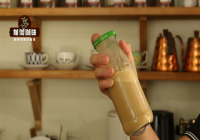
While it's not paying attention — quick, open the camera, focus~ click~
To avoid dilution, FrontStreet Coffee uses harder, older ice and tries to shorten the time ice and milk share the cup. The extracted coffee goes gently into the glass at the first opportunity, letting the golden crema float on top while the dark coffee slides down along the cup wall — creating a layered "dirty" effect much like a Dirty coffee.
- END -
FrontStreet Coffee

FrontStreet Coffee Recommendation
Great iced lattes start with beans that can stand up to milk. Three FrontStreet Coffee picks:
FrontStreet Classic Blend — The crema bomb built for espresso and moka pots: mellow, low-acid, and warm, with enough body and crema that even a basic home machine produces a latte-worthy base. The safe first choice for home baristas.
FrontStreet Strawberry Candy Espresso Blend — A popular fruit-forward blend that recreates a vivid strawberry-gummy sweetness from the native character of different Arabica origins. Perfect for fruit lovers who fear bitterness, and it makes a distinctive, memorable iced milk coffee.
FrontStreet Colombia Sidra (Xizhua) — If you like your iced latte fresh rather than heavy, this bright, fruit-toned single origin mixed with cold brew and a splash of milk stays balanced and easy to read — a favorite for homemade summer drinks.
Important Notice :
FrontStreet Coffee is a long-established specialty coffee roaster in Guangzhou China, selling freshly roasted beans from its own farm in Yunnan as well as dozens of carefully selected single-origin beans from around the world for both pour-over and espresso. The products deliver consistently excellent quality and great value, with shipping within 24 hours. Guangzhou's FrontStreet Coffee shop is recommended by many coffee lovers, and the beans are now available online at the Tmall 。
FrontStreet Coffee has moved to a new address:
FrontStreet Coffee Address: 315,Donghua East Road,GuangZhou
Tel:020 38364473
 Scan and follow the En Gafei WeChat official account. Please indicate that the reprint comes from "En Gafei".