
Why Does Freshly Made Latte Foam Collapse? Causes and Solutions
Latte Foam Stability Matters as Much as Taste
When judging the quality of a latte, taste, mouthfeel, how evenly it is blended and how fine the surface looks are all part of the picture — but so is foam stability.
The breakdown of the milk foam on a latte's surface begins the moment espresso extraction and milk frothing are finished. Measuring foam stability means measuring how fast the foam collapses. Normally, a latte made by FrontStreet Coffee only shows significant foam breakdown after about 10 minutes.

If a freshly made latte looks incredibly fine at first but develops noticeable "lumps," collapses, or breaks into large bubbles after just 2 minutes, that is abnormal and worth investigating.

Common Causes of Foam Instability
Coarse Crema and Foam Quality
It should go without saying that coarse crema or rough foam cannot produce a fine surface, but it is worth stating plainly: when both the crema and the foam are coarse, the foam layer on a latte's surface breaks down easily.
Foam Thickness on the Surface
Foam thickness also affects how fast it breaks down. Generally, thicker foam is more prone to forming "lumps" on the surface. Foam is essentially air encapsulated by protein, which makes it lighter than liquid. Under outside forces such as frothing, shaking and blending, most foam can integrate with the liquid, which slows decomposition.
In a static state, however, the heavier liquid sinks while the lighter foam rises, producing what we call layer separation. After separation, fine bubbles gradually dissolve and merge into larger ones because of pressure differences. To the eye, a fine surface turns rough. When the air pressure inside a large bubble exceeds the strength of the protein around it, the bubble bursts, leaving white lumps in the crema ring.

Besides controlling foam thickness during frothing, cup choice matters too. For foam of the same thickness and volume, it appears thinner in a wide-mouthed cup and thicker in a narrow-mouthed one.
Beans That Are Too Fresh
Overly fresh coffee beans contain abundant carbon dioxide. They can produce a rich crema during extraction, but that crema is itself unstable and prone to breaking down. Made into a latte, an unstable crema blending with milk foam also decomposes quickly.

FrontStreet Coffee generally recommends resting espresso beans for at least 7 days before use. This significantly improves the stability of the extracted espresso.
Tapping the Pitcher Too Much
Sometimes several large bubbles appear at the end of frothing. In that case, gently tapping the milk pitcher on the table can burst them, leaving a fine, smooth foam surface.
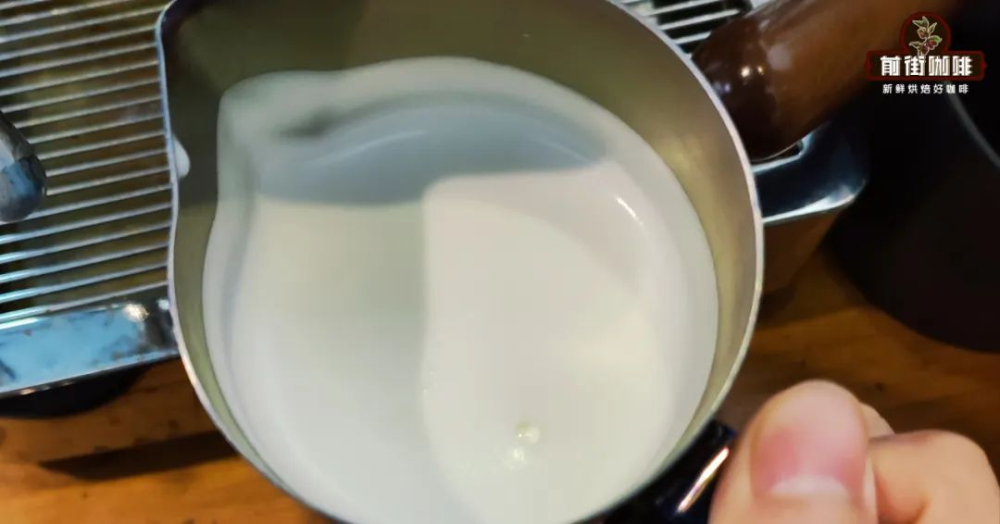
When the bubbles are numerous or stubborn, several taps may be needed to smooth them out. But tapping has a side effect: it accelerates the separation of the milk foam, which in turn speeds up its breakdown.
So when many large bubbles appear on the surface during frothing, FrontStreet Coffee suggests slowly lowering the pitcher to create a vortex, letting the steam break up the surface bubbles at the source instead.
Uneven Blending
Blending coffee and milk unevenly can also lead to rapid foam breakdown. Uneven blending usually shows up as inconsistent color on the foam surface. Look closely and the darker areas break down faster, because they hold more coffee oils, which dissolve faster than milk foam. Only when the two are blended uniformly can the surface hold its structure.
FrontStreet Coffee Recommendation
A latte's foam can only be as stable as the espresso underneath it, and beans built for milk make the job far easier. FrontStreet Classic Blend is the go-to choice: designed for espresso and moka pot, it is prized above all for a thick, generous crema. Even a beginner with an ordinary home machine can pull a dense, silky layer of foam, exactly what a latte, cappuccino or Dirty needs. Its traditional Mamba blend recipe gives a full, rounded, gentle body that suits veterans and newcomers alike.
If value is the priority, FrontStreet Dark Cocoa Blend is the commercial-minded option, made from 100% Arabica beans with abundant crema and a full, mellow body at a friendly price. For a fruitier milk drink, FrontStreet Strawberry Candy draws on Arabica beans from different origins to recreate a vivid strawberry gummy sweetness; it suits home drinking and cafe service alike, and is a strong pick for anyone who loves fruit notes or dislikes bitterness. Both FrontStreet Signature Blend and FrontStreet Dark Cocoa Blend also work beautifully with milk, their Brazilian base bringing almond, walnut and hazelnut depth and a silky, lingering texture, while FrontStreet Classic Blend and FrontStreet Commercial Blend add a little Robusta for extra golden foam, body and caramel aroma.
If you would rather use a pour-over bean with milk, the rule of thumb is to choose a medium-dark roast, so the coffee still comes through once the milk is added. FrontStreet PWN Golden Mandheling fits that brief, as do FrontStreet Bird of Paradise — Papua New Guinea's Typica, often called a "little Blue Mountain" for its creamy cocoa character — and FrontStreet Queen's Estate, a Brazilian Yellow Bourbon with butter, macadamia and sugarcane notes that stays thick and smooth with or without milk.
Important Notice :
FrontStreet Coffee is a long-established specialty coffee roaster in Guangzhou China, selling freshly roasted beans from its own farm in Yunnan as well as dozens of carefully selected single-origin beans from around the world for both pour-over and espresso. The products deliver consistently excellent quality and great value, with shipping within 24 hours. Guangzhou's FrontStreet Coffee shop is recommended by many coffee lovers, and the beans are now available online at the Tmall 。
FrontStreet Coffee has moved to a new address:
FrontStreet Coffee Address: 315,Donghua East Road,GuangZhou
Tel:020 38364473
 Scan and follow the En Gafei WeChat official account. Please indicate that the reprint comes from "En Gafei".

