
"Do you know how valuable baristas are? After all, certification is so expensive!" Are barista certificates really useful?
Is Barista Certification Worth It? A Comprehensive Guide
Lately, our inbox has been full of questions about barista certification. As specialty coffee culture weaves itself into daily life, becoming a barista or opening a coffee shop has become a dream career or lifestyle for many. But in an era where everyone can make coffee, how do you make yours — or your shop — stand out? Certification is usually the first answer that comes to mind.

① Is certification really useful?
Yes, definitely. Like every exam we've taken in life, standardized testing lets you understand your abilities and recognize your gaps. Courses exist to help you master knowledge and skills; certification verifies whether you've actually absorbed them. So the real question isn't whether you hold a certificate — it's whether the course leading up to it was useful to you.
Certification is a stepping stone. At any level, within its domain, it offers the chance to learn fundamentals and work in a more standardized way. Exams also serve as benchmarks — reference points everyone can measure against.

The Q-Grade sensory exam is a good example. Sensory perception is inherently subjective — everyone can have different opinions and feelings about the same cup. The course supplies a shared reference framework, letting people calibrate their judgments and avoiding endless individual sensory disputes.
② Barista certification helps you improve yourself, but doesn't prove how exceptional you are
Certification is a basic competency assessment. It can't prove you're exceptional — only that you studied and passed a course-template assessment. Real barista work, though, throws up ever-changing situations nothing like the stability of a training classroom.
So passing an exam doesn't mean you've truly learned it all. A certificate is just paper — the real value lies in you. After the courses, keep deepening your coffee expertise, learning more, and sharpening your skills. That's what matters.
Truly exceptional people don't stop at "I'm certified." Building on that foundation, they keep digging into coffee knowledge and operational principles and push beyond them, making sure their vision extends past the espresso machine. The coffee industry may not be vast, but it definitely extends beyond the counter — and the world outside it may be the most worth exploring and innovating in.
③ Should you get certified before applying for a barista position?
Not necessarily. It depends on your situation — not all coffee shops require certification. Those fees aren't cheap, and many certificates can't be taken individually; a full set can run over 10,000 or even 20,000 yuan. Moreover, being certified doesn't guarantee a higher salary than an uncertified barista; it mostly depends on what the shop owner plans for the future.
④ Do you need certification before opening a coffee shop?
Again, not necessarily. To ordinary customers, whether the owner is certified doesn't matter — what they want is coffee with stable flavor and quality at reasonable prices (not competing purely on low prices). If you know nothing about coffee but want to open a shop, by all means take courses to build yourself up. But before opening, you must make sure your products are stable and broadly appealing.
For customers who already know coffee, certification matters even less. Serious coffee drinkers won't obsess over how skilled you are or pepper you with irrelevant questions — they can taste the difference. When drinkers find your coffee good and worth the price, they'll quietly become regulars.
And if customers volunteer suggestions or trade ideas, they're worth listening to. You can't satisfy every palate, but you can keep refining your understanding of roasting and extraction. Sometimes a customer's suggestion is more "valuable" than anything learned in a training course.

⑤ What are the current internationally recognized coffee certifications?
The most authoritative barista certificate in the industry is issued by the SCA (Specialty Coffee Association) — essentially globally recognized, with the highest international standing. SCA barista certificates come in three levels: beginner, intermediate, and professional. The beginner exam is relatively simple, focusing on basic theory and practical knowledge.
If you've already worked in coffee shops for a while, you can skip the courses and test directly for the SCA beginner certificate. If you feel your knowledge and skills are already solid, you can skip beginner entirely and test straight for the intermediate certificate — but you must hold the intermediate certificate before testing for the SCA professional certificate.
The Q-Grader is a coffee quality assessor certification from the CQI (Coffee Quality Institute), a branch of the SCA education module — and currently the most expensive coffee certification there is.
Unlike the SCA course system, the CQI focuses on green bean quality assessment, offering the Q-Grader (Arabica assessor) alongside the R-Grader (Robusta assessor). If you simply want to be a barista or run an ordinary café, you really don't need the Q certification.
⑥ Are there national professional skill certificates for baristas?
In 2016, the State Council canceled 61 professional qualification permits and certifications, barista certification among them. Socialized professional skill level certification didn't begin until 2019, when China's barista qualification transitioned to a model led by government and assessed by third-party agencies. Simply put, the government no longer supervises issuing these certificates nationwide; third-party evaluation agencies print and issue them independently.
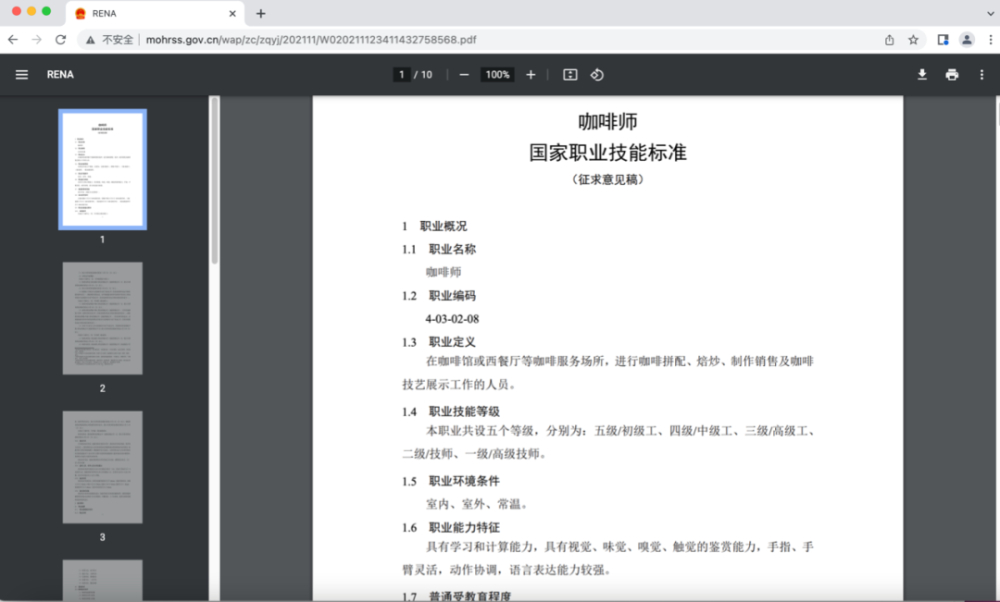
Currently, the Ministry of Human Resources and Social Security has published the National Professional Skill Standards for Baristas (draft for comment) on its official website, and barista certification is expected to return next year. If it does, it could become the most valuable coffee skill certificate domestically — though it may not be recognized by the global coffee industry.
⑦ Differences between national professional qualification certificates before and after the reform
Differences: 1. The new certificates are no longer stamped by departments of the Ministry of Human Resources and Social Security but bear the official seal of third-party certification agencies. 2. The new certificate cover no longer carries the national emblem — it bears the third-party agency's name instead. 3. Examinations may be conducted online or offline, subject to approval by the Ministry's regulatory departments. 4. After the reform, certificates are collectively called professional skill level certificates; before, they were national professional qualification certificates.

Similarities: All certificates can be verified on the professional skill level website designated by the Ministry. Pre- and post-reform certificates carry equal validity, are nationally recognized, and are exempt from lifelong review.
Whatever level of certification you pursue, the value lies not in the paper but in what the whole learning process gives you. If you truly love coffee and take every task seriously, you can be a great barista with no certificate at all.
This article's position: Answering questions.
Image source: Internet
FrontStreet Coffee Recommendation
Whether you're studying for an exam or just brewing at home, tasting widely is the fastest education. FrontStreet Coffee suggests building your palate with distinct, well-made lots: the washed Ethiopia Guji cooperative lot trains you to pick out jasmine florals, lemon acidity, and berry sweetness in a clean frame.
Then contrast it with the PWN Golden Mandheling — triple hand-sorted Indonesian beans with a heavy body, herbal spice, and caramel sweetness — and the Jamaica Blue Mountain No. 1, whose near-perfect balance of cream, caramel, and nuts defines "balance" for most professionals. Tasting these three side by side teaches more about coffee than any single certificate.
Important Notice :
FrontStreet Coffee is a long-established specialty coffee roaster in Guangzhou China, selling freshly roasted beans from its own farm in Yunnan as well as dozens of carefully selected single-origin beans from around the world for both pour-over and espresso. The products deliver consistently excellent quality and great value, with shipping within 24 hours. Guangzhou's FrontStreet Coffee shop is recommended by many coffee lovers, and the beans are now available online at the Tmall 。
FrontStreet Coffee has moved to a new address:
FrontStreet Coffee Address: 315,Donghua East Road,GuangZhou
Tel:020 38364473
 Scan and follow the En Gafei WeChat official account. Please indicate that the reprint comes from "En Gafei".

