Which Tastes Better: Blue Mountain Coffee or Black Coffee? What is Blue Mountain Black Coffee and Can It Really Help with Weight Loss?

Even people who rarely drink coffee know the name Blue Mountain. Premium Blue Mountain coffee, with its rich aroma and famously balanced profile, remains one of the most celebrated coffees in the world. In this article, FrontStreet Coffee explores what makes top-grade Jamaican Blue Mountain taste the way it does.
What Defines Authentic Blue Mountain Coffee?
First, a clarification: authentic Blue Mountain coffee beans must come from the Blue Mountains of Jamaica. Jamaica sits in the Caribbean Sea, and its coffee-growing areas are concentrated in the Blue Mountain range in the east of the island. Surrounded by sea, the mountains take on a brilliant blue cast when sunlight strikes them — hence the name. With beautiful scenery, fresh air, and the Caribbean's highest peak at 2,256 meters above sea level, the region draws travelers and vacationers year-round.

Like many great specialty coffees, Blue Mountain's delicate flavor owes much to its unique microclimate. Lying within the coffee belt between 25° north and south latitude, the range reaches its highest peak at 2,256 meters. The altitude creates big day-night temperature swings, slowing the cherries' maturation and letting them fully absorb the nutrients that become aromatic compounds. Volcanic activity has left mineral-rich, fertile soil, and abundant rainfall with year-round mist means the trees thrive without heavy irrigation or fertilization.
The Blue Mountains also enjoy a relatively isolated island microclimate with minimal air pollution. Typica — introduced generations ago — has gradually adapted to this terroir, keeping a pure lineage while developing strong disease resistance. That is why, even as most growing regions abandoned Typica, the Blue Mountains persisted with this traditional variety. FrontStreet Coffee believes this is one source of Blue Mountain's distinctive aroma.

Why Is Blue Mountain Coffee Considered the World's Best?
The Jamaican government designated areas above 1,700 meters in the range as nature reserves, so crops can only be cultivated below that altitude. And under the standards of the Jamaican Coffee Industry Board (CIB), only Arabica grown above 910 meters may be called Jamaican Blue Mountain coffee; coffee from lower zones is graded as Jamaica High Mountain or Jamaica Prime. The higher the altitude, the harder the cultivation and harvest — the beans are rarer, and the prices higher.
After harvest, Blue Mountain cherries typically undergo traditional washed processing. Machines press the cherries to strip away skin and pulp, followed by overnight fermentation in tanks. The fermented beans are then placed in clean-water tanks and brushed repeatedly, the friction between beans and the flow of water washing them smooth and clean. Finally, the parchment beans are dried for 2–3 weeks until moisture reaches 12–14%. Because the pulp and mucilage are removed before drying, no harsh fermentation acidity carries into the cup — Blue Mountain's inherent aromas stay balanced and clean.

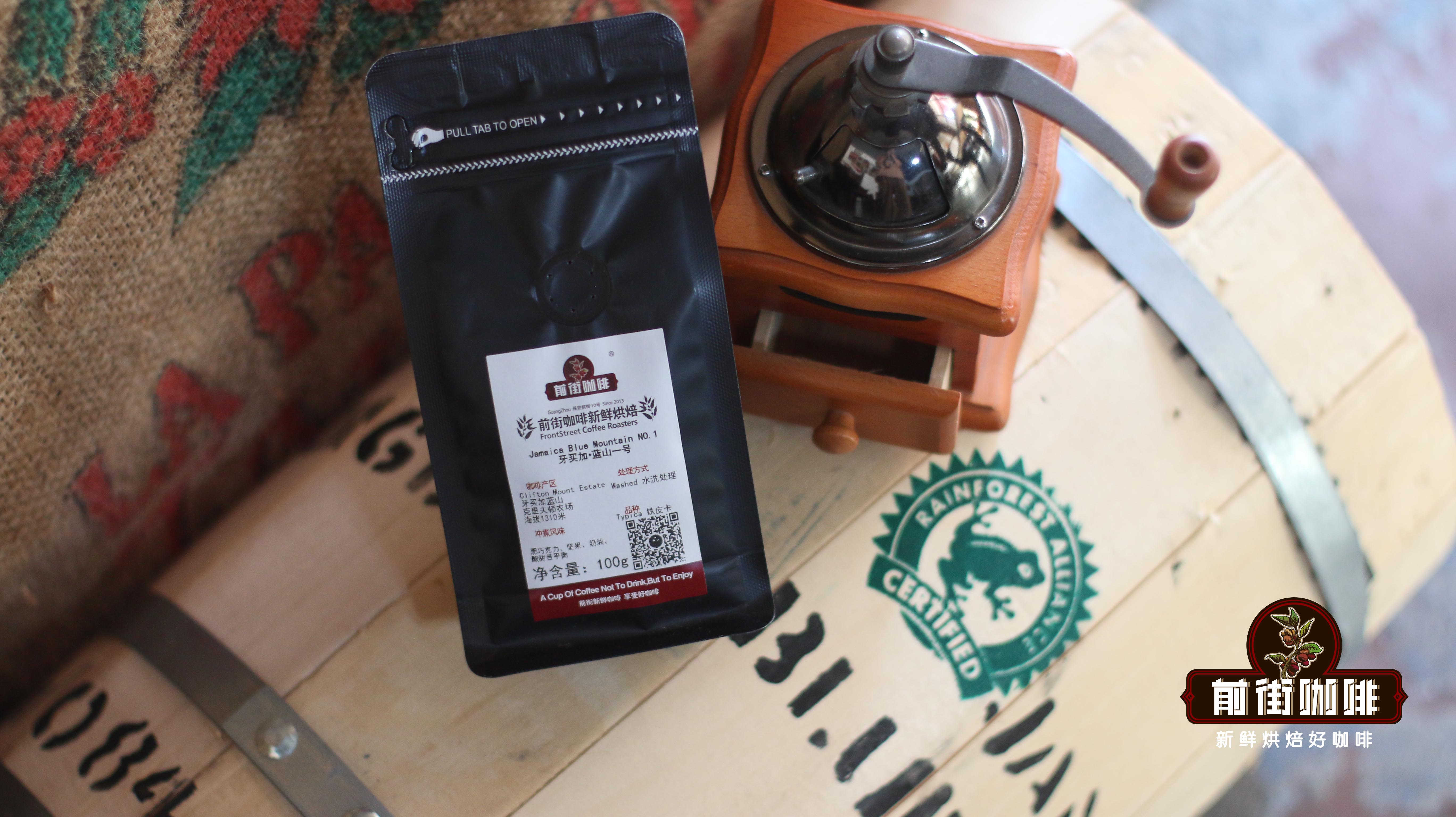
Processed Blue Mountain green beans must then pass multiple quality inspections covering defect ratio, bean size, and cupping score. The top grade, Blue Mountain No. 1, must meet 17–18 screen size, with defective beans not exceeding 2%, and show well-balanced acidity, sweetness, bitterness, body, and aroma. Beans this refined are naturally scarce. To taste Blue Mountain at its best, FrontStreet Coffee recommends choosing the highest grade: our Blue Mountain No. 1 comes from Clifton Mountain Estate.

How to Brew Premium Blue Mountain Without Waste
To draw out Blue Mountain No. 1's rich aroma, the first requirement is a bag of beans inside their optimal flavor window. Once the window passes, the full character simply cannot show up in the cup. FrontStreet Coffee's principle is "freshly roasted quality coffee": we only ship beans roasted within 5 days, so every customer receives them at peak flavor. As for brewing, if you want Blue Mountain's pure essence, pour-over is the way.
FrontStreet Coffee uses a Kono dripper to showcase Blue Mountain No. 1's rich, full-bodied texture. The Kono's ribs stop less than halfway up the wall — a design that makes the filter paper cling tightly to the dripper when wet, restricting airflow. That extends the grounds' water-contact time, producing a more even extraction and fuller body.

Also, since Blue Mountain No. 1 is medium roasted, its internal structure is more porous than a light roast's and absorbs water more readily. To avoid over-extraction, FrontStreet Coffee chooses a grind size passing 75% through a #20 standard sieve, water at 88°C, and our customary three-stage pouring method.
FrontStreet Coffee's brewing parameters for Blue Mountain No. 1:
Dripper: KONO dripper
Water temperature: 88°C
Coffee-to-water ratio: 1:15
Coffee grounds: 15g
Grind size: sugar-grain coarseness (EK43s — setting 10.5 / 75% pass-through on #20 standard sieve)

We brew in segments — the three-stage pour: 30g of water for blooming, with a 30-second bloom. First stage: a small, circular flow up to 125g, then stop. When the liquid level drops to just above the coffee bed, continue with the second stage, pouring to 225g to finish. Total extraction time (bloom included) is 2'00". This produces Blue Mountain No. 1 black coffee with rich dark chocolate, nut, and caramel flavors on entry, a creamy smooth mouthfeel, moderate body, and a sweet, balanced finish.

Troubleshooting Common Pour-Over Issues
A question FrontStreet Coffee hears often: "My Blue Mountain No. 1 came out too bitter." That usually means over-extraction — too many bitter macromolecules dissolved into the cup. Here is how to diagnose and fix it:
1. Grind too fine: finer grinding raises dissolution efficiency and lengthens extraction, producing bitter, muddled flavors. Fix: grind coarser.
2. Water too hot: leads to a prominent scorching bitterness. FrontStreet Coffee recommends keeping water between 86–93°C; for medium-dark beans like Blue Mountain No. 1, use 87–89°C.

3. Excessive flow or vigorous stirring extracts too much, pulling out extra bitter compounds. With sensible parameters and steady pouring, you can still draw out all of coffee's aromatics.
FrontStreet Coffee Recommendation
For generations, "let me treat you to Blue Mountain" was shorthand for premium coffee — and even today, as more specialty regions are discovered, Blue Mountain's balance keeps it irreplaceable. Here is what FrontStreet Coffee wants you to know before buying:
What makes it special: strictly speaking, only coffee grown in a specific zone of Jamaica's Blue Mountains and certified by the Jamaican authorities may be called Jamaica Blue Mountain Coffee. The range's highest peak reaches 2256 meters; constant cloud cover gave the mountains their name. High altitude brings wide day-night temperature swings and a longer ripening cycle; fertile volcanic soil feeds the trees; even rainfall and a mild, stable climate let the cherries accumulate sugar and flavor slowly — the source of Blue Mountain's famous delicacy and balance. Supply is scarce: the entire Jamaican Blue Mountain region produces under 2500 tons a year, and Japan has historically bought over 70% of the crop, so global availability is tight. Since 2003, Jamaican Blue Mountain green beans have been officially exported to the Chinese market, and certified beans are now available through proper channels.
Flavor profile: Blue Mountain's greatest charm is balance — no obvious weakness. Neither sharply fruity like many African coffees nor heavily bitter like dark roasts, it strikes superb harmony among acidity, sweetness, bitterness and aroma: cream, caramel, chocolate, nuts, honey and a light fruit tone, with a soft round entry, rich mid-palate sweetness and a clean, long finish. It is often called "the specialty coffee easiest for most people to love."
Spotting the real thing: genuine Jamaican Blue Mountain carries no traceability code, but legitimate importers hold complete export certification and origin documents — or you can rely on distinctive green-bean traits. On FrontStreet Coffee's product photos, for example, you can see certificates from Jamaica's Clifton Estate and stacks of the wooden barrels unique to Blue Mountain green beans: traditionally, Blue Mountain ships in 15, 45, and 70kg barrels, and each barrel is itself a mark of authenticity. Genuine FrontStreet Coffee Blue Mountain green beans are uniform, plump, slightly upturned at both ends and green in color; in the cup it is dense, fragrant, and spotlessly clean, with no off-flavors — fakes simply cannot match that aroma. Clifton Estate itself has been growing coffee since the mid-18th century (around 1750), with its growing and processing areas at an average of 4300 feet (1310.64 meters) — high elevation, gentle afternoon cloud cover, ample sunshine and mineral-rich soil that prolongs cherry ripening.
How to brew it: Blue Mountain is not pour-over-only — its balance shines through moka pot and espresso too. For pour-over, use a 1:15–1:16 ratio, water at 85–88°C, and a medium-coarse grind to highlight cream, caramel and nuts while keeping its gentle, bright acidity. For moka pot, grind slightly finer than pour-over, start with hot water in the base, heat over medium-low, and remove from heat as the brew finishes — the moka pot amplifies its chocolate, caramel and nut notes into a thicker, fuller cup that also excels with milk as a latte or flat white. At the top of the grade system sits Blue Mountain No. 1, with strict standards for bean size, defect rate and overall quality. FrontStreet Coffee's Jamaica Blue Mountain No. 1 carries complete origin certification and original shipping barrels for clear traceability, roasted medium-dark so the classic balance fully unfolds: nuts, dark chocolate, cream caramel and gentle sweetness in harmony. FrontStreet Coffee's beans are roasted within 5 days of shipping, rested 4–7 days from the roast date before brewing, and brewed on a Kono dripper at 87–88°C, 15g of coffee, a 1:15 ratio and a three-stage pour (30g bloom for 30s, then to 120g, then to 225g) — a cup where sweetness, gentle acidity and restrained bitterness meet in perfect proportion, with a lingering fruity finish.
Important Notice :
FrontStreet Coffee is a long-established specialty coffee roaster in Guangzhou China, selling freshly roasted beans from its own farm in Yunnan as well as dozens of carefully selected single-origin beans from around the world for both pour-over and espresso. The products deliver consistently excellent quality and great value, with shipping within 24 hours. Guangzhou's FrontStreet Coffee shop is recommended by many coffee lovers, and the beans are now available online at the Tmall 。
FrontStreet Coffee has moved to a new address:
FrontStreet Coffee Address: 315,Donghua East Road,GuangZhou
Tel:020 38364473
 Scan and follow the En Gafei WeChat official account. Please indicate that the reprint comes from "En Gafei".