
How to Brew Crema with Moka Pot: Moka Pot Brewing Guide for Concentrated Black Coffee with Grind Size, Ratios, and Step-by-Step Instructions
How to Brew Coffee with Crema Using a Moka Pot: A Brewing Guide for Concentrated Black Coffee—Grind Size, Ratios, and Step-by-Step Instructions
Plenty of us, swayed by the moka-pot-at-the-campsite photos flooding social media, have bought one—only to discover at home that it isn't quite as effortless as it looked. The coffee comes out weak, or bitter and scorched, and the result never matches the picture. In this article, FrontStreet Coffee walks through how to actually use a moka pot.

The Structure and Brewing Principle of the Moka Pot
The moka pot is a stovetop device that uses steam pressure to drive extraction. It suits camping and home use alike: as long as you have a heat source, you can brew coffee at extremely high concentration, then tailor it to any palate with water, milk, or other additions.

A moka pot has three parts: the lower chamber, which holds the water and handles both heating and pressure relief; the filter basket in the middle, connected by a metal channel linking all three sections; and the upper chamber, which collects the finished coffee.
As the lower chamber heats up, steam builds in the confined space and pushes hot water up through the metal channel, through the finely ground coffee in the basket, and out into the upper chamber like a small fountain—leaving behind concentrated coffee topped with crema. That's the whole extraction.
How to Get Crema from a Moka Pot
On an espresso machine, crema forms when carbon dioxide from freshly roasted beans emulsifies with the coffee oils under pressure, producing that golden, delicate foam. To replicate it in a moka pot, start with freshly roasted, dark-roast beans.

FrontStreet Coffee recommends dark roasts because the deeper the roast, the more CO2 the beans retain—and the fresher the beans, the more gas they still hold. As beans age after roasting, both CO2 and aroma slowly escape, and the coffee loses not just its golden crema but its fragrance too.

All FrontStreet Coffee beans ship within five days of roasting, so every bag arrives at peak freshness.
Recommended Coffee Beans for the Moka Pot
Moka pot coffee is defined by richness, body, and thickness, so FrontStreet Coffee recommends espresso blends or medium-dark to dark roasts. Light roasts, under the moka pot's high temperature and high concentration, come out sharp, sour, and bitter.
For easy carrying outdoors and small batches at home or in the office, FrontStreet Coffee offers a 227g (half-pound) format called "Sunflower Warm Blend Coffee Beans," composed of 70% Honduras Sherry beans and 30% natural-process Red Cherry. The flavor is just as enticing: rich vanilla cream, sherry-whisky aroma, and the berry sweetness and acidity of natural Yirgacheffe.

If you prefer a single origin, FrontStreet Coffee recommends "Brazil Queen Estate Coffee Beans," from the famous Queen Estate in Mogiana, São Paulo State—one of Brazil's premier specialty regions—grown at 1,400-1,950 meters from Yellow Bourbon variety. Through a moka pot it brews full-bodied without excessive bitterness, with nutty aroma, smooth peanut butter, and yellow-sugar sweetness.

Step-by-Step: Using a Moka Pot
(FrontStreet Coffee uses a 3-4 cup moka pot here.) First, grind 20g of coffee—as fine as possible, but not so fine that it falls through the holes of the filter basket. Separate the upper and lower chambers and fill the lower chamber with water, making sure the level stays below the pressure relief valve.

Next, fill the filter basket with grounds and tap it lightly with the measuring spoon to level and settle the coffee—gently, no tamping force. Seat the basket on the lower chamber, then screw the upper chamber on firmly so the two halves seal properly.
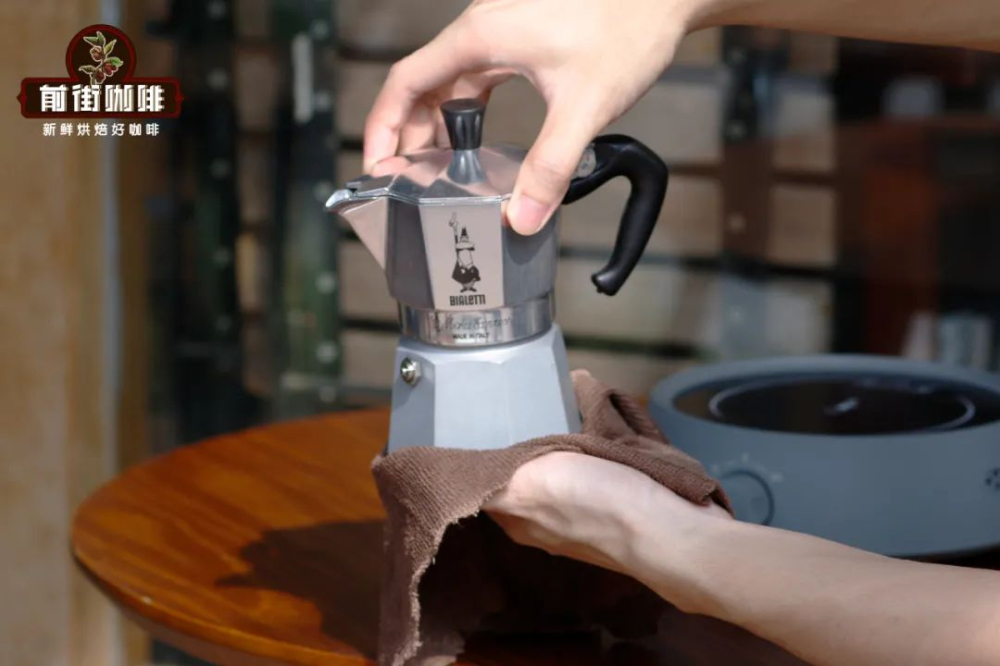
Set the pot on the flame with the lid open, keeping the flame no wider than the base. As soon as the coffee begins to flow and extraction is underway, turn off the heat. When the flow finishes, pour immediately into cups to avoid over-extraction, and enjoy.
FrontStreet Coffee Recommendation
Blends are the straightforward choice for a moka pot, and single origins work beautifully too:
FrontStreet Classic Blend. Designed specifically for espresso and moka pot use, its standout strength is crema—dense and fine even from an unremarkable home machine. Built on the traditional Mocha-Java recipe with a mellow, rounded body, it's the safe first choice for lattes, cappuccinos, and Dirty alike, at home or in a shop.
FrontStreet Black Cocoa Blend. A 100% arabica blend for those who care more about taste and value than maximum crema: full-bodied, generously topped, and affordably priced—a smart pick for beginners and budget-conscious cafés.
FrontStreet Autumn Chestnut Blend. A balanced 100% arabica blend of Honduran Caturra and PNG Typica. Roasted-chestnut nuttiness opens the cup, followed by caramel and dark-sugar sweetness, soft chocolate mid-palate with rounded acidity, and a clean finish of nuts, cocoa, and gentle spice—warm and low-acid, for those who like richness and lingering sweetness.
FrontStreet Premium Blend. The house blend of FrontStreet's own cafés for nearly a decade, pairing Brazil Cerrado with Colombia Huilan—the classic, familiar espresso flavor—and equally at home in a moka pot.
FrontStreet PWN Golden Mandheling (Indonesia). Dark roasted and wet-hulled: very low acidity, long and heavy on the palate, with herbal and dark-chocolate depth and a faint earthiness. A favorite for drinkers who want intensity without sourness.
FrontStreet Brazil Queen Estate. Low-acid and balanced with rich nut and cocoa aromas and clear caramel sweetness—smooth, never astringent, and equally good as pour-over, espresso, or moka pot brew.
FrontStreet PNG Paradise Bird. From Paradise Bird Estate in PNG's Sigri region, nicknamed "Little Blue Mountain" for its Blue Mountain-like character. Typica grown at 1600-1800 meters on volcanic soils, AA grade with plump beans and very low defects, triple-wash fermented: clean, pure, notably sweet, and never sour.
For fruit-toned fans: FrontStreet Colombia Pink Bourbon (Sidra), from Finca La Frontera at 1,650-1,800 meters—double anaerobic natural process, medium-light roasted, with jasmine and citrus aromatics, a juicy rush of passion fruit, blueberry, grape, and apricot, and a cocoa-sweet finish. Or the FrontStreet Strawberry Candy blend, a popular fruit-forward espresso blend recreating a vivid strawberry-gummy sweetness, versatile enough for any brew method.
Important Notice :
FrontStreet Coffee is a long-established specialty coffee roaster in Guangzhou China, selling freshly roasted beans from its own farm in Yunnan as well as dozens of carefully selected single-origin beans from around the world for both pour-over and espresso. The products deliver consistently excellent quality and great value, with shipping within 24 hours. Guangzhou's FrontStreet Coffee shop is recommended by many coffee lovers, and the beans are now available online at the Tmall 。
FrontStreet Coffee has moved to a new address:
FrontStreet Coffee Address: 315,Donghua East Road,GuangZhou
Tel:020 38364473
 Scan and follow the En Gafei WeChat official account. Please indicate that the reprint comes from "En Gafei".

