Iced Pour-Over Coffee Tutorial: Water-to-Coffee Ratio - Can You Add Ice to Pour-Over Coffee? How Do Baristas Make Iced Pour-Over?

As temperatures spike, Guangzhou — home of FrontStreet Coffee — slips into what feels like Schrödinger's summer, and iced coffee has climbed right back to the top of in-store sales. Iced pour-over, everyone's favorite, lets you pick the beans you love while adding a chill that's mellow yet refreshing — the perfect remedy for hot weather.
Taking advantage of today's sunshine, FrontStreet Coffee has put together a set of iced pour-over extraction methods with zero barriers to entry — simple enough for anyone to master. Save this guide!

What You Must Know About Making Iced Pour-Over
No matter the extraction method, every parameter we tune ultimately serves two things: extraction rate and concentration. Extraction rate determines whether the cup leans acidic, balanced, or bitter. Concentration shapes how we perceive it — too concentrated and the cup becomes harsh and flavors hide behind the intensity; too diluted and it might as well be water. As long as both land in the right range, the parameter combinations can flex freely.

Iced pour-over is derived from the hot pour-over framework. In conventional hot brewing we coordinate grind size, water temperature, ratio, equipment, and pouring technique to hit a suitable extraction rate and concentration. Iced pour-over simply adds ice to cool the finished coffee. But if you apply the hot recipe and toss in ice, you get an appropriate extraction rate with a ruined concentration — the melting ice dilutes the brew, and the result is inevitably bland, watery iced coffee.
So the core problem of great iced pour-over is this: how do you keep the concentration right after the coffee cools? The common solutions are adjusting ratios, adjusting grind, using technique, and physical cooling — which FrontStreet Coffee has organized into four methods.

Method 1: High Concentration, High Extraction
High concentration, high extraction means exactly that. High concentration ensures the coffee still tastes full and flavorful after the ice melts in. The method is simple: use less hot water and grind finer.
With the same dose of coffee, a higher extraction rate pulls more soluble material from the grounds. Iced pour-over replaces part of the hot water with ice, so total water is lower than a conventional hot brew and contact time shortens — which reduces late-stage extraction. "High extraction" here therefore means extracting as much as possible with the limited water available, and technique is how we get there.

Using FrontStreet Coffee's medium-light roast Kaffa Forest as an example, here are the high-concentration, high-extraction iced parameters:

Coffee dose: 15g
10x hot water: 150g
5x ice: 75g
Water temperature: 92°C
Grind size: 83% pass-through rate on #20 sieve (EK43s setting 9, C40 setting 22)
Dripper: Hario V60
Technique: Three-stage pour
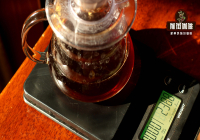
First, place 75g of ice in the server, then add 15g of ground coffee to the dripper and level the bed gently. For the first stage, use a small 3ml/s flow to pour 30g of hot water from the center outward in small circles for a 30-second bloom. After 30 seconds, repeat the same technique with the next 60g of water, keeping the liquid level low to avoid under-extraction. Just as the coffee liquid is about to run dry, pour the final 60g of hot water at 3ml/s, making sure total extraction time falls between 1 minute 50 seconds and 2 minutes.

Brewed this way, the Kaffa Forest shows rich lemon and blueberry fruit alongside a distinct sweet melon-seed aroma, with a light body and balanced sweet-sour-bitter structure. Because some crushed ice will remain after brewing, drink it quickly or remove the ice if you don't want further dilution.
Method 2: Ice-Rinsing Method
For the first method FrontStreet Coffee used dense square "old" ice, which melts slowly — the coffee chills fast without over-diluting. But if your home freezer only makes smaller, faster-melting ice, the same parameters will yield a watery, thin-flavored cup.

To prevent the concentration from collapsing, use the "ice-rinsing" method instead. The brew parameters stay the same; just prepare double the ice (150g) and find a filter that can hold ice while catching the liquid — FrontStreet Coffee simply uses the dripper itself. Then pour the freshly brewed coffee directly over the ice, cooling it through continuous rinsing.

This version of the Kaffa Forest beats the first in both richness and flavor layers: yellow peach, citrus and apricot aromas dominate, with a soft mouthfeel and a sweet finish.
Method 3: Stirring Method
Added stirring is an external force that raises the extraction efficiency of hot water on the grounds, boosting flavor concentration. For light-to-medium roasts, stirring during the pour accelerates the release of acids and sweets, giving the cup a juicier body and brighter florals. The corresponding iced parameters:
Coffee dose: 15g
Hot water: 160g
Ice cubes: 80g
Grind size: 80% pass-through rate on #20 sieve (EK43s setting 9.5, C40 setting 24)
Dripper: Hario V60
Three-stage: 30g, 80g + stirring, 50g

Before pouring, place the ice in the server and add all the grounds to the dripper. The bloom stage is unchanged: a small 3-4ml/s flow, 30g from the center outward in circles. After 30 seconds, pour 80g of hot water in circles from inside out, letting the level rise slightly. When the scale reads 110g, stop pouring, take a prepped small spoon, and stir 5 circles in one direction along the dripper wall, then let the liquid drain slowly.

When the coffee bed is about to be exposed, pour the remaining 50g of hot water into the center with a small flow. Let all the liquid finish dripping, then remove the dripper — total time should be around 2 minutes to 2 minutes 10 seconds. Finally, swirl the server to melt the remaining ice, and taste.
This stirred iced Kaffa Forest carries richer sweetness and acidity, led by grapefruit, orange, yellow peach and tangerine with a tea-like aftertaste. The ice lends a refreshing lift, and the whole cup feels full of juice.

Method 4: Ice-Bath Cooling Method
Beyond the three common methods, FrontStreet Coffee's collection has one more luxurious option: "ice-bath cooling." It requires no adjustment to grind or ratio at all — the coffee is cooled entirely by external ice water, which eliminates the watery taste melting ice causes. The downsides are the large amount of ice and the long cooling time. Prepare a thermometer before brewing. The parameters:
Coffee dose: 15g
Coffee-to-water ratio: 1:15
Grind size: 78% pass-through rate on #20 sieve (EK43s setting 10, C40 setting 26)
Water temperature: 92°C
Dripper: Hario V60
Pouring technique: Three-stage pour

Stage one: pour 30g of water for a 30-second bloom. Then pour 95g from the center outward at a medium 5ml/s flow, finishing in about 50 seconds. When the level drops to two-thirds of the coffee bed, pour the remaining 100g of hot water the same way; drip filtration completes in about 2 minutes 10 seconds. Then set the whole server into an ice-water bath. Once the thermometer reads 10°C, it's ready to drink.

Cooled in an ice bath, this Kaffa Forest shows remarkably clear sweetness. With no ice touching the coffee, you taste white florals and citrus acidity immediately on entry, plus sweet melon, tangerine and blueberry. The sweet-sour structure is full and rich — the most layered cup of the four methods.
FrontStreet Coffee Recommendation
Kaffa Forest's floral-citrus profile is exactly what a V60 was built to showcase: the 60° cone and single large aperture extend water-to-coffee contact while allowing a fast, free-flowing extraction that renders florals, fruit acidity and tea-like delicacy in full relief. For beans in the same style, the FrontStreet Yirgacheffe Worka (Guodingding Cooperative) is a classic starting point — clear citrus, berry and white florals with a green-tea finish, gentle and bright rather than harshly sour. The FrontStreet Ethiopia Cherie (Huaqui) goes further into tropical territory: strawberry, passion fruit, jackfruit and lychee aromatics with pronounced sweetness and almost no bitterness — often described as "the coffee for people who don't like coffee."
If you prefer your iced pour-over low in acidity, the FrontStreet PWN Indonesia Golden Mandheling (deep roast: herbal, dark chocolate, faint earth) or the balanced FrontStreet Brazil Queen Estate (nut, cocoa, caramel sweetness) both hold up beautifully when chilled.
Important Notice :
FrontStreet Coffee is a long-established specialty coffee roaster in Guangzhou China, selling freshly roasted beans from its own farm in Yunnan as well as dozens of carefully selected single-origin beans from around the world for both pour-over and espresso. The products deliver consistently excellent quality and great value, with shipping within 24 hours. Guangzhou's FrontStreet Coffee shop is recommended by many coffee lovers, and the beans are now available online at the Tmall 。
FrontStreet Coffee has moved to a new address:
FrontStreet Coffee Address: 315,Donghua East Road,GuangZhou
Tel:020 38364473
 Scan and follow the En Gafei WeChat official account. Please indicate that the reprint comes from "En Gafei".