Barista Fundamentals: How to Make Delicious Pour-Over Coffee and Adjust the Water-to-Coffee Ratio
Water-to-Coffee Ratio
The water-to-coffee ratio is crucial for determining whether a cup of pour-over coffee tastes good. It is not only about the relationship between strength and weakness.
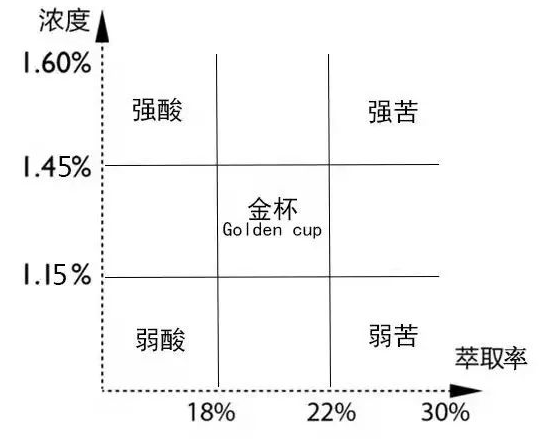
What is the appropriate water-to-coffee ratio for pour-over coffee? 1:15 is likely the most commonly heard answer. The 1:15 ratio seems to exist as an unshakable "truth." In many pour-over brewing experiments conducted by FrontStreet Coffee, when using a 1:15 ratio, the concentration mostly falls between 1.30-1.36%, with calculated coffee extraction rates between 17.86-18.69%. Through tasting, this ratio also excellently expresses the coffee's flavors.
Does this mean that the 1:15 pour-over ratio is a golden rule?
FrontStreet Coffee, approaching with bold hypotheses and careful verification, reasoned that while using a 1:15 ratio to brew coffee produces excellent flavor performance, there could possibly be an even more suitable water-to-coffee ratio.
In Golden Cup theory, 1.30-1.36% concentration is considered relatively high, while the extraction rate is relatively low. This is known as "high concentration, low extraction." So if we use more water for brewing, could we reduce the coffee's concentration while increasing its extraction rate?
To verify this hypothesis, FrontStreet Coffee brewed five groups of coffee using a 1:16 ratio. The measured concentration values were 1.23-1.33%, with calculated coffee extraction rates of 18.18-19.68%. On paper, this data perfectly fits the Golden Cup range. Through tasting, most coffees showed very suitable overall sensory performance, but one group of Sherry coffee beans exhibited a watery texture and thin flavor, despite measuring 1.25% concentration.
The Impact of Water-to-Coffee Ratio on Coffee Flavor
To understand how the water-to-coffee ratio affects coffee flavor, FrontStreet Coffee conducted a comparative experiment using Guji Grade 5.0 coffee beans with varying ratios: 1:15, 1:16, 1:17, and 1:18, measuring their concentration and extraction rates while gathering flavor feedback. This experiment essentially involved adding 15ml more water to each successive cup, revealing that extraction efficiency decreases with later additions of water. This explains why some brewing instructions describe the early to middle stages of water addition as extracting flavor, while the later stages adjust concentration.
With the Guji coffee beans, although the 1:15, 1:16, and 1:17 ratios showed slightly different levels of sweetness and acidity, they all delivered positive sensory experiences, in other words, delicious from different perspectives. The difference between the 1:17 and 1:18 groups was minimal, and both concentration and extraction rates fell within the Golden Cup range. However, sensory perception detected an unpleasant bitterness in the finish of the 1:18 brew. We can boldly infer that the final 25ml of water in the 1:18 ratio extracted bitter compounds that reached the human sensory threshold, making the bitterness detectable.
Of course, we also concluded that Guji Grade 5.0 coffee beans not only perform satisfactorily at a 1:15 ratio but also show excellent results at 1:16 and 1:17 ratios.
FrontStreet Coffee Recommendation
For pour-over, the dripper matters as much as the ratio. Hario, the company behind the V60, was founded in Tokyo in 1921 and redesigned the V60 in 2004, naming it for its distinctive 60° cone and V shape. Its single large hole lets you control the flow, and its fast extraction suits aromatic, bright coffees especially well.
With that in mind, FrontStreet suggests flower-and-fruit-forward beans for the V60. FrontStreet's Gedeb cooperative coffee, with its classic Yirgacheffe profile, is a good starting point, showing citrus, berry, and floral notes with a green-tea-like finish. FrontStreet's Hambela is richer in tropical fruit, and FrontStreet's Strawberry Candy brings a Geisha-like character, while FrontStreet's Mozart adds raisin notes.
If you are just starting out, FrontStreet's washed Gedeb cooperative coffee is also one of the most approachable specialty beans. Ripe Yirgacheffe lots like this carry clear citrus, berry, and floral aromas with a mellow sweetness, so a gently bright cup is easy to achieve even for a beginner.
Important Notice :
FrontStreet Coffee is a long-established specialty coffee roaster in Guangzhou China, selling freshly roasted beans from its own farm in Yunnan as well as dozens of carefully selected single-origin beans from around the world for both pour-over and espresso. The products deliver consistently excellent quality and great value, with shipping within 24 hours. Guangzhou's FrontStreet Coffee shop is recommended by many coffee lovers, and the beans are now available online at the Tmall 。
FrontStreet Coffee has moved to a new address:
FrontStreet Coffee Address: 315,Donghua East Road,GuangZhou
Tel:020 38364473
 Scan and follow the En Gafei WeChat official account. Please indicate that the reprint comes from "En Gafei".