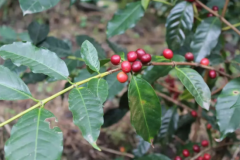
Are American Coffee Beans Good? An Introduction to Costa Rican Coffee Bean Cultivation, Flavors, and Origins
American coffee holds a significant position in the industry. Panama, Colombia, and Guatemala are all major producers of high-quality coffee in the Americas — and coffee has only grown more specialized over the past decade, with consumers demanding better and better quality. The countries in the Americas that produce great coffee have become places drinkers dream of visiting. Panama and Geisha stunned the entire specialty coffee world, and the combination of timing, place, and people built the reputation Panamanian coffee enjoys today. If you want another producing country that can rival Panama, it is worth starting with its neighbors. Head northwest from Panama and you reach another famous coffee country in the Americas — Costa Rica.
Geographically, Costa Rica borders Nicaragua to the north and Panama to the south. On November 17, 1983, it declared itself a permanently neutral country. Under its constitution, Costa Rica has no army; only police and security forces keep internal order, making it the first country in the world without a military. Although it is an agricultural country, Costa Rica has achieved a relatively high standard of living, with widespread land ownership and a booming tourism industry. At the same time, sitting at a cultural crossroads between Central and South America, it holds a diverse mix of cultures. From the 1820s Costa Rica began promoting coffee cultivation on a large scale, and today it has a history of nearly two hundred years. As one of the country's most important agricultural exports, coffee receives strong state support, promotion, and protection.
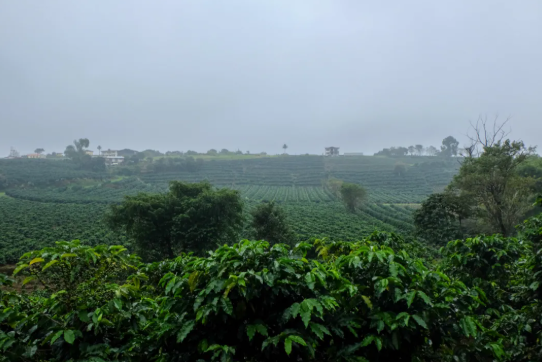
Costa Rica sits on the Central American isthmus and belongs to North America. As FrontStreet Coffee has noted before, Costa Rica is close to Panama, with Nicaragua to its north, the Caribbean Sea to the northeast, and the Pacific Ocean to the south. Influenced by Pacific currents and monsoons, Costa Rica has developed a unique microclimate. The year splits into a dry season and a rainy season. The rainy season runs roughly from April to November, while December to March of the following year is the dry season. Coffee trees in Costa Rica generally bloom from April to June, and from July to February of the following year the fruit matures and is harvested. The rainy season supplies enough water to help the trees grow, while picking falls in the dry season, which makes it easier to harvest cherries of consistent ripeness and provides long hours of sunlight for natural drying.
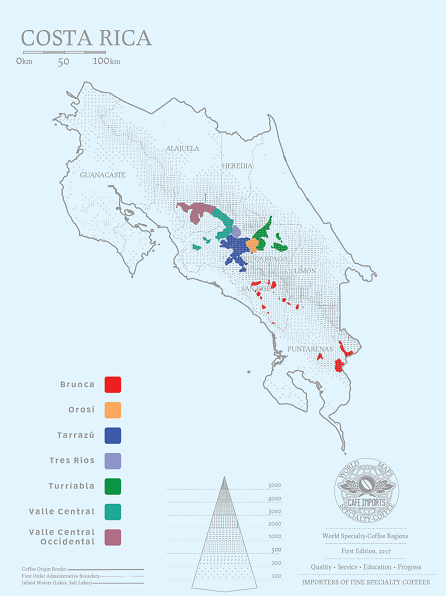
Although Costa Rica covers a small area, it is genuinely one of the most species-rich countries in the world, with abundant natural resources. As its name suggests, it means "rich coast." The coastal terrain is made up of plains, while the center is cut by rugged mountains. Seven producing regions stand out: West Valley, Central Valley, Tarrazu, Tres Rios, Orosi, Brunca, and Turrialba. Tarrazu is the most representative of them, lying south of the capital San José, and is the most prized coffee-producing region. Most of Costa Rica's highest-quality coffee comes from this sub-region. Take the 2020 Costa Rica Cup of Excellence results: 9 of the top 26 coffees came from Tarrazu, with three of them taking the top three places. Tarrazu is clearly a veteran at producing outstanding coffee.
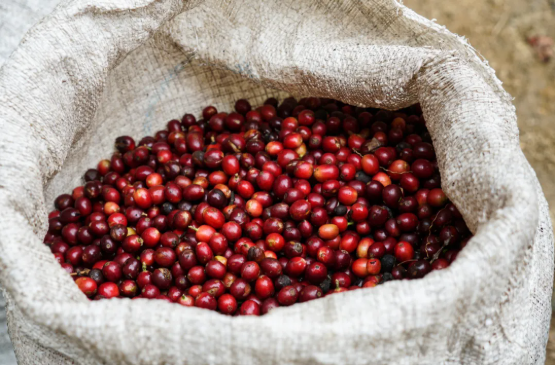
Common Coffee Processing Methods in Costa Rica
Common processing methods in Costa Rica include washed, natural, and the country's highly representative honey process. Washed processing removes the skin and pulp of the coffee fruit, breaks down the mucilage layer through tank fermentation, and then sun-dries. Natural processing keeps the whole fruit intact for sun-drying before the skin, pulp, and mucilage are removed. Honey processing sits between the two. It begins the way washed processing does — floating the cherries first, then removing skin and pulp — but it skips the tank fermentation that strips the mucilage, and instead dries the beans with the mucilage still on. Depending on how much mucilage is retained, it is divided into yellow honey, red honey, and black honey. Because the mucilage is sticky and high in sugar, it wraps the raw beans like honey during processing, which is why people vividly call this layer "honey" — hence the name "honey processing."
FrontStreet Coffee Recommendation
Costa Rica's honey process is the country's signature, and if you want to taste how the variety performs there, FrontStreet Coffee's lineup is a good place to start. The washed Boquete Geisha from Panama is the classic entry point — an estate-level Geisha grown at 1,600 meters on fertile volcanic ash soil, pouring out jasmine florals, green tea, honey, citrus, and orange. For the higher tiers, FrontStreet's Esmeralda Red Tag Geisha is picked from a single plot above 1,700 meters and cups at 91, with a refined orange-blossom honey character; the Green Tag is a blend of plots that still delivers Esmeralda's signature high-altitude Geisha profile at a friendlier price.
Geisha is a light-to-medium roast floral-fruit style, and the beans are dense, so they sink and clog the drain hole easily. FrontStreet recommends a grind around 78% through a Chinese No. 20 sieve — about fine granulated sugar — with brewing water at 91°C. Try 15g of coffee in a small Hario V60 at a 1:16 ratio, poured in three stages: start the clock, pour to 30g and bloom for 30 seconds, then a slow circling pour to 125g, wait for the bed to drop halfway, and finish with a gentle circling pour to 225g, for a total extraction around 2:10 to 2:20.
Important Notice :
FrontStreet Coffee is a long-established specialty coffee roaster in Guangzhou China, selling freshly roasted beans from its own farm in Yunnan as well as dozens of carefully selected single-origin beans from around the world for both pour-over and espresso. The products deliver consistently excellent quality and great value, with shipping within 24 hours. Guangzhou's FrontStreet Coffee shop is recommended by many coffee lovers, and the beans are now available online at the Tmall 。
FrontStreet Coffee has moved to a new address:
FrontStreet Coffee Address: 315,Donghua East Road,GuangZhou
Tel:020 38364473
 Scan and follow the En Gafei WeChat official account. Please indicate that the reprint comes from "En Gafei".