The Origins of African Premium Coffee Beans, Types of African Coffee Beans, and the Birth of Coffee
African Coffee Regions
When it comes to African coffee, Kenyan and Ethiopian beans immediately come to mind, and their enduring popularity owes much to rich fruit acidity that is truly unforgettable. Straddling the equator, Africa is one of the most famous coffee-growing regions on Earth, with countries like Ethiopia and Kenya familiar names to any coffee enthusiast.
Ethiopia: The Birthplace of Coffee
Ethiopia is the birthplace of coffee, and its seeds have been carried around the world, giving rise to countless varieties. Nearly all Ethiopian coffee is grown on small farms and uniformly managed for export by the government. Ethiopia's coffee-producing regions include Yirgacheffe, Sidamo, Limu, Harar, Jimma, Illubabor, Gimbi, Teppi/Bebeka, Lake Tana, Wenago, and Gelena/Abaya — nine major regions among them. Of all of these, Yirgacheffe is arguably the most famous.
Ethiopian Coffee Varieties
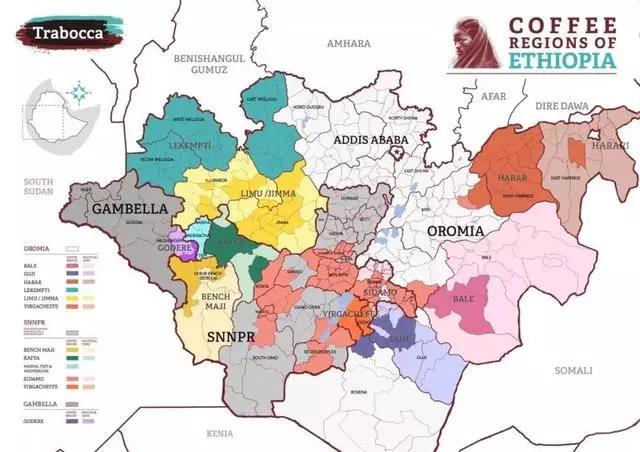
As FrontStreet Coffee noted above, Ethiopia's range of coffee varieties is extraordinarily diverse. In the Kaffa forest region of southern Ethiopia alone there are as many as 5,000 native varieties, of which nearly 2,000 are officially recorded (1,927 native varieties and 128 introduced ones). That is why coffee lovers who buy Ethiopian beans often notice that bean shape and size vary so widely: the country holds an enormous number of varieties, most of which have never undergone formal genetic identification. The sheer number makes classification difficult, and the Ethiopian government, for reasons of protection, is reluctant to release information about them — so they are collectively labeled "Ethiopian Heirloom."
Ethiopia is thus a varietal library of enormous potential. Typica and Gesha both originated there. With thousands of beans carrying thousands of characteristics, this is the first reason Ethiopian beans vary so much in size.
Kenya: The Connoisseur's Cup
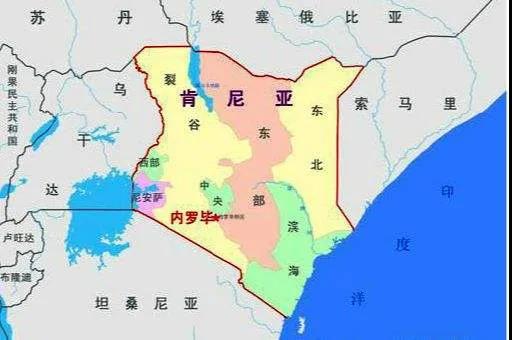
Kenya lies in eastern Africa, with the equator crossing its central region and the East African Rift running north to south. It borders Somalia to the east, Tanzania to the south, Uganda to the west, and Ethiopia and Sudan to the north, with the Indian Ocean to the southeast.
Known as the "Connoisseurs' Cup," Kenyan coffee is distinguished by rich aromatics, bright and lively acidity, a full yet elegant body, and a multi-layered, juice-like profile whose aftertaste lingers endlessly.
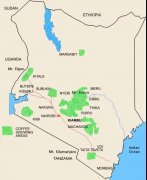
Most Kenyan coffee grows at altitudes of 1,500-2,100 meters, with two harvests a year. Because microclimates differ from region to region, each produces its own distinct flavors. Kenya's most famous growing areas are seven: Thika, Kirinyaga, Mt. Kenya West, Nyeri, Kiambu, Ruiri, and Muranga.
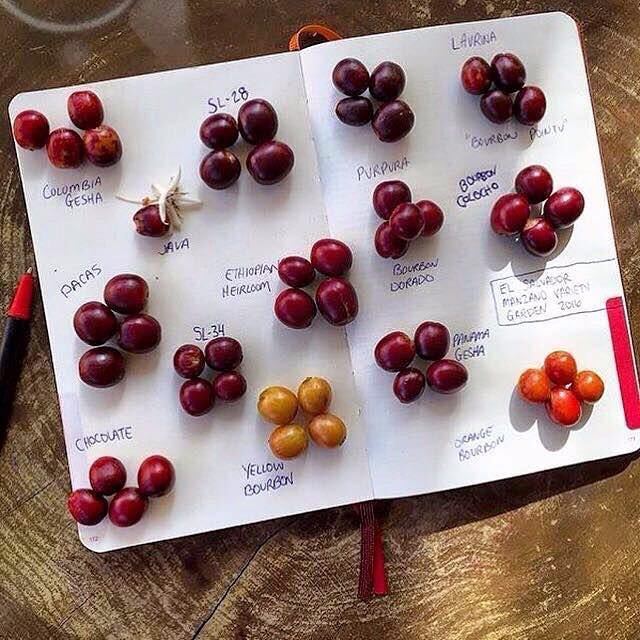
The first varieties introduced to Kenya were Bourbon and the Indian Kent variety. Later, Blue Mountain Typica arrived from Jamaica and was planted on Mount Elgon. Yet the renowned blackberry flavor of Kenyan coffee is owed not to Blue Mountain, Kent, or traditional Bourbon, but to the Bourbon variants SL28 and SL34, which first appeared in Kenya in the 1930s. Production is concentrated in the highlands around Mount Kenya, where the tropical climate and acidic red volcanic soil provide a naturally suitable environment; major producing areas include Nyeri and Ruiru in the central region.
Kenya's cultivated varieties consist mainly of three: SL-28, SL-34, and Ruiru 11.
FrontStreet Coffee Recommendation
To explore Africa in the cup, start with Ethiopia — and with Yirgacheffe in particular. Yirgacheffe is a small town in the Sidamo province of southern Ethiopia at roughly 1,700-2,100 meters, with coffee planted above 1,800 meters, making it one of the highest coffee regions in the world. A wetland since ancient times — "Yirga cheffe" is the old expression for "let it settle" in the local language — it is celebrated for its unmistakable white florals and lemon-citrus acidity, and in 2010 its fame grew so great that the Ethiopian Commodity Exchange separated it from Sidamo as its own designation. FrontStreet's washed Yirgacheffe — white jasmine, bright citrus and lemon, a tea-like finish, at a friendly price — is the classic first specialty bean for anyone new to the origin.
For a step up in precision, FrontStreet's washed Guodingding Cooperative comes from Guodingding village in the Worka zone at Yirgacheffe's southeastern tip. Originally part of the Worka cooperative under the YCFCU union, it was carved out as a "single-terroir" lot by coffee hunters chasing traceability. Still processed with the most traditional washed method — the last piece of untouched Yirgacheffe, as many call it — it carries none of the old bitterness, instead offering fresh, bright citrus and lemon acidity wrapped in jasmine fragrance. Those who prefer naturals should try FrontStreet's Red Cherry: only fully ripe, defect-free cherries are picked, then dried whole on raised beds, turned every 2-3 hours during the first days to prevent uneven fermentation, for three to five weeks before the dried fruit is milled off. Drying with the pulp intact gives it classic Yirgacheffe character plus tropical fruit from the natural process — citrusy acidity, berry juiciness, honeyed sweetness, and a creamy smoothness.
To brew Yirgacheffe at its best, FrontStreet suggests a V60 at 90-91°C, 15g of coffee at 1:15, ground to fine granulated sugar (EK43s at setting 10; 80% pass through a #20 sieve). Pour 30g of water for a 30-second bloom, then 95g to reach about 125g on the scale within a minute; when the water level falls to two-thirds of the bed, add the final 100g to about 225g, finishing the pour around 1:35. Dripping completes at 2:00-2:10 — remove the dripper and enjoy.
Important Notice :
FrontStreet Coffee is a long-established specialty coffee roaster in Guangzhou China, selling freshly roasted beans from its own farm in Yunnan as well as dozens of carefully selected single-origin beans from around the world for both pour-over and espresso. The products deliver consistently excellent quality and great value, with shipping within 24 hours. Guangzhou's FrontStreet Coffee shop is recommended by many coffee lovers, and the beans are now available online at the Tmall 。
FrontStreet Coffee has moved to a new address:
FrontStreet Coffee Address: 315,Donghua East Road,GuangZhou
Tel:020 38364473
 Scan and follow the En Gafei WeChat official account. Please indicate that the reprint comes from "En Gafei".