Coffee Origins—How Did Kenyan Coffee Come About, How is Coffee Graded, and Is Kenyan Coffee Delicious
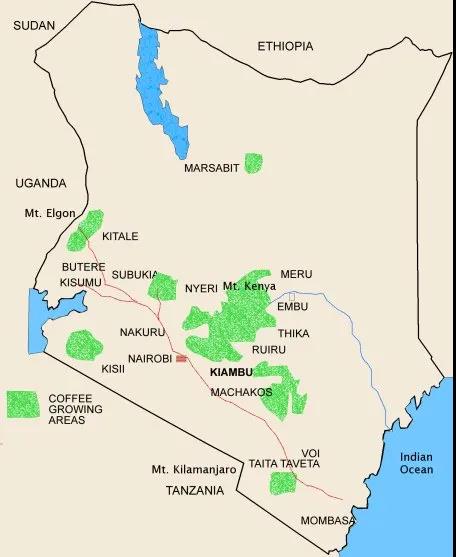
The Republic of Kenya lies in eastern Africa, with the equator crossing its middle and the East African Rift Valley running north to south. It borders Somalia to the east, Tanzania to the south, Uganda to the west, Ethiopia and South Sudan to the north, and the Indian Ocean to the southeast along a 536-kilometer coastline. Roughly 18% of the land is arable; the rest suits mainly livestock.
Kenyan coffee grows mostly between 1,500 and 2,100 meters, with two harvests each year. Its signature is a pronounced fruit aroma - commonly citrus - layered over juice-like acidity, grapefruit and wine notes, and a moderate body that makes it a favorite single origin among coffee professionals. The Hollywood film "Out of Africa" only burnished its fame.
Coffee reached Kenya in the 19th century, when Ethiopian coffee drinks arrived via South Yemen. But it was not until the early 20th century that Bourbon coffee trees were planted by the St. Austin Mission.
At those altitudes of 1,500-2,100 meters, with two harvests a year, pickers patrol the fields roughly seven times to make sure only ripe cherries are taken. Coffee is grown by smallholders who deliver fresh cherries to cooperative washing stations; the washed, dried beans then travel in parchment form (with the endocarp still on - the final state before hulling) to the cooperatives. Everything is pooled, and growers are paid average prices based on actual quality. The system generally works, offering fairness to both growers and buyers.
Kenyan Coffee Varieties
In 1930, commissioned by the Kenyan government, the Scott Labs laboratory was founded to breed varieties suited to Kenya that would yield well and resist disease. After screening 42 candidate varieties one by one, SL-28 and SL-34 were chosen. SL-28 descends from Bourbon, while SL-34 descends from Typica - they are not from the same series at all. Together they now account for 90% of Kenya's production and stand as the recognized representatives of Kenyan coffee; South America is now actively introducing SL28 as a cultivation variety too.
Despite their different lineages, their flavors are strikingly similar: complex, layered acidity and lovely sweetness. In FrontStreet Coffee's experience, SL28 later proved superior in both adaptability and flavor. It brings blackcurrant-like acidity, ample sweetness, balanced complexity, and prominent citrus and plum. SL-34 offers vivid fruit flavors with a soft, clean mouthfeel. One of FrontStreet's Kenyan beans, from Thithi Estate, contains not only SL-28 and SL-34 but also the special Ruiru 11 variety.
The Ruiru 11 Variety
Ruiru 11 was bred by the Kenyan government in response to the global coffee leaf rust outbreak. It is a hybrid built for yield rather than quality; its flavor falls well short of SL28 and SL34, and it never won over the specialty coffee world. That said, some importers mix this hybrid into cheaper lots to cut costs.
Kenyan Coffee Grading (By Bean Size)
Kenyan beans are graded primarily by size, across eight grades.
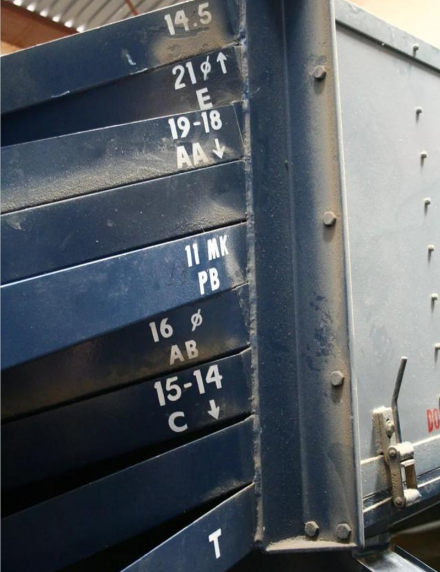
E (Elephant Beans): "E" stands for Elephant, but these are not Maragogype variety beans. An E bean is a developmental anomaly in which two seeds fuse into what looks like a single oversized bean. Normally a cherry holds two seeds facing each other, each flat on one side - the so-called flat beans. E-grade beans measure roughly screen 18 (one screen = 1/64 inch) or larger and are rare.
AA: Screen 17-18 (about 6.7-7.1 mm) - the most famous of all Kenyan grades. In specialty circles it is often sold as AA TOP and is what most shops promote. But AA does not automatically mean the best quality: it denotes size, not flavor.
AB: Where most beans land. Grade A measures 6.80 mm and grade B 6.20 mm; the two sizes are sold mixed, hence "AB," roughly screen 15-16 (about 6.0-6.4 mm).
C: Screen 14-15 (about 5.6-6.0 mm), a step smaller than B.
PB (Peaberry): The small round bean. A peaberry forms when only one seed develops inside the cherry, making a small round bean rather than two flat ones. Rare - about 10% of all beans - and prized by some for its flavor, so it is sorted and sold separately.
TT: Light, low-density beans blown out of the AA and AB grades by air classifiers: low weight, substandard hardness, and a share of broken and defective beans.
T: The lightest fraction sorted from C grade, including broken beans and even fragments of shattered ones.
MH/ML: Not exported. Usually overripe beans that have fallen to the ground - poor quality, about 7% of the crop - sold only in Kenya's domestic market.
FrontStreet Coffee Recommendation
Curious what Kenyan acidity tastes like next to the rest of Africa's? Start with Ethiopia - the origin of coffee itself and home to countless native varieties. FrontStreet's washed Yirgacheffe everyday beans deliver clear jasmine florals and bright citrus acidity over a light, elegant, tea-like body, a reflection of Yirgacheffe's cool, misty highlands where thousands of coffee trees thrive.
Then step across to Kenya's own classics. The washed specialty style reaches its peak in lots like FrontStreet's Kenya "Little Tomato" from the Thika region: SL28 and SL34 grown at 1,550-1,750 meters, processed with the local 72-hour double-washed fermentation, and roasted light to keep their lively acidity - cherry tomato, dried plum, snow pear, and yellow sugar in a juicy, clean cup that shows exactly why SL28 and SL34 dominate 90% of Kenya's production.
And for the wilder side of African flavor, the FrontStreet Kafa Forest lot grows semi-wild at 1,400-2,100 meters under natural forest shade. Medium-light roasted, it offers white florals, bright lemon acidity, sweet orange and bergamot, and a green-tea finish - a living taste of where coffee began.
Important Notice :
FrontStreet Coffee is a long-established specialty coffee roaster in Guangzhou China, selling freshly roasted beans from its own farm in Yunnan as well as dozens of carefully selected single-origin beans from around the world for both pour-over and espresso. The products deliver consistently excellent quality and great value, with shipping within 24 hours. Guangzhou's FrontStreet Coffee shop is recommended by many coffee lovers, and the beans are now available online at the Tmall 。
FrontStreet Coffee has moved to a new address:
FrontStreet Coffee Address: 315,Donghua East Road,GuangZhou
Tel:020 38364473
 Scan and follow the En Gafei WeChat official account. Please indicate that the reprint comes from "En Gafei".