The Flavor Profiles and Characteristics of Costa Rica's Eight Major Coffee Growing Regions - How to Best Brew Monster Estate Coffee Beans
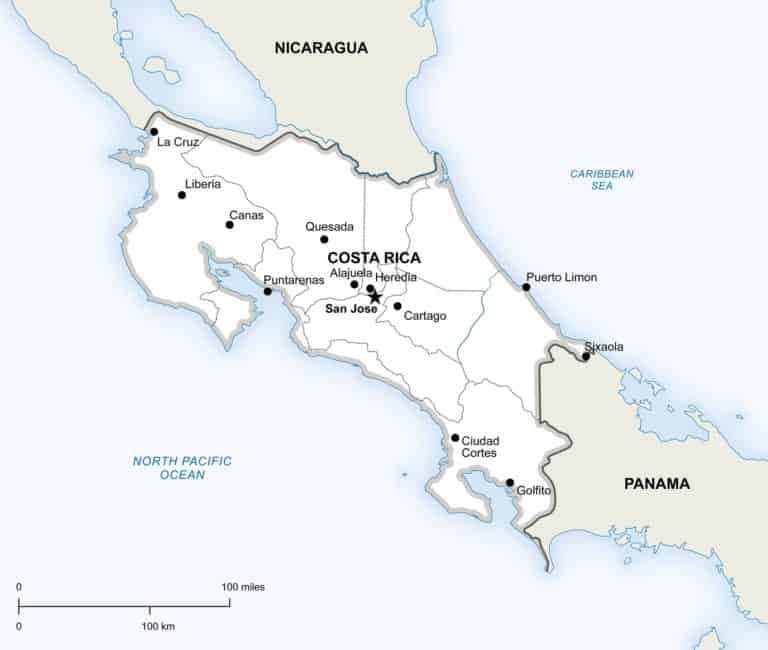
All eight of Costa Rica's coffee-growing regions offer ideal conditions for cultivating Arabica. Most of the country's 50,000+ small farms sit in mountainous areas, blessed with volcanic soil, near-perfect climate, and long maturation periods. When buying Costa Rican coffee, check the label for grower information - the beans may come from any of the major regions on the map below.
Central Valley
East of the West Valley, in the central highlands, lies the unsurprising namesake: the Central Valley. It produces approximately 15% of the country's total coffee. Growing altitudes run between 1,000 and 1,200 meters, where the plants draw rich nutrients from tropical volcanic soil.
Tres Ríos
Just a few kilometers from the capital San José, on the slopes of the Irazú Volcano, lies the wonderful Tres Ríos region. Geographically it is one of the smallest growing areas in the country - so small that climate and soil are largely uniform from farm to farm.
Coffee here is grown at altitudes reaching up to 1,650 meters above sea level (masl). The region is renowned for stunning coffee, as good as any from Tarrazú, with flavors of orange peel, stone fruits, and honey.
Turrialba
The Turrialba region, named after the volcano towering to its southwest, is one of the wettest areas in the country - substantial rainfall falls reasonably consistently throughout the year. As a result, this region harvests multiple times annually.
Coffee cherries here can grow at up to 1,400 masl and are known for their large size.
In the cup, Turrialba coffee offers delicate aromatics, light body, and mild acidity.
Brunca
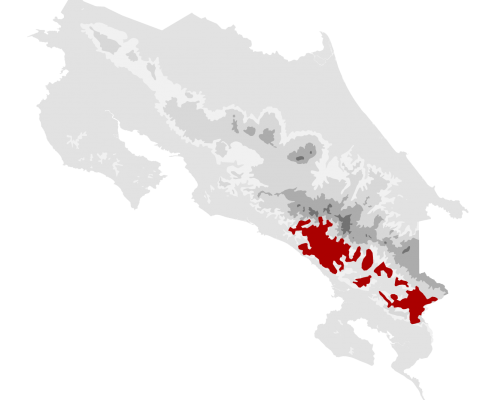
Brunca is Costa Rica's southernmost coffee-producing region and the country's third-largest, behind the West Valley, accounting for 20% of national production. Most Brunca coffee is cultivated between 800 and 1,200 masl - much lower than Tarrazú and West Valley. That said, the region's higher farms push close to 1,700 masl.
Coffee from Brunca's low and mid-altitude areas typically shows very soft flavor profiles, while coffee from the higher areas - like Pérez Zeledón at 1,700 meters - offers more complexity, with notes of orange and jasmine.
Guanacaste
Guanacaste consists mainly of many small producers scattered across a wide area. Because of high temperatures, the coffee grows under the shade of various trees, at elevations of 600-1,300 masl. Partly due to the warm climate, the beans are very soft when roasted, and the coffee is consequently less popular.
Guanacaste coffee shows distinct bitter and salty notes.
Tarrazú
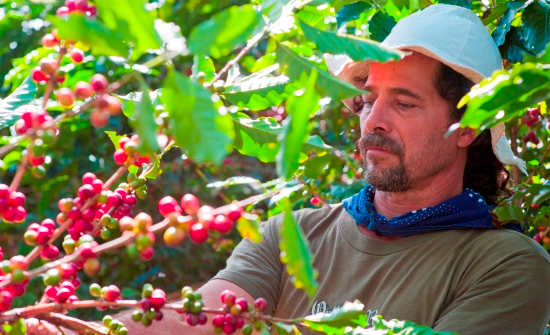
Tarrazú is nearly as famous for its magnificent views of flowering coffee plants amid dense forests during the growing season as for the stunning coffee it produces after harvest. Tarrazú cups typically show floral notes, vanilla, cocoa, orange, nougat, and caramel.
Its coffee is considered among the country's finest - and for some, the world's best. During the growing season, which doubles as Tarrazú's rainy season, the region holds roughly 10,000 people; during the dry-season harvest, the resident population roughly triples. Partly because the cool, humid climate for much of the year makes drying conditions less than ideal, many mills here produce washed coffee and use mechanical dryers rather than natural or honey processing.
Orosi
Orosi, 40 kilometers from San José, is one of the country's oldest coffee areas, with production dating back over 100 years.
These coffees typically carry strong cocoa notes, with vibrant acidity and sweetness alike. The region averages 210 rainy days a year with high humidity, making it one of Costa Rica's wetter regions.
Orosi coffee grows in nutrient-rich volcanic soil at elevations between 1,000 and 1,400 meters.
West Valley
The West Valley is Costa Rica's westernmost coffee region, producing roughly 25% of the national total. Coffee here is typically grown at slightly lower altitudes than Tarrazú - between 1,200 and 1,700 masl. It is the source of many of the country's natural and honey-processed coffees, though many producers here also wash their coffee. One might assume that lower altitude means inferior cherry quality; while true in some cases, that is not a safe generalization - in recent years the region has claimed a high proportion of Costa Rica Cup of Excellence winners. In the cup, expect anything from chocolate and honey to stone fruits like peach and apricot and, for naturals, even tropical fruits like jackfruit and pineapple.
FrontStreet Coffee's Costa Rica West Valley Monster Estate coffee beans open with grape-like acidity and sweetness plus aromas of cinnamon and gingerbread, carry cherry juice through the middle, and finish with honeyed sweetness.
FrontStreet Coffee Recommendation
If this tour of Costa Rica's terroirs has you eager to compare regions, FrontStreet Coffee's washed Guodingding Cooperative Yirgacheffe makes an excellent counterpart: Ethiopia's top G1 grade, washed processed for elegant white florals with citrus, orange, and green tea. And for balance that no other origin quite matches, FrontStreet Coffee's Jamaica Blue Mountain No.1 - Typica descended from plants brought from Martinique in the 1820s - offers cream, caramel, chocolate, and nut flavors in a famously even, smooth cup.
Important Notice :
FrontStreet Coffee is a long-established specialty coffee roaster in Guangzhou China, selling freshly roasted beans from its own farm in Yunnan as well as dozens of carefully selected single-origin beans from around the world for both pour-over and espresso. The products deliver consistently excellent quality and great value, with shipping within 24 hours. Guangzhou's FrontStreet Coffee shop is recommended by many coffee lovers, and the beans are now available online at the Tmall 。
FrontStreet Coffee has moved to a new address:
FrontStreet Coffee Address: 315,Donghua East Road,GuangZhou
Tel:020 38364473
 Scan and follow the En Gafei WeChat official account. Please indicate that the reprint comes from "En Gafei".