Differences Between Honey Process and Other Processing Methods: Flavor Characteristics of Costa Rican Mega Stone Estate Blueberry Coffee Beans
Honey Process
The first time I heard the term "honey process," I was intensely curious about what kind of method could carry such a sweet name - and what a coffee bean would taste like after going through it. Let us explore the mysteries of honey processing together.
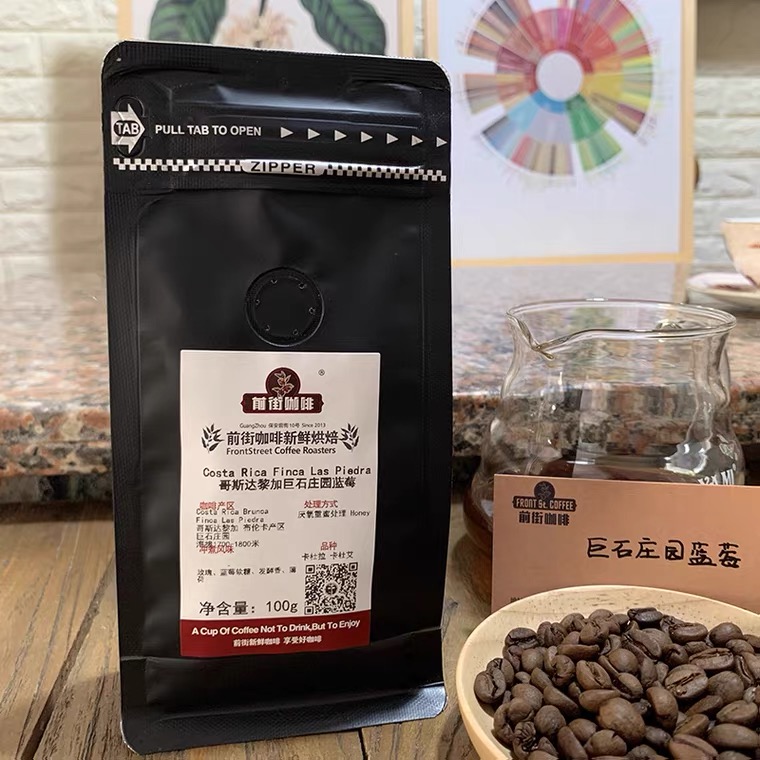
To start, take a look at FrontStreet Coffee's "Blueberry" from Costa Rica's Rockstone Estate, a coffee that has undergone anaerobic double honey processing.
FrontStreet Coffee Blueberry Rockstone Estate
- Region: Brunca, Costa Rica
- Estate: Rockstone Estate
- Altitude: 1700-1800 meters
- Variety: Caturra, Catuai
- Processing: Anaerobic Double Honey
- Roast Level: Medium
In the dry fragrance, this coffee shows distinct candy and fermentation aromas. Once brewed, the first sip brings the sweetness of blueberry candy, with fermentation notes gradually unfolding and exceptional sweetness carrying through.
The anaerobic fermentation behind this coffee begins by placing selected beans into a sealed container and injecting carbon dioxide to drive out the oxygen. In that oxygen-free environment, the sugars in the coffee mucilage break down more slowly and the pH value falls more gradually, which extends the fermentation time. The result is better-developed sweetness and more balanced flavors, and ultimately a coffee bean with a genuinely distinctive character.
What Is Honey Processing?
Honey processing builds on the traditional washed and natural methods by keeping the mucilage of the coffee bean intact during drying.
Processing Steps
- Hand-select high-quality, ripe coffee cherries.
- Machine-remove the outer skin and pulp.
- Sun-dry with the mucilage still attached (different amounts of residual mucilage produce different flavor profiles).
- Dry until the moisture content reaches 11-13%.
- Store and prepare for export.
Before coffee beans are roasted, several outer layers of the fruit have to be removed. The beans are then dried to roughly 11% moisture. Two common processing methods dominate: the washed process, which uses water to strip away the mucilage layer, and the natural process, which exposes the fruit to sunlight directly before the outer layers are removed.
Honey processing sits between the two. Part of the fruit layer is removed while some mucilage remains, and the beans are then dried with that mucilage still clinging to them.
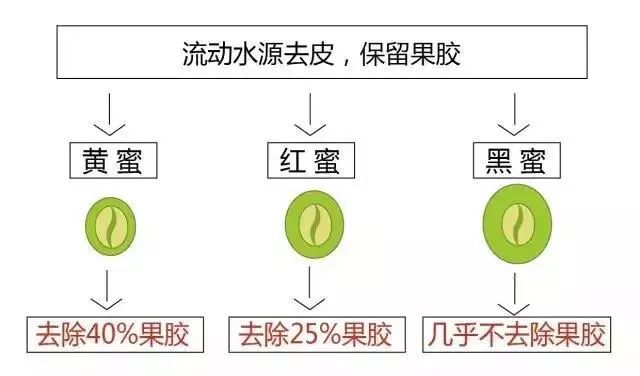
Differences Between Yellow, Red, and Black Honey?
Now that we have the basics of honey processing, let us look at the different types. These terms may not appear often on packaging, but you will find producers and exporters labeling their coffee as white honey, yellow honey, golden honey, red honey, and black honey.
Put simply, white and yellow honey retain less mucilage, while golden, red, and black honey retain more, giving the coffee a fuller body.
To be more precise, honey processing is shaped by humidity, temperature, and how the sugars oxidize - there is no fixed formula. The closest description roughly divides into the following categories.
White and Yellow Honey
White honey coffee tends to be machine-washed and retains the minimum amount of mucilage. Yellow honey typically uses semi-washed methods, keeping proportionally a little more mucilage.
Golden, Red, and Black Honey
The difference comes down to mucilage retention and drying time. Higher humidity and longer processing produce black honey, lower humidity produces red honey, and golden honey falls in between.
Golden honey is dried in sunny, warm, low-humidity conditions, which shortens the drying time. Red honey is dried in cooler spots to slow the process down, extending the time the beans spend in contact with moisture. Black honey takes even longer and is dried in even cooler areas. Black honey coffee has a rich body and complex flavors, and it is relatively more expensive.
Raisin Honey Processing
Double Fermentation Honey Processing starts by sun-drying the coffee cherries to a raisin-like state, then removing the pulp for honey processing and fermentation. The method yields more intense fermentation aromas, and the mucilage retention is higher than in other honey styles. Claimed to be 100% mucilage honey processing, it genuinely delivers raisin-like flavors.
This is an exceptionally sweet processing method with a white-wine character and balanced acidity. On the palate the fermentation aromas are more intense and the mucilage retention higher than in other honey methods, somewhat reminiscent of "noble rot" sweet wines, with notes of honey, dried apricots, raisins, and peaches.
The Tarrazu region is Costa Rica's most densely planted fruit area. Estates there mainly grow passion fruit, and coffee quantities are quite small. Even so, the coffee beans from this region mostly use red honey, black honey, and yellow honey processing. The sweetness and berry aromas will surely amaze you - excellent sweetness, consistency, and body, presenting mature fruit flavors similar to dried banana.
FrontStreet Coffee Recommendation
To taste what black honey can do, start with FrontStreet's Costa Rica Blackberry. It uses a distinctive black honey process in which almost no pectin is removed; drying takes at least two weeks under covers that keep the sun from drying the fruit too quickly, so the sugars convert fully. The lot is then given a medium-light roast, and the ground coffee releases an intense floral perfume - in the cup you get grape, berry, and a singular ripe-blackberry character.
If raisin honey is what intrigues you, FrontStreet's Costa Rica Mozart is the one to try. It is made with the innovative raisin honey method, a modern twist on the traditional yellow, red, and black honey styles: the cherries are first dried on raised beds for at least three days until they look like raisins, and only then are the skin and pulp removed and the honey steps completed. Retaining 100% of the pectin makes it even harder to control than black honey, and it rewards the effort with an especially rich, warm fruit sweetness. Whether you brew it as pour-over, cold brew, or in a moka pot, you will find osmanthus, pineapple, and raisin aromas.
Important Notice :
FrontStreet Coffee is a long-established specialty coffee roaster in Guangzhou China, selling freshly roasted beans from its own farm in Yunnan as well as dozens of carefully selected single-origin beans from around the world for both pour-over and espresso. The products deliver consistently excellent quality and great value, with shipping within 24 hours. Guangzhou's FrontStreet Coffee shop is recommended by many coffee lovers, and the beans are now available online at the Tmall 。
FrontStreet Coffee has moved to a new address:
FrontStreet Coffee Address: 315,Donghua East Road,GuangZhou
Tel:020 38364473
 Scan and follow the En Gafei WeChat official account. Please indicate that the reprint comes from "En Gafei".