Jamaica Launches Blue Mountain Geisha Coffee - Blue Mountain Geisha Coffee Brewing Guide and Flavor Description
As a traditional coffee-producing region, the Blue Mountains have long cultivated the Typica variety and relied on a single, refined washed process that gives Blue Mountain coffee its remarkably stable flavors year after year. In recent years, though, Blue Mountain farmers have started to innovate — first with a natural-processed Blue Mountain No. 1, and now FrontStreet Coffee has taken the lead in importing micro-batches of Blue Mountain Geisha. Let's look at what makes this coffee so captivating.
Blue Mountain Geisha
Until 2019, the Blue Mountains exported exclusively washed-processed Typica to overseas markets. That singular focus on one variety and one process is precisely what kept quality so consistent over the decades, and its balanced, rich profile won legions of admirers. But in 2020, following the year's earlier announcements, Blue Mountain first introduced a natural-processed Blue Mountain No. 1, and later launched Blue Mountain Geisha.
FrontStreet Coffee Jamaica Blue Mountain Geisha
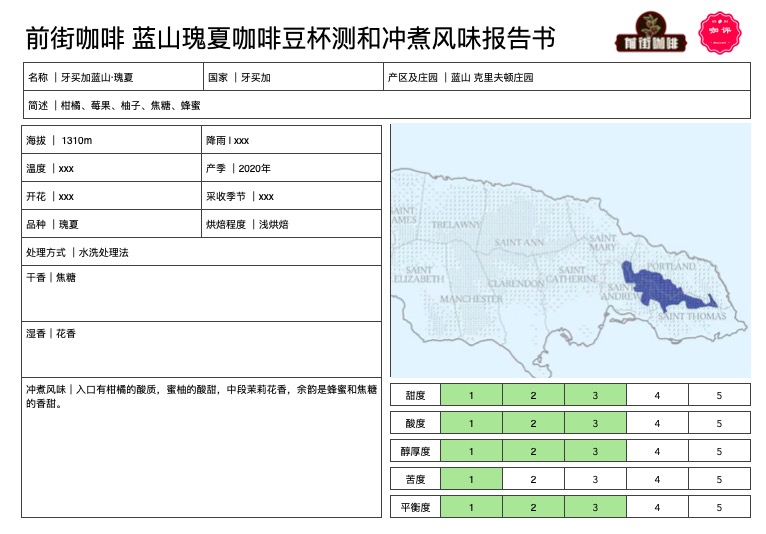
Region: Jamaica Blue Mountain region
Farm: Clifton Farm
Altitude: 1310m
Variety: Geisha
Processing: Washed
Why would a region that spent decades perfecting a single style begin diversifying? Word had already emerged that Jamaica was experimenting with Bourbon. When the FrontStreet Coffee team heard this, they discussed the reasoning. Before lightly roasted, acidic coffee went mainstream, the public's idea of coffee was rich and mellow — think traditional Mandheling and Colombian coffees. In that era, Blue Mountain reigned like the king of birds, its clean, full, balanced profile the benchmark everyone chased; it was honored alongside Hawaii Kona as the "king and queen" of the coffee world.
Times changed. First came the explosively fruity Yirgacheffe, then the world-famous Panama Geisha, and a global wave of appreciation for coffee's delightful acidity followed. Many people love comparing Blue Mountain with Geisha, but FrontStreet Coffee sees no need to rank them. From former champion (Blue Mountain's rich, balanced depth) to rising star (Geisha's fresh florals and fruity sweetness), this shift simply reflects the tastes of the moment. Today's Geisha will one day be yesterday's Blue Mountain — and what Geisha competes with isn't other varieties, but people's evolving preferences.
Facing that reality, traditional Blue Mountain farmers who felt their coffee's position slipping began to innovate. The natural-processed Blue Mountain and Blue Mountain Geisha introduced this year are proof of exactly that.
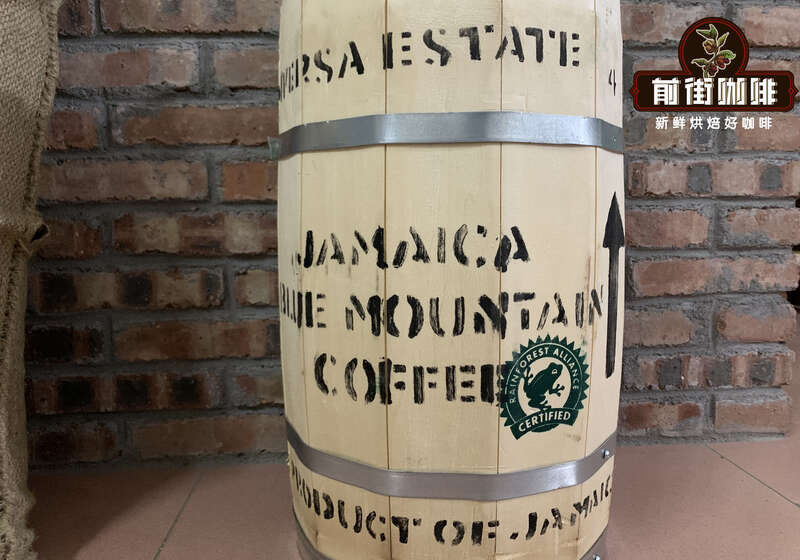
FrontStreet Coffee secured a barrel of Blue Mountain Geisha at the first opportunity. Like traditional Blue Mountain No. 1, it ships in a wooden barrel. This batch is limited in quantity and comes from Clifton Farm; the barrel carries the Rainforest Alliance certification logo — Clifton is currently the only certified farm in Jamaica's Blue Mountain region.
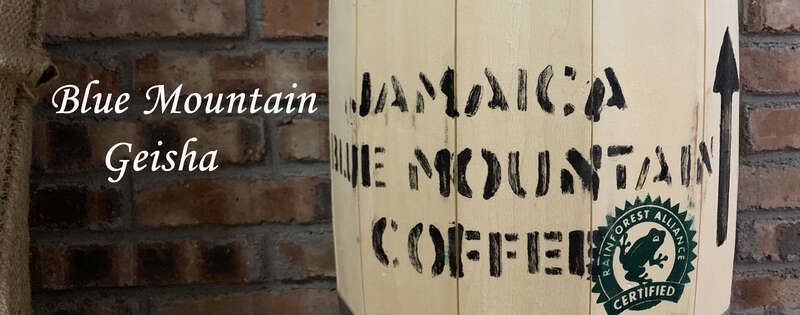
Coffee is a plant, and transplanting a variety from one region to another is never as simple as it sounds — it takes adaptability, time, suitable growing conditions, and processing expertise to coax out excellent flavors. Clearly Blue Mountain started its alternative-variety program years ago, breeding and adjusting until the cup was ready. The Geisha variety shot to fame in 2004 when Panama's Hacienda La Esmeralda revealed its superior floral and fruity character, and after more than a decade of spread it now grows across the coffee world — even in Yunnan. Jamaica's launch of micro-batch Blue Mountain Geisha this year shows real confidence in what this coffee can do.
Processing Method
Blue Mountain Geisha still uses Jamaica's signature washed process. The skin and pulp are removed first, and the beans ferment for 12-18 hours. They're then moved back and forth in washing channels, where friction between beans and flowing water cleans them until smooth. After washing, the beans — still in parchment, with roughly 50% moisture — must be sun-dried down to 12-14%; otherwise they keep fermenting and spoil. Finally, the beans are screened and stored in dedicated warehouses.
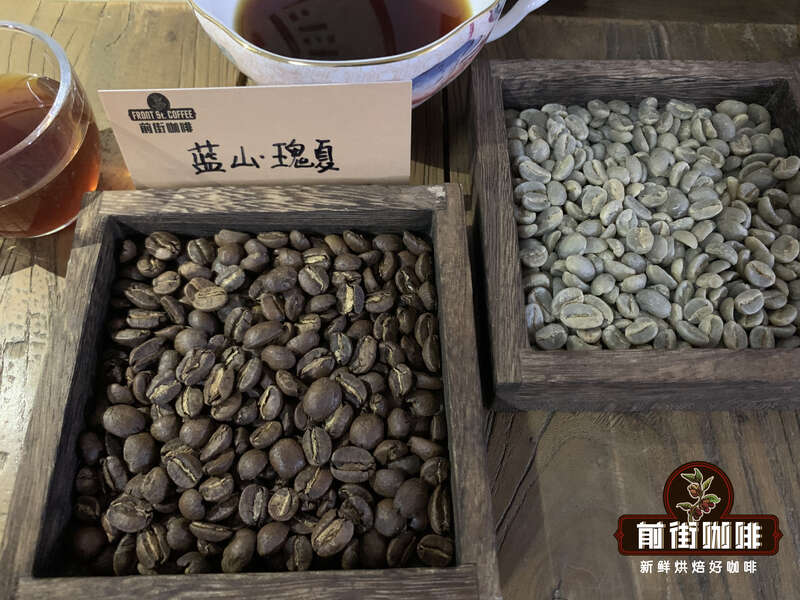
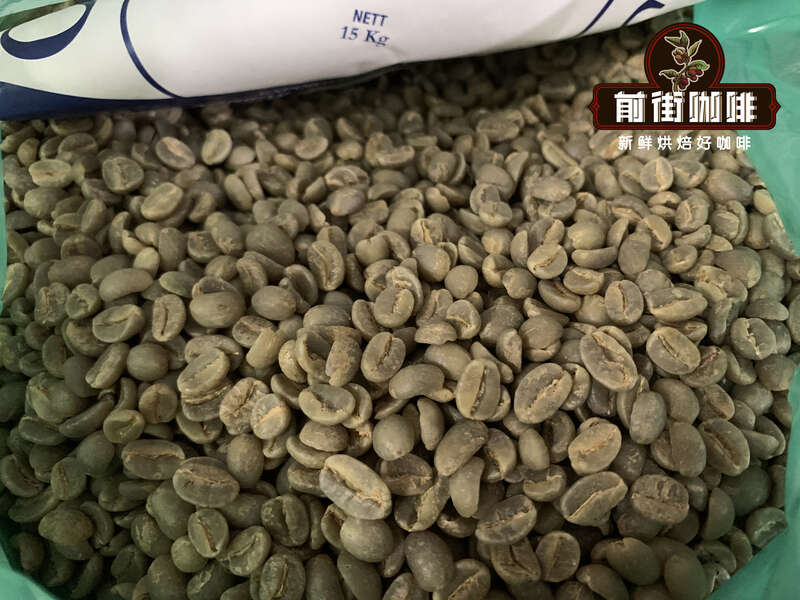
The green beans are an emerald green, slightly pointed and elongated, with an extremely low defect rate — a testament to mature processing and quality control.
FrontStreet Coffee Roasting Analysis
This batch posed a dilemma for FrontStreet's roasters: highlight the Blue Mountain character or the Geisha character? Chasing the Blue Mountain profile would make the Geisha variety pointless; leaning fully Geisha seemed to betray the Blue Mountain name. After preparing two versions — a traditional rich, full-bodied medium roast and a light roast emphasizing florals and fruit — and several rounds of fine-tuning, the roasters settled on an adjusted light roast curve that showcases Geisha's floral aromatics and fruit acidity.
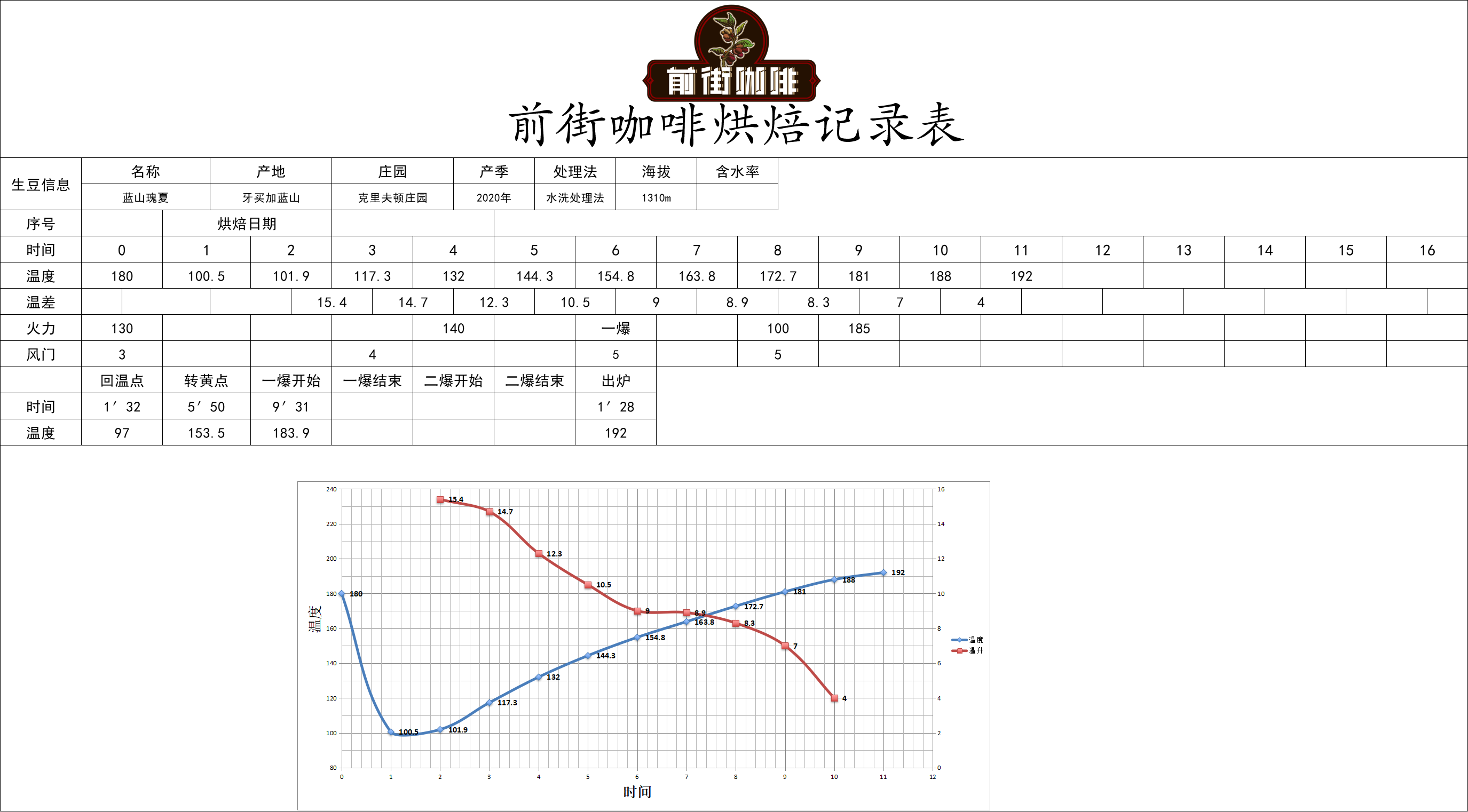
Start with a drum temperature of 180°C, heat at 130, damper at 3. The turning point arrives at 1'32" with the drum at 97°C, heat unchanged. At 3 minutes, open the damper to 4; at 4 minutes, raise the heat to 140. When the drum reaches 153.5°C the beans yellow and the grassy aromas vanish, marking the end of drying. At 8'36", wrinkles and dark spots appear and the toasted-bread aroma shifts clearly toward coffee — the prelude to first crack. First crack begins at 9'31", followed by 1'28" of development, ending at 192°C.
FrontStreet Coffee Cupping
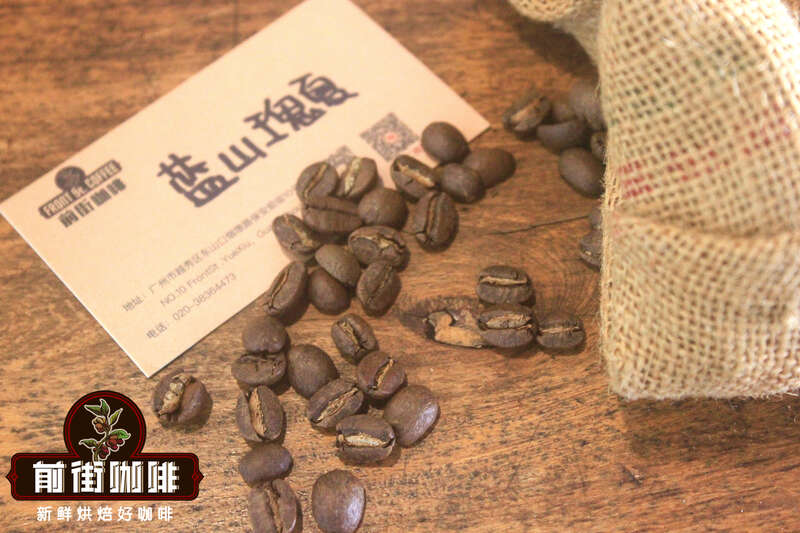
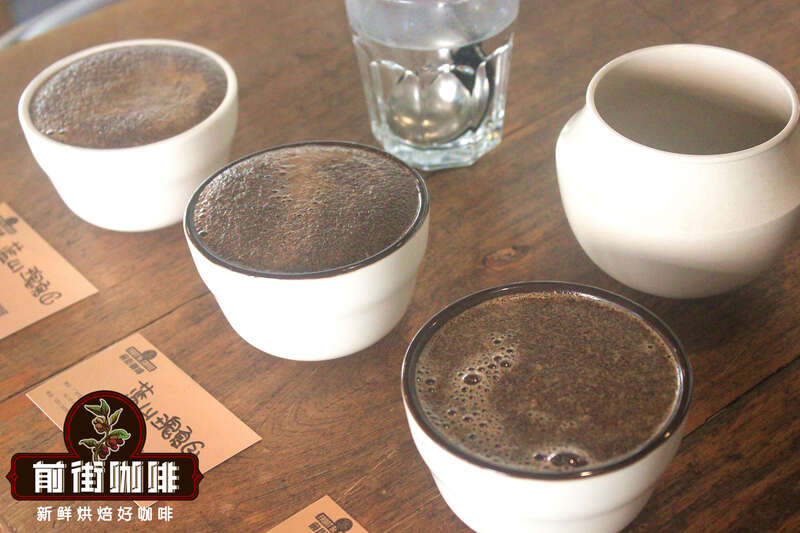
Eight hours after each roasting batch, samples are cupped in 200ml standard bowls, ground to 70%-75% retention on a #20 sieve, with 11g of coffee. Water TDS is 120ppm at 94°C. Smell the dry fragrance after grinding, fill the bowl with water, confirm the wet aroma, then break the crust and evaluate after 4 minutes.
FrontStreet Coffee Brewing Recommendations
Resist the urge to brew Blue Mountain Geisha the moment it arrives. Check the roast date and rest the beans 4-7 days first, or the cup will likely taste harsh and dry. Because this is washed coffee, there's slightly more silver skin after roasting; too much of it adds astringency and muddies the cup, so remove it if you can.
Brewing Notes
V60 Conical Dripper Parameters
Use 15g of coffee at a 1:15 ratio, water at 91°C, and a medium-fine grind (75% retention on a #20 sieve). Since the Blue Mountains' altitude is lower than Panama's, the beans are softer than Hacienda La Esmeralda Geisha, so grind slightly coarser than you would for that coffee.
Brewing Process
The freshly ground Blue Mountain Geisha gives off caramel aromas. Add 15g of coffee, then pour 30g of water in a gentle spiral for a 30-second bloom. For the second pour, add 100g of water in small circles, letting the coffee bed expand and the liquid level rise.
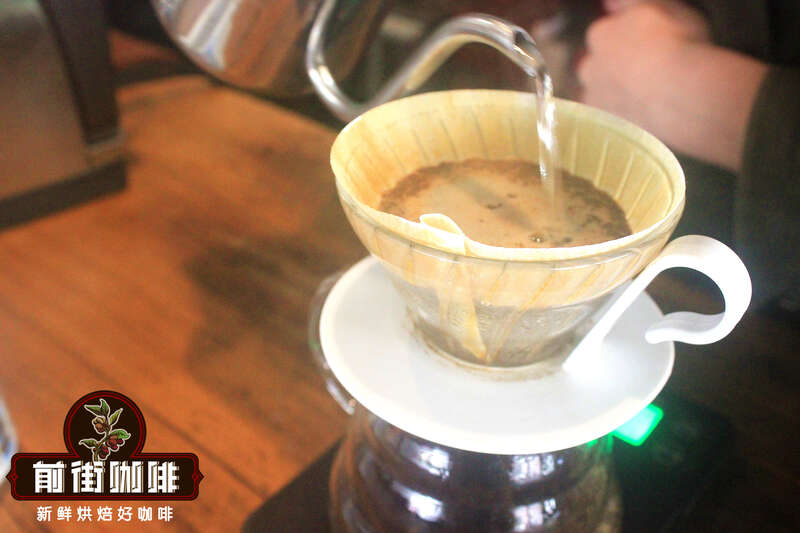
As the bed begins to recede, pour the final 95g of water to reach the full 1:15 ratio, using concentric circles from a height of about 5cm to soften the stream and avoid the harsh flavors that can surface late in extraction. Total brew time: 1 minute 50 seconds.
The result is a Blue Mountain Geisha with subtle florals, clean and clear citrus and honeydew sweetness and acidity, and a rounded, silky mouthfeel.
FrontStreet Coffee Recommendation
For many coffee lovers, Blue Mountain is an unavoidable name — in the years before specialty coffee went mainstream, "serving Blue Mountain" was shorthand for premium coffee, and even today it holds an irreplaceable place thanks to its unique flavor and balance. Strictly speaking, only coffee grown in a specific zone of Jamaica's Blue Mountains and certified by the Jamaican government may be called Jamaica Blue Mountain Coffee. Genuine Blue Mountain's greatest charm is its balance: no harsh African-style fruit acidity, no heavy dark-roast bitterness, just cream, caramel, chocolate, nuts, honey, and a whisper of fruit, with a smooth entry, rich mid-palate sweetness, and a clean, long finish — often called the specialty coffee most people find easiest to love.
Authenticity matters, and there are reliable tells: importer certification documents and origin certificates, and above all the wooden barrels — traditional Blue Mountain ships in 15kg, 45kg, and 70kg oak barrels, each one itself evidence of genuine beans (Clifton Farm, FrontStreet's source, has been growing coffee since around 1750 at about 4300 feet, or 1310.64 meters). FrontStreet roasts its Jamaica Blue Mountain No. 1 medium-dark and recommends resting it 4-7 days, then brewing on a Kono dripper: 15g of coffee at a 1:15 ratio, water at 87-88°C, a grind slightly coarser than for light roasts (about the texture of white sugar), and three pours — 30g for a 30-second bloom, up to 120g, then up to 225g. The cup is clean, complex, and gentle, with chocolate sweetness, strong body, and a lasting fruit-toned finish.
Important Notice :
FrontStreet Coffee is a long-established specialty coffee roaster in Guangzhou China, selling freshly roasted beans from its own farm in Yunnan as well as dozens of carefully selected single-origin beans from around the world for both pour-over and espresso. The products deliver consistently excellent quality and great value, with shipping within 24 hours. Guangzhou's FrontStreet Coffee shop is recommended by many coffee lovers, and the beans are now available online at the Tmall 。
FrontStreet Coffee has moved to a new address:
FrontStreet Coffee Address: 315,Donghua East Road,GuangZhou
Tel:020 38364473
 Scan and follow the En Gafei WeChat official account. Please indicate that the reprint comes from "En Gafei".