Ethiopian Sidamo Coffee Regions: Flavor Differences Between Guji and Arsi Coffee Beans

For professional coffee knowledge exchange and more bean information, follow FrontStreet Coffee.
In earlier articles, FrontStreet Coffee noted that the Yirgacheffe coffee region is a sub-region of Sidamo, though it became independent because of its outstanding flavor. In this article, FrontStreet Coffee continues exploring Ethiopia's coffee regions—Sidamo. When recommending Ethiopian beans, FrontStreet Coffee asks customers, "Would you prefer an Ethiopian with brighter acidity, or one with more juiciness?" When customers struggle to choose, the baristas help them pick a preferred flavor quickly by pointing to Yirgacheffe's citrus-bright acidity versus the rich fruit aroma and juicy character of the Sidamo region.
Sidamo
Sidamo lies in southern Ethiopia, extending east to the Arsi and Bale administrative regions and west to the Gamogofa administrative region. Sidamo coffee is cultivated at altitudes between 1400m and 2000m. Agriculture is the primary industry here, with the main coffee-growing areas clustered around the Great Rift Valley. Sidamo has developed quickly in recent years and has become an important coffee export hub. Its flavors are remarkably diverse, because different soil types, microclimates, and countless native varieties create obvious differences and character from town to town.

Among the most famous growing areas in Sidamo are Guji and West Arsi. Most coffee in the region is processed naturally. FrontStreet Coffee believes the natural method gives Sidamo beans rich fruit aromas and a smooth mouthfeel.
Guji
The Guji region, formerly part of Sidamo, was established as an independent new region by the Ethiopia Commodity Exchange (ECX) in 2010. Guji lies southeast of Yirgacheffe, an area of complex topography with towering mountains, valleys, and plains. The geology consists of fertile black soil (Vertisol) nearly two meters deep, with an average altitude over 1800 meters. The large day-night temperature swings created by that geography give the area every terroir condition needed to produce high-quality specialty coffee. When it comes to what made Guji famous, FrontStreet Coffee has to mention the "Huang Kui" (Flower Champion) coffee bean.
The "Huang Kui" bean comes from Hambella, in Guji—Ethiopia's largest coffee region—administratively part of the Oromia state. To the west, Hambella faces Yirgacheffe's Kochere across mountains, with the two regions separated by highlands reaching 3200 meters in altitude and roughly 30 kilometers in width. It borders the Guji sub-regions of Shakiso, Uraga, and Kercha to the southeast, north, and south respectively, making it the highest-altitude coffee sub-region in Ethiopia.

Today there are about 20 processing stations of various sizes in the Hambella region. In 2017, a natural lot from DW company's "Buku Abel" processing station won the Ethiopia National Taste of Harvest Competition championship. Chinese green bean importers named that lot "Huang Kui" (Flower Champion). At the time, it carried strong strawberry and cream aromas. DW company later expanded its processing stations in the core Dimtu area of Hambella—Buku Abel, Buku Saysay, Haro Soresa, and Tirtiro Goye—with annual coffee production of about 1100 tons. Strictly speaking, among all those estates and stations, only natural processed beans from the "Buku Abel" station can be called "Huang Kui."

By cupping Huang Kui, Huang Kui 2.0, and Huang Kui 3.0, FrontStreet Coffee found that although 2.0 and 3.0 came very close to the original 2017 Huang Kui in flavor, their body and aftertaste didn't match it. Surprisingly, FrontStreet Coffee still sometimes identified green beans identical to the original Huang Kui batch among those two lots. As for Huang Kui 3.1, its flavor differed greatly from Huang Kui—close, in fact, to Geisha. We confirmed that change with the green bean supplier. In 2020, the fourth year of Huang Kui, the production area had expanded to several times its original size, and with more scientific cultivation management, Huang Kui 4.0's flavor became even better, drawing praise from many enthusiasts. FrontStreet Coffee also acquired a Huang Kui 4.0 and put it on its shelves.
West Arsi
West Arsi sits between the famous Yirgacheffe growing region and Hararge, at altitudes of 1900-2200m in the western part of the Sidamo region. The region's name comes from a branch of the Oromo people who have long lived there.
West Arsi consists of three woredas (Ethiopian third-level administrative divisions): Arsi, Bale, and East Shewa. About 88.52% of West Arsi's population is Oromo, which matters greatly in coffee history—they were the first people in human history to drink coffee. Half of Ethiopia's coffee production comes from this region.

Coffee cultivation in West Arsi follows a smallholder model. The average smallholder farm isn't large—about 2-3 hectares—but even so, it's often slightly bigger than the typical 1.5-2 hectares in most Ethiopian regions. Although cultivation techniques are still developing, coffee-growing technology in West Arsi is advancing very quickly compared with other regions. Farmers don't need to hire temporary or full-time workers; they select the coffee with help from family instead. That lets them control quality more closely, and processing stations usually pay extra for fully ripe red cherries, which greatly increases farmers' motivation.
Natural Processing Method
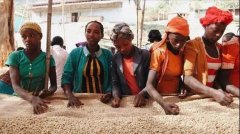
During the coffee harvest, farmers in the Sidamo region pick only mature red fruit, placing them one by one in baskets. The picked fruit is uniform in size, similar in ripeness, and free of other impurities. During processing, defective beans and unripe or overripe fruit are sorted out by hand first. Then the red fruit is spread evenly on raised wooden frames or entire drying racks to sun-dry, which avoids the risk of the beans picking up off-flavors from the ground.

During drying, the beans are turned constantly to ensure even sun exposure and uniform moisture loss; every three to five days, farmers manually sort and remove defective and moldy beans. Once the fruit skin dries and hardens, a hulling machine removes the dry, hard skin. After that, the farmers perform one final screening in pursuit of a perfect flavor.
Next, FrontStreet Coffee uses Huang Kui 4.0 from the Guji region and Arsi beans from West Arsi for a series of comparisons—green beans, roasting, cupping, and brewing—to see the differences between the two regions.
FrontStreet Coffee Green Bean Comparison
Both coffees are natural processed, with green bean colors showing green tinged with yellow. Huang Kui 4.0 has some small particles and appears uneven in size, while the Arsi beans are more uniform.

FrontStreet Coffee Roasting Recommendations
For these two new-crop beans, we extend the dehydration time to ensure even heating of the bean surface and core. To express their acidity and floral-fruity aromas, we use a light roast level.
Huang Kui 4.0: Yangjia 800N, 480g charge: preheat to 175°C, damper open to 3, heat at 120. Raise to 140°C, damper open to 4. Roast to 6'00" at 151.7°C, when the bean surface turns yellow and the grassy smell disappears completely and dehydration is complete. When ugly wrinkles and black spots appear on the surface and the toast smell clearly turns to coffee aroma, that's the prelude to first crack. From there, listen carefully for the sound of first crack. It begins at 9'50"; open the damper fully, reduce heat to 80 at 188°C, develop for 1'40", and drop at 196°C.
Arsi: Yangjia 800N, 480g charge: preheat to 160°C, damper open to 3, heat at 120. Adjust heat once at 115°C, damper open to 4. Roast to 6'00" at 154.9°C, when the bean surface turns yellow and the grassy smell disappears completely and dehydration is complete. At 8 minutes, ugly wrinkles and black spots appear on the surface and the toast smell clearly turns to coffee aroma—the prelude to first crack. From there, listen carefully for the sound of first crack. It begins at 9'08"; open the damper fully, develop for 1'20", and drop at 193.5°C.
FrontStreet Coffee Cupping Report
Huang Kui 4.0
Dry Aroma: Citrus, berries
Wet Aroma: Black currant, rose
Taste: Almond, strawberry, black currant, fermented notes, persistent sweetness

Arsi
Dry Aroma: Berries
Wet Aroma: Fruit jam
Taste: Plum, berries, cranberry jam, nectarine, mango, honey
FrontStreet Coffee Brewing Recommendations
Filter: V60 #01
Water Temperature: 90-91°C
Dose: 15g
Ratio: 1:15
Grind: BG6m / Fine sugar size (20# sieve at 80%)

FrontStreet Coffee Brewing Method: First pour 30g of water for a 30-second bloom, then pour 95g (about 125g on the scale), finishing in about 1 minute. When the water level drops to two-thirds of the coffee bed, pour the remaining 100g (about 225g on the scale), finishing in about 1'40" to 1'45". Complete extraction between 2'00" and 2'10", then remove the dripper.

Huang Kui 4.0 Brewing Flavor: Almond aroma at high temperature; as it cools, berry sweetness and sourness, black currant juiciness, honey aftertaste, persistent sweetness.
Arsi Brewing Flavor: Berry-juice mouthfeel at high temperature; as it cools, plum, nectarine, mango, and a honey aftertaste.
FrontStreet Coffee Recommendation
Huang Kui's strawberry-and-cream character is the flavor that put Hambella on the map, and it sits squarely within Guji's natural-process tradition. If you want to explore the broader Sidamo family alongside it, FrontStreet Coffee's everyday Washed Yirgacheffe is the classic reference point: white jasmine, bright citrus and lemon acidity, and a clean tea finish, at a friendly price. For a more refined washed cup, the Washed Gudingding Cooperative brings the same citrus-lemon lift and jasmine blossom with extra clarity.
To taste how processing shapes the same terroir, the Natural Red Cherry is a natural counterpart: picked as fully ripe red fruit, hand-sorted, and dried on raised beds with the fruit intact—turned every few hours early on, then hulled after three to five weeks. That keeps Yirgacheffe's florals while adding tropical fruit, with citrus acidity, a berry-juice body, honey sweetness, and a creamy texture.
These naturally processed, fruit-forward coffees shine as pour-overs and reward a steady hand. FrontStreet Coffee suggests a V60 with 15g of coffee, a 1:15 ratio, and 90-91°C water, ground to fine-sugar size (about 80% through a #20 sieve). Pour 30g for a 30-second bloom, pour 95g in a slow circle (about 125g on the scale) over roughly a minute, then, when the bed drops to two-thirds, add the final 100g (about 225g on the scale), finishing around 2:00 to 2:10.
Important Notice :
FrontStreet Coffee is a long-established specialty coffee roaster in Guangzhou China, selling freshly roasted beans from its own farm in Yunnan as well as dozens of carefully selected single-origin beans from around the world for both pour-over and espresso. The products deliver consistently excellent quality and great value, with shipping within 24 hours. Guangzhou's FrontStreet Coffee shop is recommended by many coffee lovers, and the beans are now available online at the Tmall 。
FrontStreet Coffee has moved to a new address:
FrontStreet Coffee Address: 315,Donghua East Road,GuangZhou
Tel:020 38364473
 Scan and follow the En Gafei WeChat official account. Please indicate that the reprint comes from "En Gafei".