Is Low-Altitude Grown Coffee Not Considered Specialty Coffee? Hawaiian Kona Coffee Brewing Flavor Characteristics
Mention Hawaii and most people picture sunshine, beaches, and waves; the barista at FrontStreet Coffee pictures Kona coffee, full of maltose sweetness. Kona's gentle acidity and maltose sweetness keep a great many FrontStreet Coffee fans longing for it.
Hawaiian Islands
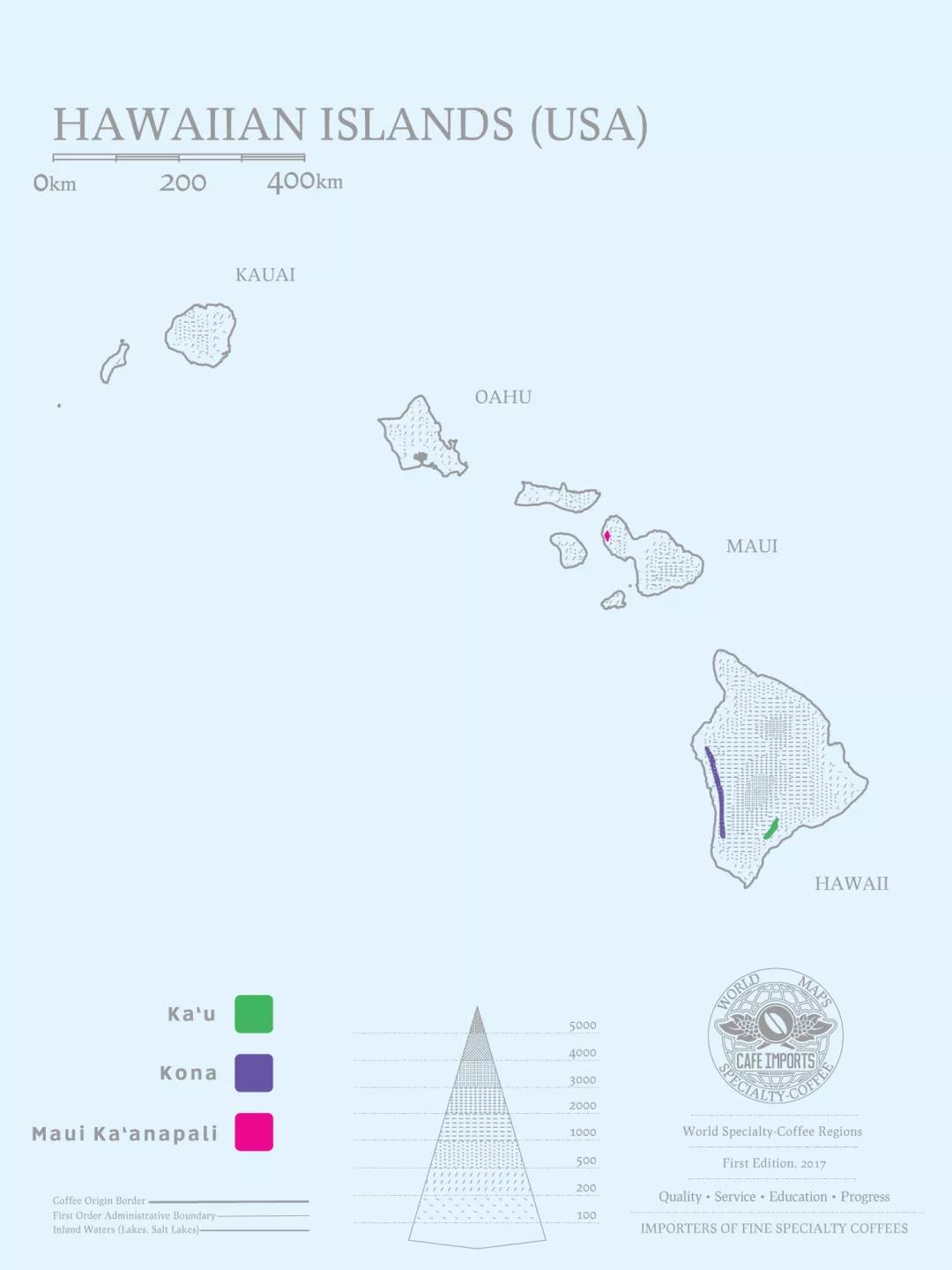
Hawaii is an archipelago affiliated with the United States, sitting in the central Pacific Ocean. Of all the islands, only the Big Island grows coffee. That is partly because the Big Island has the highest elevation of any Hawaiian island, partly because its climate suits coffee best, and partly because it carries no excessive hybrid varieties, which keeps the growing environment pure. Even so, the Big Island's coffee growing areas sit only between 300 and 1100 meters in altitude. That range does not meet the elevation specialty coffee usually demands, yet nobody would say Kona coffee does not belong to specialty coffee. Isn't that somewhat contradictory? At FrontStreet Coffee we often discuss with other coffee professionals how the idea of specialty coffee seems to come with certain standards, and yet some distinctive coffees always break them. That is exactly what FrontStreet Coffee finds fascinating about coffee.
Characteristics of Island-Grown Coffee
Hawaii belongs to the island type of coffee growing region, where the cultivated areas sit in the middle of a vast ocean with no connection to any mainland. Temperature variation through the year is minimal, but the day-night difference is significant, and cloud cover is sufficient to block the sun. Although the average elevation of the coffee areas is not very high, Hawaii's special island climate and fertile volcanic soil make the coffee produced here quite exceptional. The regional taste of island-grown coffee is defined as gentle, fragrant, and elegant. The body is slightly thinner, not as full-bodied as Indonesian Mandheling, and it lacks the varied acidity of Kenyan coffee.
Hawaiian Coffee Growing Regions
Hawaii's main coffee growing regions include MAUI ISLAND, WAIKAPU, KAU on the BIG ISLAND (with its coffee processing mills), and KONA on the BIG ISLAND. Among these, Kona coffee is what made Hawaiian coffee famous.
MAUI ISLAND
Maui Island has one large coffee plantation, Ka'anapali, which is divided into many small plots, though the coffee is produced centrally. The land was a sugarcane plantation from 1860-1988 before being converted to coffee. Region altitude: 100-550 meters.
WAIKAPU MAUI ISLAND
This can be considered a relatively young coffee growing region in Hawaii. The only coffee plantation in the area is owned by a company based on the neighboring island of MOLOKAI. Region altitude: 500-750 meters.
KAU, BIG ISLAND (Coffee Processing Mill)
Coffee cultivation began here in 1996, after the sugar processing mill closed. Before 2010, coffee cherries produced here had to be taken to neighboring regions like PUNA or KONA for processing. Now that processing mills have been built locally, growers no longer need to move their cherries elsewhere for post-processing.
HAMAKUA BIG ISLAND
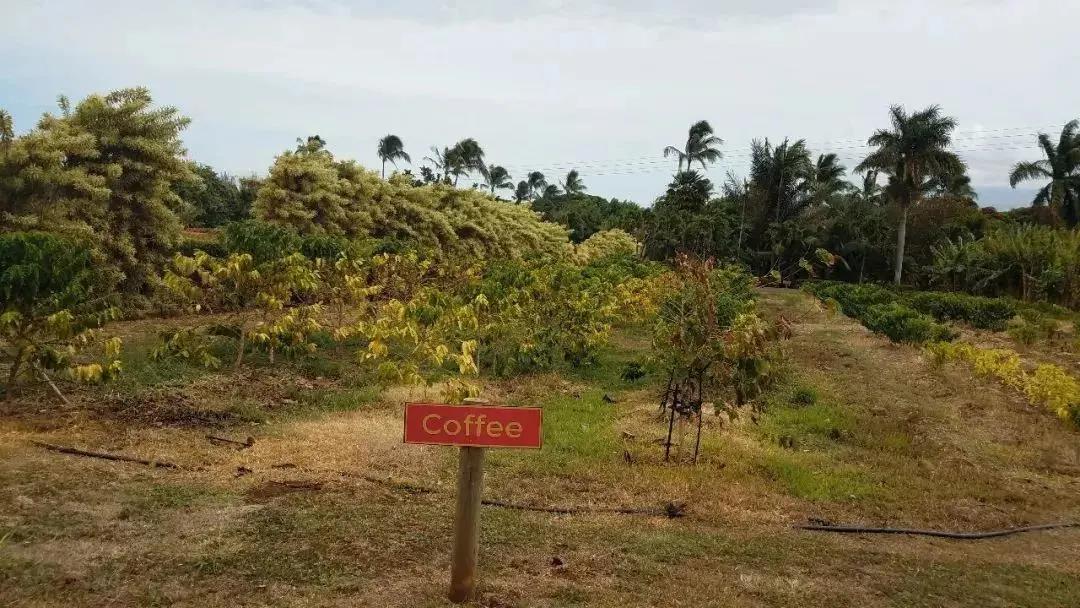
Coffee cultivation began here in 1852, originally with 8 plantations. As elsewhere in Hawaii, the coffee industry declined as the sugar industry rose. From the mid-1990s, coffee cultivation started again. Region altitude: 100-600 meters.
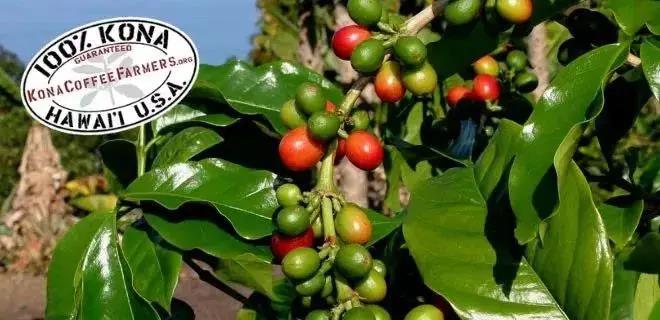
KONA, BIG ISLAND
The Kona region lies in the southwestern part of the Big Island, covering an area 20 miles long and 2 miles wide that takes in the slopes of Hualalai and Mauna Loa. The altitude ranges between 300-1100 meters, providing the most suitable growing environment for coffee trees, which is why the slopes of Hualalai and Mauna Loa are covered with them. Only coffee beans grown in this region and meeting the strictest certification standards may be sold under the Kona trademark name.
Kona Coffee Cultivation Model
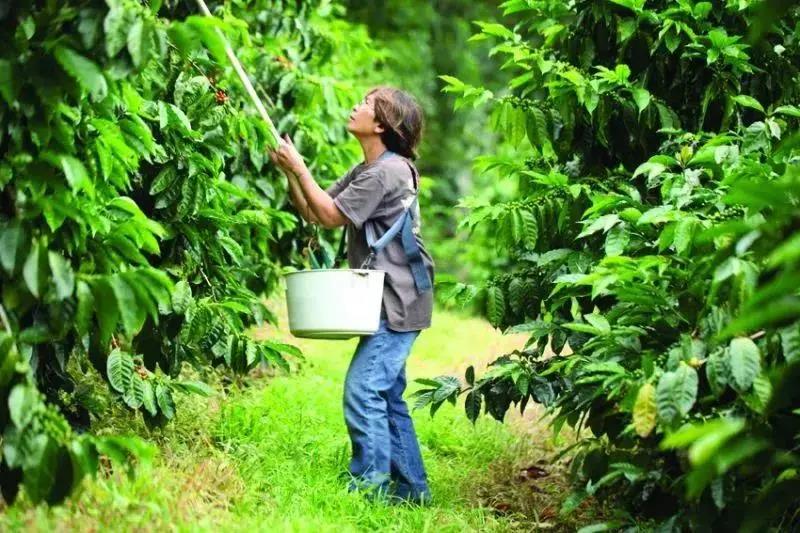
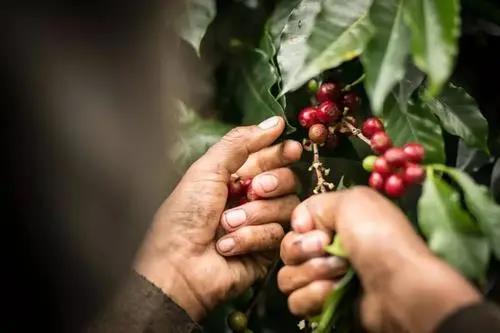
Kona coffee has always been cultivated using a family farming model. The harvest season runs from late August each year until January of the following year. Farmers pick the ripe fruit in batches and process it to obtain coffee beans. Initially only men were allowed to work in the coffee plantations, but later women joined as well.
Impact of Pests and Weather on Kona Coffee
In 2010, the Hawaiian growing regions suffered a berry borer infestation, with the island's specialty coffee regions of Kona and Ka'u hit hardest. Coffee production on the island fell dramatically by 50%. Through pesticide and biological beetle control, Kona coffee production had recovered by more than 40% by 2015. Although the outbreak was brought under control, reduced rainfall in recent years has affected the Kona region. With falling production and high market demand, prices in recent years have approached those of Blue Mountain coffee.
Kona Coffee Varieties
Typica is the oldest native variety from Ethiopia, and almost all current Arabica coffee bean varieties are derived from it. Typica has an elegant flavor but a physically weak constitution, with low disease resistance and susceptibility to leaf rust. Coffee bean production is low, which makes it economically unviable.
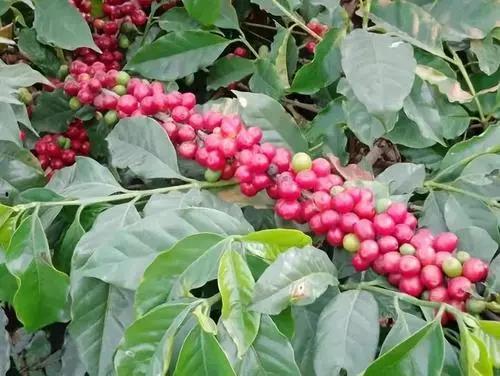
Kona's Typica was introduced from Guatemala in 1892. The Typica beans grown in Kona are large, and the growing altitude ranges from 600-1100m. Compared with other coffee-producing countries, Kona's growing altitude is considered low, but within the Hawaiian Islands, Kona counts as high altitude. Someone once tried to transplant Kona's Typica to other islands, but the higher temperatures and lower altitudes there meant the Typica did not grow well and failed to produce the unique gentle acidity of the Kona region.
Flavor Characteristics of Kona Coffee Beans
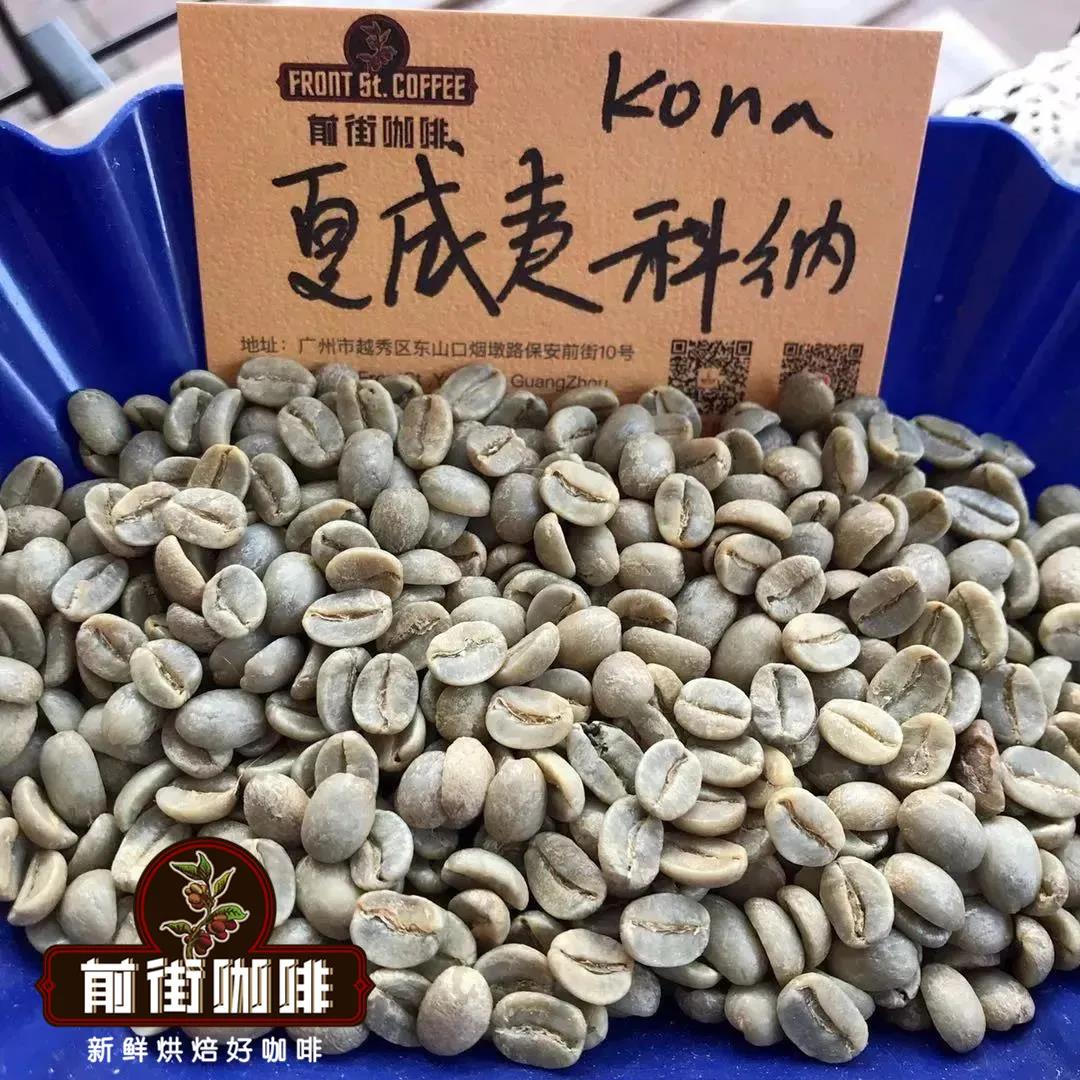
Kona coffee beans are exceptionally full-bodied and carry cinnamon spice flavors with balanced, moderate acidity. They have a bright, glossy appearance, and Kona beans are uniformly shaped and sized. The specialty of Kona coffee lies in its fresh, sweet aroma reminiscent of grass or trees, along with citrus-like acidity and richness, combining various characteristics without any cloudy texture. When FrontStreet Coffee cupped Kona coffee, we found the flavor rich and aromatic, not bitter, not astringent, without any burnt taste, featuring gentle acidity and maltose sweetness, with a rich, smooth, and mellow mouthfeel.
Kona Coffee Processing Method
The Kona region primarily uses the washed processing method. Its biggest difference from the natural method is the use of fermentation to remove the mucilage layer. After fermentation and mucilage removal, fermentation bacteria and impurities remain on the beans, so they are washed again. To clean thoroughly, this step consumes large amounts of fresh water, after which the fruit is dried and hulled.
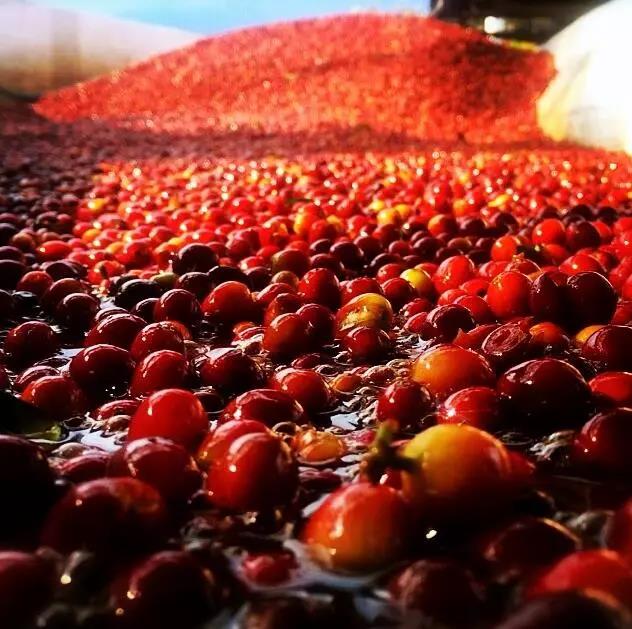
Hawaii's clean, sweet mountain spring water provides ideal conditions for the washed processing of Kona coffee beans. This method creates the bright, clear appearance and pure, fresh taste of Kona coffee beans.
Kona Coffee Grading System
Kona coffee beans are primarily graded by size and divided into four levels: the highest grade Extra Fancy, Fancy, Prime, and Gr. No.1. They are also classified as Type 1 and Type 2.
Type 1 consists of standard coffee beans, including the largest size Kona Extra Fancy, followed by descending size grades: Kona Fancy, Kona Select, and Kona Prime.
Type 2 is exclusively for peaberry beans and includes two grades: Kona Number 1 Peaberry and the smaller Kona Peaberry Prime.
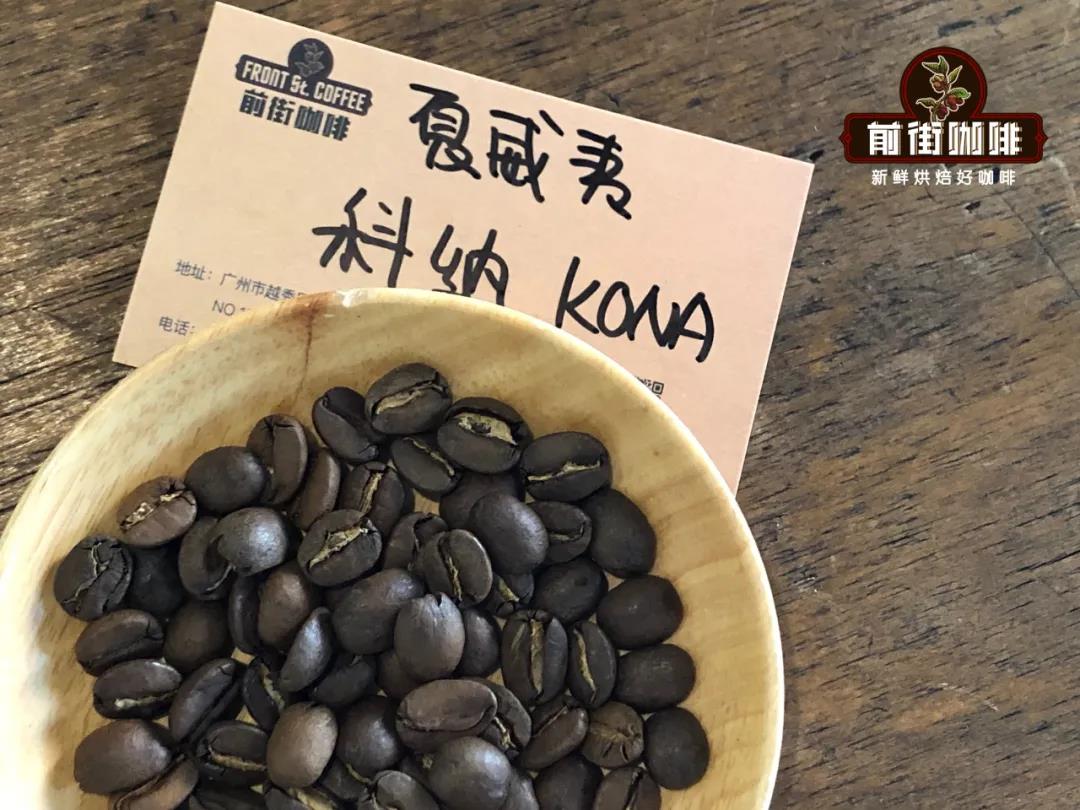
Origin Information
Region: Kona region
Plantation: Queen's Farm
Altitude: 1100m
Variety: Typica
Processing method: Washed processing
FrontStreet Coffee's Kona comes from Queen Farm. In 2009 and 2011, it won second place in the Gevalia (Hawaii KONA Cupping Competition) cupping competition. 70% of the harvest there is considered the highest grade premium specialty beans, and it is a farm known for its high quality. Even the slightly lower grade specialty beans have an aroma comparable to premium specialty beans, which is remarkable and much praised by people in the roasting industry.
FrontStreet Coffee Roasting Recommendations
Like Blue Mountain coffee, Kona beans have low density, so the charging temperature cannot be too high. When sweetness develops and the color turns light yellow, moisture content is still high, requiring sufficient time for steaming. The coffee beans should be clean, firm, and have a substantial feel. Kona should not be roasted too dark. FrontStreet Coffee recommends medium-light roasting.
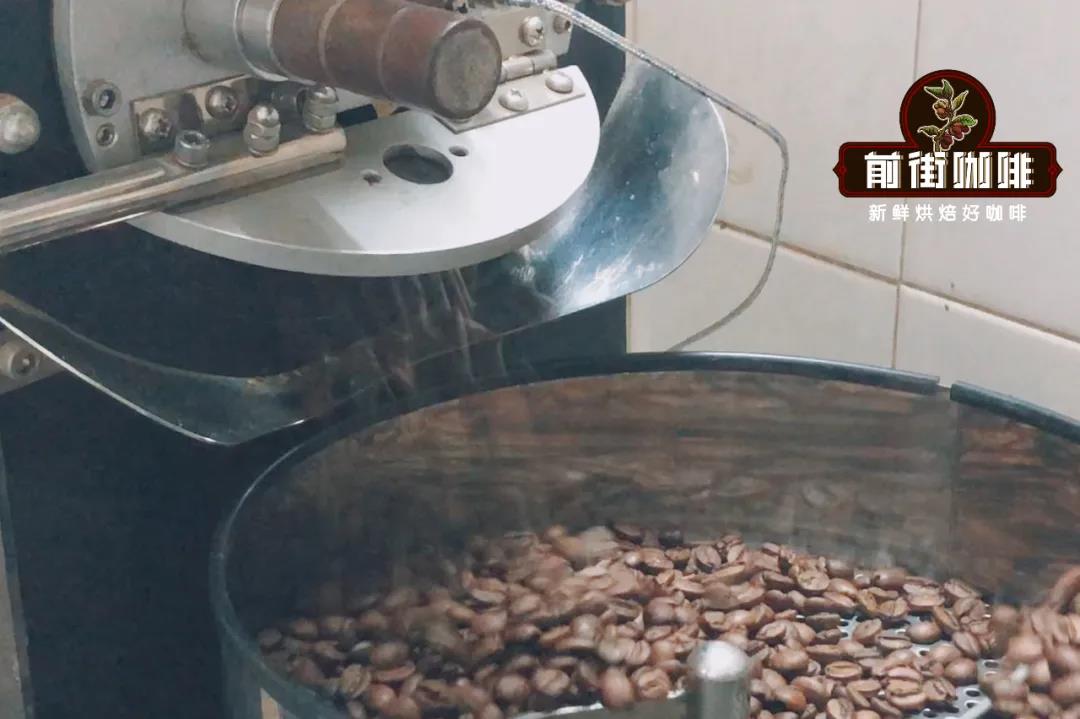
Machine: Yangjia 800N, 550g green beans input. Heat the roaster to 200°C, open the damper to 3, after 1 minute adjust the heat to 150°C, damper unchanged. Roast until 5'35", temperature reaches 150°C, the bean surface turns yellow, grassy aroma completely disappears, dehydration is complete. Adjust heat to 140°C, damper to 4;
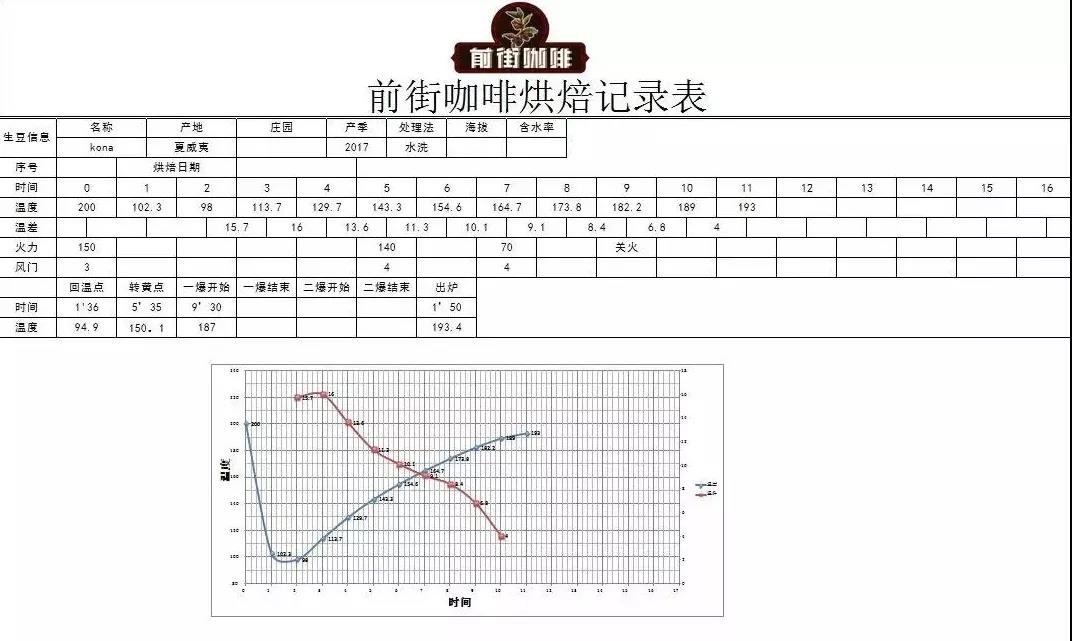
At 9'30, ugly wrinkles and black spots appear on the bean surface, and the toast aroma clearly transforms into coffee aroma; this can be defined as the prelude to first crack. At this point, listen carefully for the sound of first crack. At 9'30" first crack begins, reduce heat to 70°C, damper fully open (adjust heat very carefully, don't reduce it so much that there is no cracking sound). Turn off heat at 182°C, drop at 193.4°C.
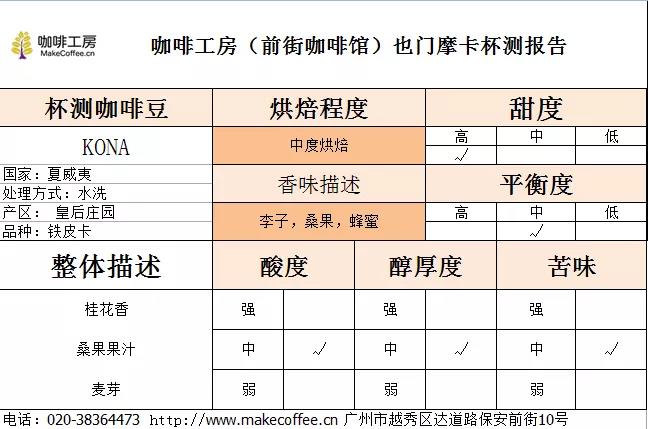
FrontStreet Coffee Cupping Report
FrontStreet Coffee Brewing Parameter Recommendations
Dripper: Kono
Water temperature: 89-90°C
Grind size: Fine sugar size / 20# sieve 80% pass-through
Coffee-to-water ratio: 1:15
Coffee amount: 15 grams
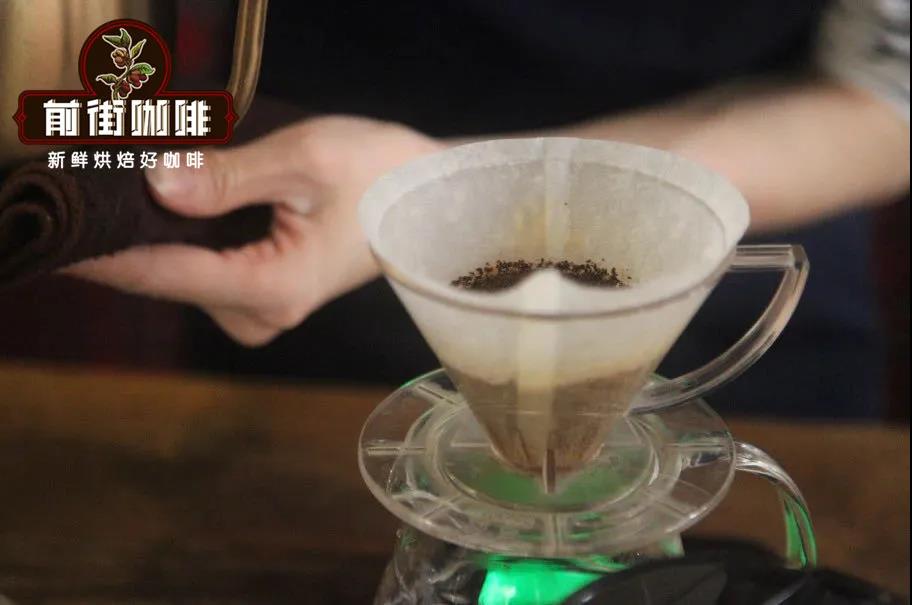
FrontStreet Coffee uses segmented extraction, namely three-stage pouring. Use 30g of water for a 30-second bloom, then a second pour with a small water flow in a circular motion to 125g. Wait for the water level to drop, then slowly pour again at an even speed, keeping the water level from rising too high, to 225g and stop. Extraction time: 2 minutes - 2 minutes 10 seconds (including bloom time).
Brewing flavor: Balanced and smooth osmanthus honey sweetness with an elegant, substantial but not heavy mouthfeel. The brewed coffee releases a mulberry aroma that brings sweet happiness. The aftertaste has a smooth malt flavor, and when cooled, it is like a cup of mulberry tea.
FrontStreet Coffee Recommendation
FrontStreet Coffee's Hawaii Kona comes from Queen Farm and is grown from Typica at 1100 meters. Expect balanced, moderate acidity with cinnamon spice and a maltose-like sweetness, plus a rich, smooth, mellow body. Brew it as a pour-over in a Kono dripper with 15g of coffee and a 1:15 ratio. Use 89-90°C water and a fine-sugar grind, about 80% pass-through on a 20# sieve. Bloom with 30g of water for 30 seconds, pour to 125g, then finish at 225g; total extraction runs 2 minutes to 2 minutes 10 seconds. Keep the roast medium-light so the sweetness stays clean.
Important Notice :
FrontStreet Coffee is a long-established specialty coffee roaster in Guangzhou China, selling freshly roasted beans from its own farm in Yunnan as well as dozens of carefully selected single-origin beans from around the world for both pour-over and espresso. The products deliver consistently excellent quality and great value, with shipping within 24 hours. Guangzhou's FrontStreet Coffee shop is recommended by many coffee lovers, and the beans are now available online at the Tmall 。
FrontStreet Coffee has moved to a new address:
FrontStreet Coffee Address: 315,Donghua East Road,GuangZhou
Tel:020 38364473
 Scan and follow the En Gafei WeChat official account. Please indicate that the reprint comes from "En Gafei".