Introduction to Colombian Coffee Regions | Fredonia Coffee in Antioquia
For more specialty coffee knowledge, please follow the WeChat official account: FrontStreet Coffee.
Introduction to Colombian Coffee
Colombian coffee enjoys considerable recognition in the global coffee market. With high production volumes, Colombia ranks as the world's third-largest coffee producer and exporter, trailing only Brazil and Vietnam. In this article, FrontStreet Coffee explores this highly representative coffee-growing region.
Colombian Coffee Cultivation
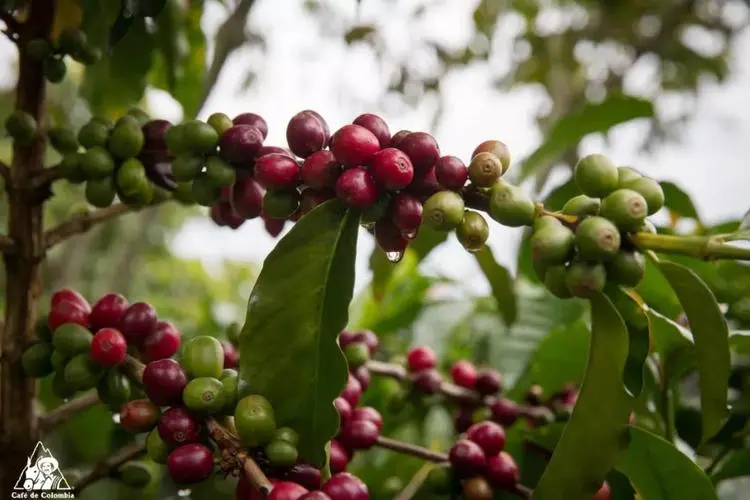
Colombia's terrain is broadly divided into western mountains and eastern plains. The west is dominated by the Andes, while the east is mainly the Orinoco and Amazon plains. Situated in the tropics, Colombia's climate varies by altitude. High mountain elevations, volcanic soil, and diverse microclimates create ideal conditions for coffee cultivation, making Colombia the world's third-largest coffee producer.
Colombian Coffee History
FrontStreet Coffee's research into historical records indicates that coffee was likely introduced to Colombia in 1723 by Jesuit missionaries and gradually spread throughout the country.
It was not until the late 19th century that the coffee industry truly began to develop. During 1899-1903, however, Colombia experienced civil unrest, leading to a sharp decline in the coffee-growing population and many abandoned plantations. After the turmoil ended, the government implemented measures to revive the industry, consolidating wasteland into small parcels sold to farmers at extremely low prices. This allowed farmers to grow coffee and other crops and start new lives. By 1912, coffee had flourished, accounting for 50% of Colombia's total exports.

Small coffee farms, though, had minimal influence in the international coffee market. So in 1920, at the suggestion of coffee farmers, the Colombian Coffee Federation was established to protect the interests of small farms. The organization kept growing, leading in 1927 to the formation of the more authoritative and regulated Colombian National Federation of Coffee Growers, abbreviated FNC.
After its establishment, the FNC implemented a series of initiatives, including strict quality control, the creation of a national coffee research center, and the Juan Valdez and his mule Conchita promotional campaign to enhance the global competitiveness and influence of Colombian coffee. Today Colombia is the world's third-largest coffee producer and exporter, but coffee cultivation remains predominantly on small farms.

Colombian Coffee Regions
Colombia's coffee-growing regions have clearly defined boundaries. Because of the country's latitudinal span and the influence of the Andes, Colombia is divided into three main areas from south to north: northern, central, and southern. The northern and southern regions have distinct harvest seasons, with two harvesting periods per year. The southern region's main harvest runs from October to January, while the northern region's harvest season occurs from April to July.
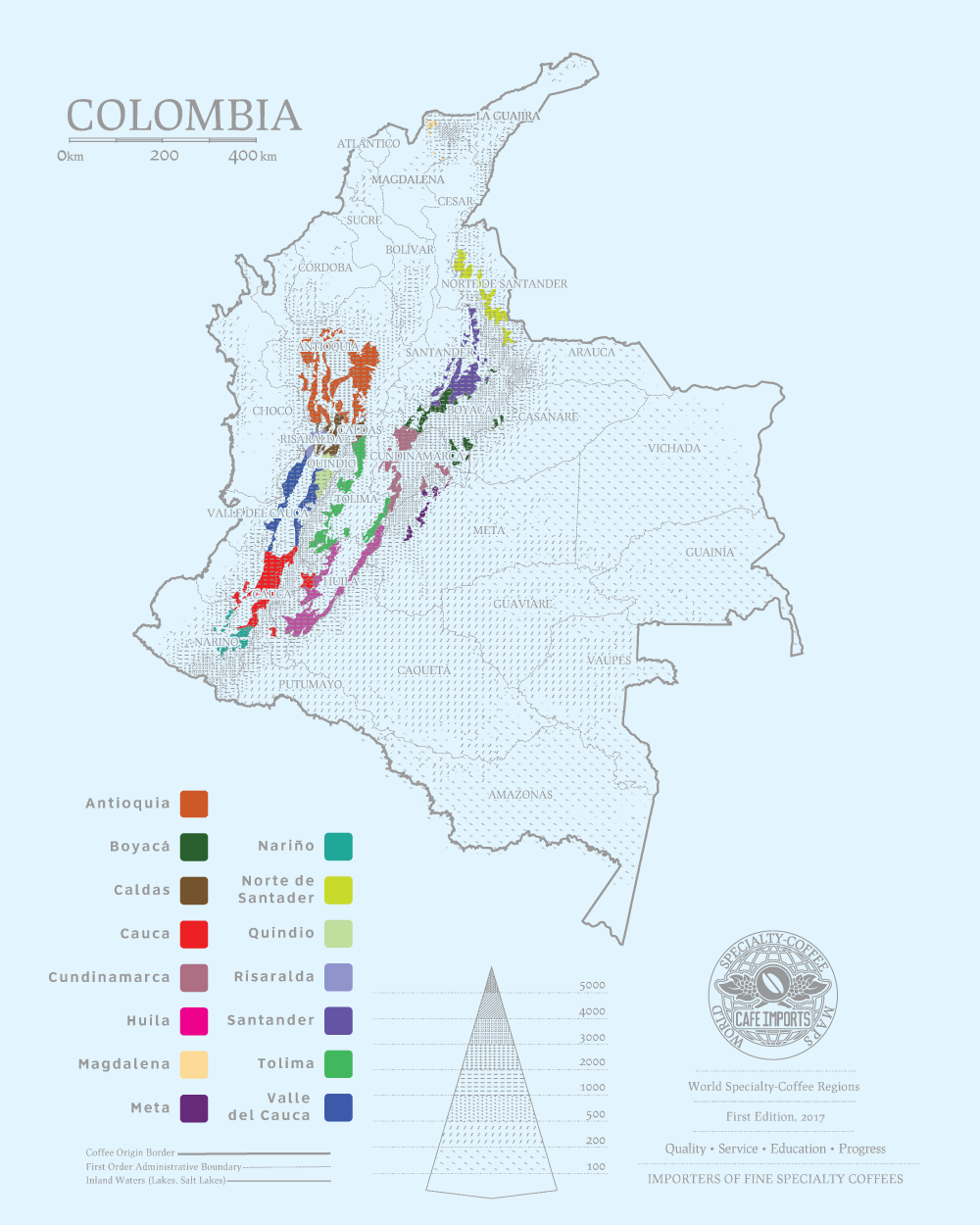
Given Colombia's considerable land area, the country has multiple coffee-growing regions. Because of mountainous terrain and different microclimates, coffee from each region shows a distinct flavor profile. Colombia's most renowned regions currently include Antioquia, Santander, Huila, and Nariño. Among these, FrontStreet Coffee's introductory Colombian coffee selection comes from the Huila region.
Antioquia Region
As the birthplace of Colombian coffee and an important producing area, Antioquia is also the region with the most extensive coffee cultivation, featuring both small producers and large estates.
This region, in northwestern Colombia, has four municipalities in Antioquia province that account for approximately seven percent of Colombia's coffee production, with cultivation areas exceeding 18,000 hectares and 9,800 families involved in production. The region grows numerous varieties, including common ones as well as specialty types such as Pacamara, Castillo, the Colombia variety (named after the country), Gesha, Eugenioides, and Laurina. FrontStreet Coffee has found that coffee produced here shows a subtle sweetness with a refined and mild mouthfeel: sweet and balanced, with herbaceous fruit notes.
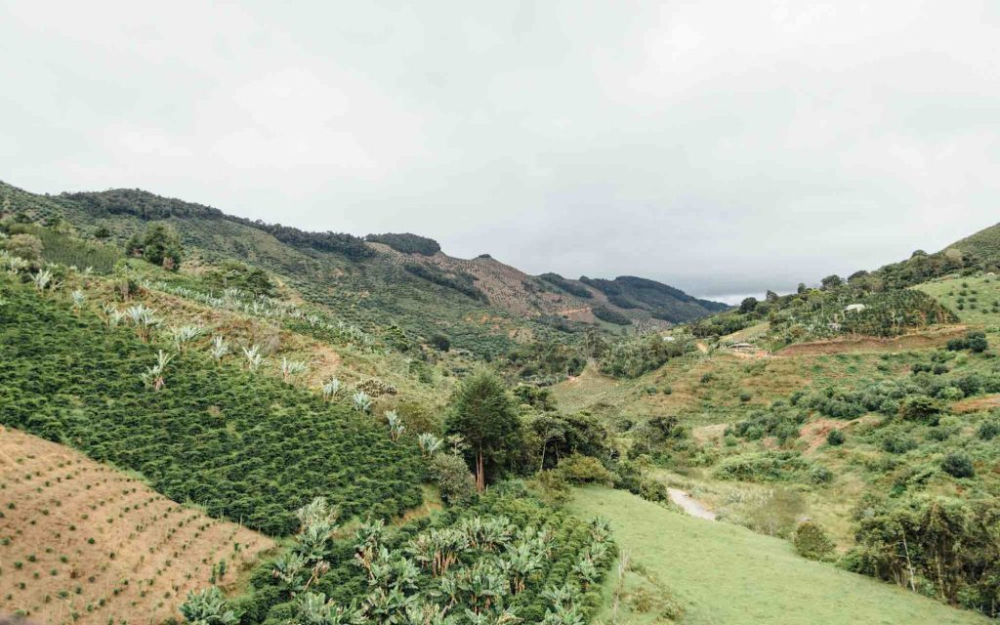
The town of Fredonia, within Antioquia province, saw its first coffee trees planted in 1873, which have been preserved to this day. This area sits in the high mountain regions of the Andes, with cultivation elevations ranging from 1,300 to 2,200 meters. It also borders the Caribbean Sea, giving the region a distinctive climate. Combined with volcanic soil, these conditions enable the production of beans with subtle sweetness: refined, mild, sweet, and balanced, with fruity characteristics.
FrontStreet Coffee Recommendation
Colombia is prized for balance and approachability, and if you enjoy that easy-drinking style, FrontStreet Brazil Cerrado Red Bourbon is a classic single-origin to try. Cerrado is a well-known producing region famed for high-quality beans, and this Brazilian lot is the common South American Red Bourbon variety. A medium roast draws out rich aromas of cream, peanut, toast, caramel, and hazelnut, with a rounded body, no acidity, and a light bittersweet note. It brews as pour-over and also works in a moka pot, espresso SOE, siphon, or French press.
For a fruitier Brazilian expression, FrontStreet Brazil Queen Estate comes from Mogiana, near South Minas, where fertile red volcanic soil lets the cherries take in abundant nutrients and develop full aroma. Its variety is the rare Yellow Bourbon, a natural mutation of Red Bourbon, with a cleaner fruit character. Through pour-over, moka pot, or a home espresso machine, it offers a sugarcane sweetness not found in other regions, along with fruit and chocolate flavors.
Important Notice :
FrontStreet Coffee is a long-established specialty coffee roaster in Guangzhou China, selling freshly roasted beans from its own farm in Yunnan as well as dozens of carefully selected single-origin beans from around the world for both pour-over and espresso. The products deliver consistently excellent quality and great value, with shipping within 24 hours. Guangzhou's FrontStreet Coffee shop is recommended by many coffee lovers, and the beans are now available online at the Tmall 。
FrontStreet Coffee has moved to a new address:
FrontStreet Coffee Address: 315,Donghua East Road,GuangZhou
Tel:020 38364473
 Scan and follow the En Gafei WeChat official account. Please indicate that the reprint comes from "En Gafei".