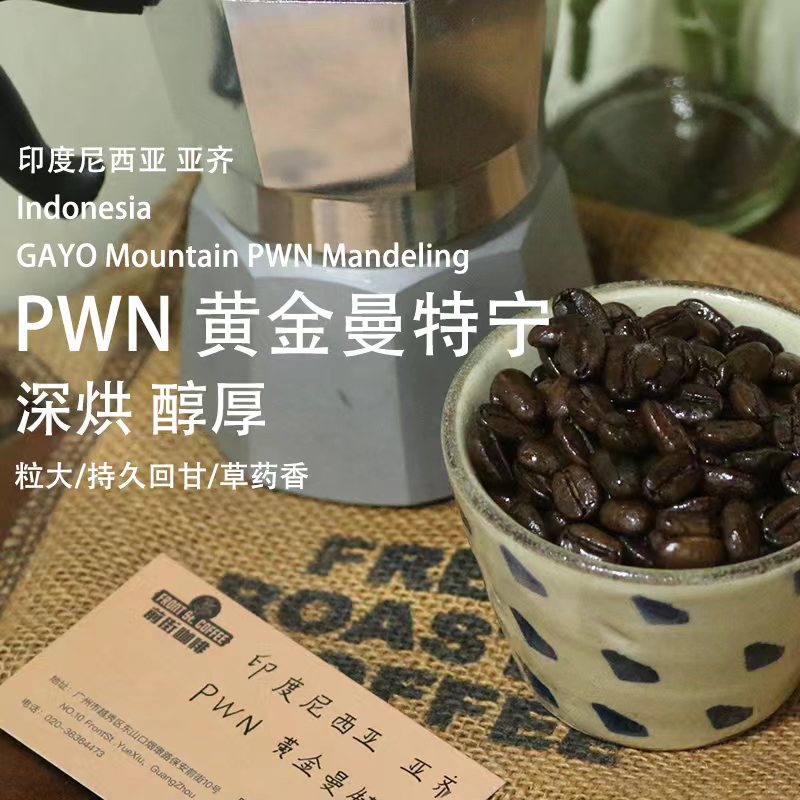
Is the New Season's Golden Mandheling Coffee Variety a Robusta Coffee?

Many people ask FrontStreet Coffee: what actually differs between coffees harvested in different seasons of the same year from the same region? Today FrontStreet Coffee compares the early 2020 season Golden Mandheling with the October season Golden Mandheling, and looks at why the two differ.

What Is Golden Mandheling Coffee?
Back in the day, when Japanese buyers asked local Indonesians what their coffee was called, the locals thought they were being asked about their ethnic group and answered "Mandheling." From then on Indonesian coffee was also known as Mandheling coffee, and the local man who gave that answer was the founder of PWN. The "Golden Mandheling" label is owned and registered by the Indonesian green bean company PWN Company (Pwani Coffee Company), which makes Golden Mandheling exclusive to PWN.
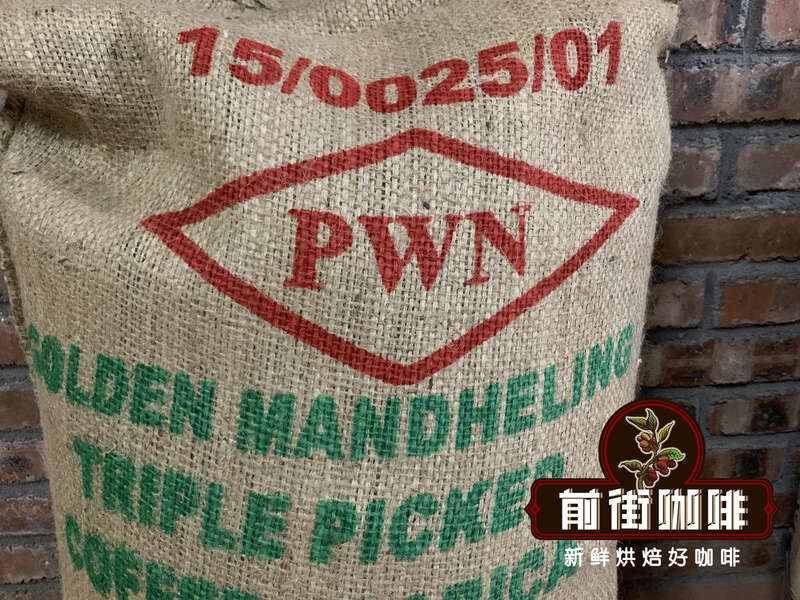
Why Is It Called Golden Mandheling?
The name comes from the claim that, during green bean processing, Mandheling beans give off a golden luster in sunlight — hence Golden Mandheling. Unlike other Mandheling coffees, Golden Mandheling holds to strict screening standards. After processing, the green beans go through density-based color sorting and then four rounds of manual bean selection. The specifications are above 18 mesh, with fewer than 3 defective beans in 300g green bean samples, putting it in the highest G1 grade, with a dark green color and a flat, uniform shape. FrontStreet Coffee's view is that after such strict screening the beans are uniform in size and heat more evenly during roasting. So when brewing Golden Mandheling, FrontStreet Coffee found it not only lacks the earthy impurities typical of regular Mandheling, it also tastes cleaner and more transparent, with stronger sweetness and aroma.

FrontStreet Coffee's Golden Mandheling comes from PWN Company. Golden Mandheling evolved from Mandheling, and it can be understood as premium selected Mandheling — which is why FrontStreet Coffee chose to stock it. FrontStreet Coffee cup-tests 300-500 batches of beans a year and selects the one-fifth with the most regionally representative flavors, and Golden Mandheling is a masterpiece of that selection. We believe it represents the Sumatran style excellently.
Golden Mandheling Coffee Bean Varieties
The variety of the new season Golden Mandheling is "Ateng." That sounds like a very unfamiliar variety, but Indonesian names for coffee varieties are quite different from what we are used to — what Indonesians call Tim Tim, for instance, is what we call Timor. Ateng is the local Indonesian name for Catimor. The Ateng variety is very well suited to growing and developing flavor in the Aceh region. Original Catimor is a hybrid of Arabica and Robusta, so if you ask about the relationship between Indonesian Golden Mandheling varieties and Robusta, Ateng would be the "grandchild" of Robusta.

Wet Hulling Process for Golden Mandheling Coffee Beans
Local weather brings frequent rain and continuous typhoons, so the good weather sun-drying needs is hard to come by. The local economy also cannot support the more expensive washed method. For these reasons the locally distinctive wet hulling method developed: during regular washed processing, the beans are sun-dried with the parchment on for 2-3 days until moisture content reaches 20-24%, then the parchment is removed. The steps fall into two phases. Phase one uses a wooden peeler to remove skin and pulp, ferments for 3 hours, then air-dries until moisture content drops to a semi-dry, semi-wet 30-50%. Phase two removes the mucilage and parchment layers and finishes drying over 2-4 days, bringing moisture content down to 12-13%.
What Are the Differences Between Early Season and October Season Golden Mandheling?
Comparing the early season Golden Mandheling with the October season, FrontStreet Coffee found the May season Golden Mandheling has lower green bean moisture content than the October season. Through shipping, storage, trade, and the roaster's own storage, green bean moisture content can change significantly. Early season beans, roasted in late November, lose moisture as the storage environment shifts. The new October season beans only reach China in late November, with shorter transport and storage time, so their moisture content is naturally higher.

How Does Moisture Content Affect Roasting?
Golden Mandheling is a relatively high-moisture green bean, and it varies more in moisture than sun-dried beans, so dehydration needs special attention. For high-moisture beans, after charging you can immediately close the damper, steam for 30 seconds, then open to level 3 until the beans turn light green or white, then open the damper to level 4, and after first crack open to level 5 (maximum). Golden Mandheling naturally has high moisture content. When the October new season arrives even higher in moisture, how does FrontStreet Coffee's roaster keep both beans on the same profile? The answer: with the same development time and exit temperature, the roaster extends the dehydration time for the October beans, pushing the yellowing point out to 6 minutes and 30 seconds.

How Does Moisture Content Affect Roasted Bean Color?
After FrontStreet Coffee's roaster roasted both Golden Mandheling coffees on the same profile, the early season beans came out slightly darker than the October season. Lower moisture content means faster dehydration and therefore a faster caramelization reaction (which you can think of as color development). Higher moisture content means slower dehydration and slower caramelization. So even exiting at the same temperature and time, there will be slight differences in bean color.

How Does Caramelization Affect Brewed Coffee Flavor?
This brew is meant to highlight Golden Mandheling's traits: rich body, clean taste, and aromatic flavor. A KONO dripper is used (it was invented to mimic the thick coffee you get from a flannel filter). For medium-dark roast coffee, choose a medium-coarse grind (57% passing through standard #20 sieve). For the ratio, use 1:13 — 20g of coffee — tightening the ratio to make the cup richer. Water temperature is 87°C.

FrontStreet Coffee's brewing process: pour slowly over the grounds, keeping them as level as possible and avoiding shaking the dripper (shaking reduces the space between grounds, which works against bloom exhaust). First stage: pour 40g in small circles around the center for a 30-second bloom, and the coffee bed slowly expands into a "hamburger" shape. Second stage: pour 120g in circles from the center outward, keeping the pouring height as close to the bed as possible and moving slowly to avoid over-stirring. Final stage: pour 100g and wait until all the liquid has flowed into the lower pot to finish extraction. Extraction time: 2 minutes.
Brewing Flavor Profiles
Early season Golden Mandheling brews with nuts, spices, herbs, licorice, chocolate, and caramel, in a clean and smooth cup.
October season Golden Mandheling brews with more pronounced acidity than the May season, a subtle black-chocolate-like acidity, nutty and herbal notes, and a caramel-like sweetness in the aftertaste. Overall cleaner than the May season.
FrontStreet Coffee's brewing comparison also shows that the longer the beans caramelize, the richer the coffee flavor.
FrontStreet Coffee Recommendation
The wet-hulled style is what gives Mandheling its distinct personality, and FrontStreet Coffee's Golden Mandheling comes from PWN — the company that owns the name — which holds exceptionally strict standards. Beans are 18 screen size or larger, with fewer than 3 defective beans per 300g green sample to meet the top G1 grade, followed by three rounds of hand sorting that remove defects completely and lift the cup's cleanliness and sweetness. It brews into a clean, full-bodied black coffee that suits anyone who dislikes acidity.
Hand pour is where Golden Mandheling shines: 87-88°C water, 15g of coffee, a 1:15 ratio, and a coarse granulated-sugar grind, poured in three stages — a 30ml bloom to wet the grounds and release gas, then 100ml to bring up the golden crema and raise the bed, and a final soft 95ml poured down the center to lift sweetness, giving a thick body with caramel sweetness and chocolate and nut notes. If you also want it in a milk drink, FrontStreet Coffee's Lindong Mandheling is the everyday counterpart, medium-dark roasted with low acidity and a wild herbal edge, and the Classic Blend layers that same Mandheling character over a Brazilian creamy-nut base with butter, roasted chestnut, and caramel notes for a rich, easy latte or Dirty.
Important Notice :
FrontStreet Coffee is a long-established specialty coffee roaster in Guangzhou China, selling freshly roasted beans from its own farm in Yunnan as well as dozens of carefully selected single-origin beans from around the world for both pour-over and espresso. The products deliver consistently excellent quality and great value, with shipping within 24 hours. Guangzhou's FrontStreet Coffee shop is recommended by many coffee lovers, and the beans are now available online at the Tmall 。
FrontStreet Coffee has moved to a new address:
FrontStreet Coffee Address: 315,Donghua East Road,GuangZhou
Tel:020 38364473
 Scan and follow the En Gafei WeChat official account. Please indicate that the reprint comes from "En Gafei".