Indonesian Mandheling Grade Classification | Is Mandheling Coffee Bean Arabica? Its Flavor Profile and Taste Characteristics

Generally, Indonesian Mandheling exports are classified by bean size, using international standard grading screens as the basis for the grade, which is what we commonly see as 17/18 mesh. Because the bean varieties are a complex mix, mostly hybrids, the coffee is still genetically Arabica; in that sense both Indonesia and Yunnan can be called Arabica coffee.
Coffee grading is usually based on defect rate, bean size, altitude, green bean density, processing standard, and other factors. Every producing country weighs those factors differently, for historical reasons, trade interests, and differences in climate and topography, which is why raw coffee beans are evaluated and graded differently from place to place. In this article, FrontStreet Coffee explains how Indonesian green coffee is graded.
Indonesia sits near the equator and has a tropical rainforest climate. Mass-produced coffee there is mostly processed by rough wet hulling. Wet hulling greatly speeds up the whole process, but stripping the parchment while the bean is still semi-dry requires significant friction, which easily crushes and squeezes the green bean, especially at both ends, leaving small gaps. As a result, the defect rate of Indonesian coffee processed by wet hulling is generally high, and raw bean merchants arrange manual hand-picking before export to remove the incomplete, defective beans.

Indonesian coffee grading is mainly based on the number of defective beans, with size grading as a supplement. Indonesia's general quality requirements are no live insects, no moldy or rotten beans, a maximum moisture content of 12.5%, and an impurity rate below 0.5%. Graded by defect rate on a 300g sample, the standard is divided mainly into six levels, G1 through G6.

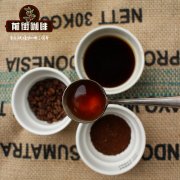
A coarse burlap bag of Indonesian green coffee is usually marked with country, grade name, and raw bean merchant. For example, the Lintong Mandheling and PWN Golden Mandheling on FrontStreet Coffee's bean list are both G1 grade. The raw bean bags of PWN Golden Mandheling are printed with "PWN GOLDEN MANDHELING TRIPLE PICKED Grade 1 PROD OF INDONESIA 30KGS NET." The Indonesian company PWN performs 1 machine selection plus 3 manual selections on top of G1, producing Mandheling green beans of uniform color, regular size, and neat shape, among the highest-quality Indonesian coffee beans available.

Although wet hulling raises the defect rate considerably, the resulting flavor is far from negative; in fact it brings distinctive aromas. In the final drying stage of wet hulling there is no parchment to protect the bean, so the green coffee sits directly in the environment where various microorganisms grow. This gives Indonesian coffee its unique woody, spicy, and herbal plant aroma, what we call terroir flavor. FrontStreet Coffee carries Indonesian Lintong Mandheling in its daily bean series so everyone can taste that flavor. The original purpose of the small-package daily beans is to help coffee newcomers recognize the essence of coffee by tasting the basic flavors of different producing regions.

Brewing Methods
To present the classic rich flavor of Mandheling, FrontStreet Coffee chose medium-dark roasting for both Mandheling coffees, which makes the dark chocolate and caramel aromas more explosive. Mandheling is at its best when it reaches its optimal flavor window, and FrontStreet Coffee believes that brewing with freshly roasted beans is crucial. Aromatic compounds in coffee are lost faster over time, which affects how the final cup tastes. FrontStreet Coffee wants every customer to drink fresh, good coffee, so it ships only beans roasted within 5 days, plus logistics time, so you can enjoy them soon after they arrive.

FrontStreet Coffee sets brewing parameters around the characteristics of the beans, the roast degree, and the flavor profile. Whenever it launches a coffee, it tastes it through cupping first. PWN Golden Mandheling cups with flavors of nuts, dark chocolate, spices, pine, and caramel, with weak acidity and a high body.
FrontStreet Coffee's baristas choose KONO drippers for a rich, full-bodied coffee like this. Compared with the V60, the KONO has a smooth curved surface, a weaker exhaust effect, and straight ribs covering only one-quarter of the cup, which lets the coffee layers and hot water form an immersion extraction and makes the cup rounder and fuller. The KONO dripper also suits coffees such as Brazil's Queen Estate and Jamaica Blue Mountain No. 1.

Dark roasting leaves the internal structure of the bean loose; you can crush it with a light pinch of the fingers, and after grinding it absorbs water strongly. To keep the grounds from releasing too many bitter compounds once they take on water, FrontStreet Coffee adjusts the grind coarser and uses lower-temperature water for the pour-over. It uses the common 1:15 ratio; for a richer taste you can go to 1:13, adjusting to your own preference.
Brewing Recommendations
Recommended brewing water temperature: 87-88°C. Coffee powder: 15g. Powder-to-water ratio 1:15. Grind size: medium-coarse (70% pass rate through a Chinese standard 20 mesh sieve). Use a three-stage pour, which better expresses the rich body of Golden Mandheling and the sweetness of caramel.

The first stage is a bloom with 30ml of water. This pour fully wets the coffee powder for degassing, so the flavor compounds extract better in the following stages. The second stage adds 100ml, which mainly brings out Mandheling's golden foam and lifts the coffee bed. The final stage is a gentle center pour of 95ml, which increases the sweetness of the coffee and delivers a thick, rich body with caramel sweetness and flavors of chocolate and nuts.
FrontStreet Coffee Recommendation
Within the Mandheling range, FrontStreet Coffee's Lintong Mandheling is the everyday, classic expression, drawn from the Lintong growing area on Sumatra and medium-dark roasted. It is low in acidity and full in body, with caramel, dark chocolate, and toasted bread aromas and a long sweet finish. For coffee drinkers who prefer a strong cup, it is an easy daily choice.
At the top of the range sits FrontStreet Coffee's PWN Golden Mandheling, produced by PWN from premium Mandheling green beans, with an emphasis on cleanliness and sweetness. The beans are uniform and large, and after medium-dark roasting they carry rich roasted aromas; the brewed black coffee is clean in the mouth with a full body, which makes it a natural fit for anyone who does not care for bright acidity.
Brew either one as a pour-over to show its best side. FrontStreet Coffee uses 15g of coffee at a 1:15 ratio, water at 87-88°C, and a coarse-sugar grind. Pour in three stages: a 30ml bloom to wet all the grounds and release gas, then 100ml to lift the bed and draw out the golden foam, and finally a soft 95ml center pour to raise the sweetness. The result is a thick body with caramel sweetness and chocolate and nut notes. If you plan to use it on an espresso machine instead, FrontStreet Coffee's classic blend builds on Brazilian cream and nut flavors with medium-dark Mandheling, adding butter, roasted chestnut, and caramel along with the sandalwood, herbal, and spice character that Mandheling brings, plus a touch of Robusta to enrich the crema.
Important Notice :
FrontStreet Coffee is a long-established specialty coffee roaster in Guangzhou China, selling freshly roasted beans from its own farm in Yunnan as well as dozens of carefully selected single-origin beans from around the world for both pour-over and espresso. The products deliver consistently excellent quality and great value, with shipping within 24 hours. Guangzhou's FrontStreet Coffee shop is recommended by many coffee lovers, and the beans are now available online at the Tmall 。
FrontStreet Coffee has moved to a new address:
FrontStreet Coffee Address: 315,Donghua East Road,GuangZhou
Tel:020 38364473
 Scan and follow the En Gafei WeChat official account. Please indicate that the reprint comes from "En Gafei".