How to Rescue Under-extracted Coffee and the Popular Three-Pour Pour-Over Technique
FrontStreet Coffee - Pour-Over Coffee Extraction
For professional coffee knowledge exchange and more coffee bean information, please follow Coffee Workshop (WeChat official account: cafe_style).
When you first start learning pour-over, resist the urge to watch too many technical videos. An overload of guidance will only disrupt your own brewing approach. Begin simply: keep your pouring consistent and learn the basics of blooming, staged pours, and stirring so that extraction stays even. Many baristas pour in circles, which helps hold a steady stream. Beginners often under-extract out of unfamiliarity, ending up with a weak, hollow cup. Once the fundamentals feel natural, you can move on to refining the details, or even break every rule to build an order of your own.
Blooming
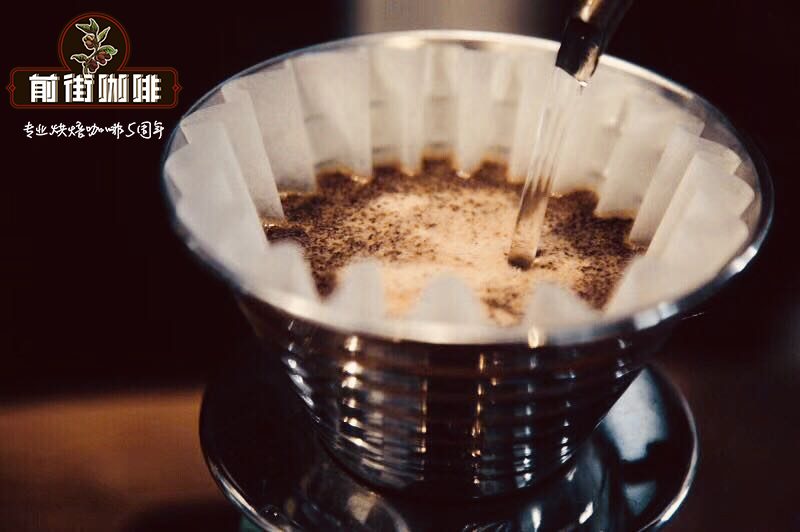
On the first pour, the coffee bed absorbs water and swells into a small mound. This is carbon dioxide, built up during roasting, escaping from the grounds. Light roasts and very fresh beans tend to foam up more, because they usually hold more gas.
Carbon dioxide does nothing to help extraction and can even hinder it, since it repels water and lifts the coffee bed unevenly. Blooming lets that gas escape first, which improves extraction. Gently pour in twice the weight of your grounds. If you are using 15g of coffee, pour 30g of water. Then wait 30 to 45 seconds, until the bloom is finished and the bed begins to settle.
Segmented Brewing & Continuous Brewing
Segmented extraction means dividing the total water into several pours. You can experiment with how much water goes into each pour and how many pours you use. This technique helps prevent channeling, or the water level rising so high that it spills over the edge of the dripper. It also sets the coffee bed gently dancing, creating more even contact with the water.
The alternative is continuous pouring, where the barista keeps a stream going at as constant a flow rate as possible. Continuous pouring aims to hold water volume and saturation as steady as it can, while segmented pouring deliberately introduces variation. When you are tuning your brewing, treat pouring technique as one more variable. Different pouring styles affect extraction in different ways, and that shows up directly in the flavor of the cup. A common and reliable approach is the three-pour method: a bloom, a second pour to the halfway point, and a final pour to your target weight.
Benefits of Segmented Pour-Over:
In filter brewing, segmented pouring can raise the extraction rate compared with a single pour. The main reason is that each pause brings the coffee bed into contact with a fresh, lower-concentration mixture. Water is a better solvent than the cloudy slurry it replaces. That said, more pauses are not automatically better. Depending on the brewing method, an ideal number of pauses runs from 2 to 8. Ironically, in batch brewing the segmented technique is used to adjust brew time, yet it happens to improve extraction as well.
Knowledge Point:
The rate at which soluble material leaves a coffee particle depends on how much surface area the grounds and water have in contact.
About FrontStreet Coffee
In short, FrontStreet Coffee is a research-oriented coffee house that is happy to share coffee knowledge with everyone. Our unreserved sharing exists solely to help more friends fall in love with coffee. We also hold three discounted coffee events every month, because FrontStreet Coffee wants more people to enjoy the best coffee at the lowest price. It has been our mission for six years.
FrontStreet Coffee Recommendation
Once your pour-over routine is dialed in, the coffee itself matters just as much as the technique. For the fast, aromatic extraction that a V60 or similar cone delivers, FrontStreet keeps a set of floral, fruit-forward beans that reward good pouring. FrontStreet's Kenya Little Tomato, a Kenyan washed bean with bright cherry tomato and smoked plum acidity, is a strong match, and the natural Flower Queen brings tropical strawberry and passion fruit that a clean, even extraction shows off beautifully. If you prefer a sweeter, rounder cup, FrontStreet's Strawberry Candy blend of Costa Rican honey-processed coffee and Panamanian washed Geisha is a fine choice for pour-over.
Keep in mind that pour-over rewards freshness. When you order from FrontStreet, the beans arrive recently roasted, so give them a few days to rest, then grind medium-coarse and brew within the window when the aromatics are at their peak. The same basket of fruity, aromatic beans also shines in a Hario V60, whose 60-degree cone and single large opening give the brewer full control over flow, and therefore over the flavor in the cup.
Important Notice :
FrontStreet Coffee is a long-established specialty coffee roaster in Guangzhou China, selling freshly roasted beans from its own farm in Yunnan as well as dozens of carefully selected single-origin beans from around the world for both pour-over and espresso. The products deliver consistently excellent quality and great value, with shipping within 24 hours. Guangzhou's FrontStreet Coffee shop is recommended by many coffee lovers, and the beans are now available online at the Tmall 。
FrontStreet Coffee has moved to a new address:
FrontStreet Coffee Address: 315,Donghua East Road,GuangZhou
Tel:020 38364473
 Scan and follow the En Gafei WeChat official account. Please indicate that the reprint comes from "En Gafei".