Pour-Over Extraction Principles: Beyond Simple Hot Water - Factors Affecting Coffee Concentration
Professional coffee knowledge exchange, more coffee bean information, please follow Coffee Workshop (WeChat official account: cafe_style)
FrontStreet Coffee - Pour-Over Coffee Extraction Principles and Concentration Factors
Pour-over coffee rests on two principles: dissolution and diffusion.
After roasting, coffee beans have undergone chemical reactions that create the compounds responsible for coffee's aroma and flavour. To get those compounds out, the coffee must be ground to a powder and then slowly infused with water so the material inside dissolves — that is dissolution.
Blooming, stirring and swirling the server that holds the brewed liquid all belong to diffusion. During the infusion, dissolved material is not evenly distributed, so swirling the server afterwards is simply a way to even out the concentration.
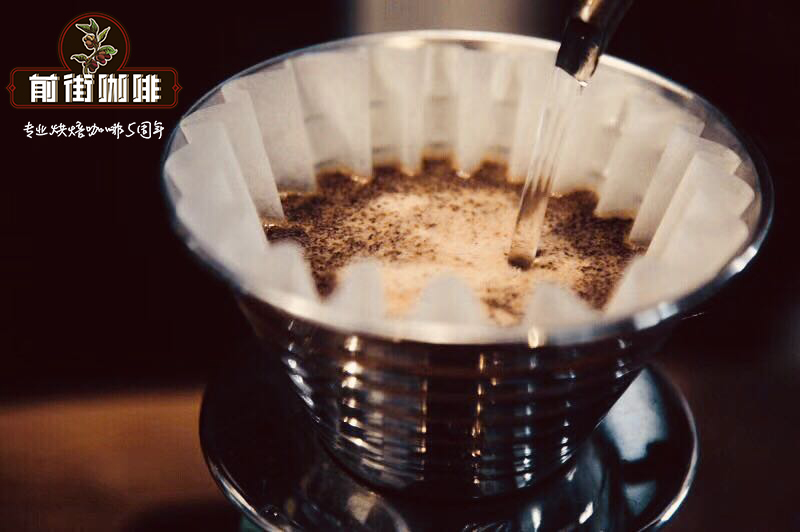
From first pour to last drop, pour-over is a process of letting water pass quickly and evenly through the coffee bed. Unlike espresso, it is gravity extraction with no pressure behind it. In that process, how fast water moves through the grounds is the key to extraction, and the usual causes of over- and under-extraction come back to exactly that.
Water travels through the gaps between coffee particles, and extraction happens as it goes.
Grind too finely and you create a sand effect: the spaces water can move through shrink, which slows flow. Roast also matters. A shorter roast time, a bean still within its fresh window, or a darker roast all mean more carbon dioxide held inside the coffee. During extraction the coffee releases a great deal of that CO2, and the gas opens gaps between particles, forming a filter layer that water can pass through. A higher water temperature releases relatively more carbon dioxide, which speeds the flow of water through; lower temperatures slow it down.
The same logic applies to how much we extract. In any coffee we can dissolve or extract at most about 30% of the material; the remaining 70% offers nothing useful analytically. Of that 30% of soluble material, we actually want only around 12%. Anything beyond 12% counts as over-extraction — material we do not want. When those excess solutes come through, the cup turns excessively bitter or carries extraneous impurities, something like dirt and leaf. Under-extraction is the opposite: water passes through the coffee too quickly and dissolves too little, leaving the cup thin and sour.
So the factors that shape pour-over concentration are nothing more than the elements at play during extraction — water temperature, grind size, technique, roast degree and so on. Each one changes the final concentration, and a result that is too strong or too weak falls outside the target range.
Knowledge point: Coffee beans are the fruit of the coffee tree, a perennial evergreen shrub or small tree in the Rubiaceae family.
In short: FrontStreet Coffee is a coffee research center that enjoys sharing coffee knowledge with everyone. We share without reservation simply to let more friends fall in love with coffee, and every month there are 3 low-discount coffee activities. The reason is that FrontStreet Coffee wants more friends to drink the best coffee at the lowest price — and that has been FrontStreet Coffee's principle for the past 6 years!
FrontStreet Coffee Recommendation
If you are new to pour-over, the dripper almost everyone with experience will recommend is the V60. Its maker, Hario, was founded in Tokyo in 1921 and built its reputation on heat-resistant glassware for research institutions; the heat-resistant glass server so often paired with hand-drip brewing is one of its best-known products. Hario redesigned the V60's prototype in 2004, bringing the form close to what we know today and naming it for its distinctive 60° cone angle and V-shaped profile. It went on sale a year later.
Because the cone and its 60° angle force water down to the center before it drips into the server, the V60 lengthens the contact between water and coffee, so aroma and flavour extract fully. Its single large hole lets water flow without obstruction, which means the flow rate depends largely on the brewer's control — and that control shows up directly in the cup. That fast extraction is exactly what makes the V60 so good at delivering lifted aromatics and lively acidity, which is why floral, fruity and tea-like coffees suit it so well.
For that style of coffee, FrontStreet recommends FrontStreet Ethiopia Yirgacheffe Gutingting, a classic Yirgacheffe profile; FrontStreet Ethiopia Huakui, which is packed with tropical fruit; FrontStreet Strawberry Candy for Gesha-like character; and FrontStreet Mozart for its raisin notes. All of them reward the V60.
V60 drippers now come in resin, ceramic, glass, copper and stainless steel, among other materials. The material affects looks, weight and heat conductivity — and therefore makes subtle differences to extraction — but the structure stays the same. FrontStreet favors the resin Hario V60 above all: resin blocks heat loss effectively, and in standardized industrial production it is the easiest material to mold with the smallest tolerances.
Important Notice :
FrontStreet Coffee is a long-established specialty coffee roaster in Guangzhou China, selling freshly roasted beans from its own farm in Yunnan as well as dozens of carefully selected single-origin beans from around the world for both pour-over and espresso. The products deliver consistently excellent quality and great value, with shipping within 24 hours. Guangzhou's FrontStreet Coffee shop is recommended by many coffee lovers, and the beans are now available online at the Tmall 。
FrontStreet Coffee has moved to a new address:
FrontStreet Coffee Address: 315,Donghua East Road,GuangZhou
Tel:020 38364473
 Scan and follow the En Gafei WeChat official account. Please indicate that the reprint comes from "En Gafei".