Which Coffee Beans Are Suitable for Pour-Over? Introduction to Sumatra Aceh Mandheling Specialty Coffee

Flavor Characteristics and Story of Sumatra Coffee Beans
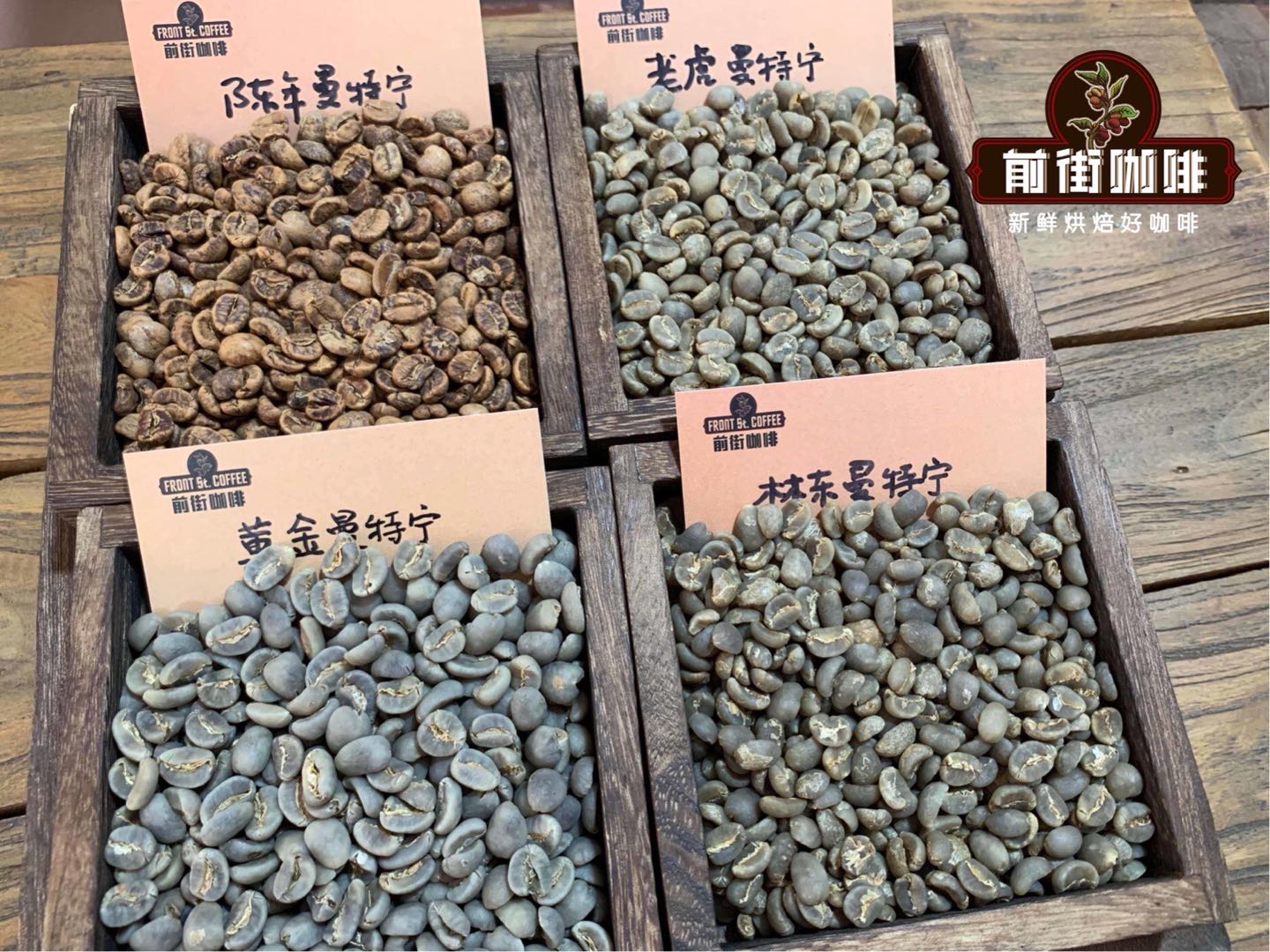
Mandheling has always been famous for its rich body and herbal notes, and when you hear the name you probably think first of Golden Mandheling. But Mandheling is hardly a single product. Among the lots FrontStreet Coffee sources, the Mandheling lineup includes three others alongside Golden Mandheling: Lintong Mandheling, Tiger Mandheling, and Aged Mandheling. Lintong Mandheling is the house pour-over that represents Mandheling's core flavor; Tiger Mandheling is more niche, with an aroma even richer than Golden Mandheling's; and Aged Mandheling, through patient storage over years, develops a deeper, mellower character still.
Indonesia is an archipelagic nation in Southeast Asia, a scatter of more than ten thousand islands strung along the equator from Malaysia to Papua New Guinea. It has always been a coffee giant: according to World Coffee Organization figures, in 2015 Indonesia produced 12.317 million bags of green beans — the second-largest producer in Asia (after Vietnam) — with 70-80% of it robusta. Robusta resists disease well but tastes inferior to arabica, yet it remains the backbone of Indonesian coffee, making up as much as 90% of production and concentrated in the lowlands of Java and Bali. Around 90% of Indonesian coffee comes from independent small farms, and because coffee is valuable, farmers often plant it in their own backyards. Fully 11 million Indonesians depend on coffee for their livelihood.

Sumatra coffee has been sold at Starbucks since 1972, and its intense earthy aroma and heavy body remain flavors unique to the island — though dark roasting leaves the herbal bitterness lingering long on the palate. FrontStreet Coffee recently sourced Sumatra beans specifically for tasting and evaluation. Tasting has always been core practice here: the original aim was never just to sell beans, but to drink coffees from around the world — every origin, every variety within an origin, every processing method for the same variety — building databases and cross-regional comparisons so that more enthusiasts can understand the world of coffee.

The "Two Lakes, Two Mandhs" of Mandheling
When people say "Mandheling," they're really talking about the "two lakes, two Mandhs": the Lake Toba region of northern Sumatra (Lake Toba, Lintong) started cultivation earlier and is known as "Old Mandheling," while the Lake Tawar region of Aceh Province (Lake Tawar, Mount Gayo) began later and is the "Young Mandheling."
Development of Sumatra Coffee
Indonesia's coffee history reaches back to 1696, when Dutch plantation owners hunting for new growing grounds settled on Java. Thirty years later, Indonesia had built a solid footing in the world coffee market. Today the country's flagship is Mandheling — hardly a surprise, since much of the Java coffee originally exported to Europe actually came from Sumatra, and Mandheling is a Sumatran product. Sumatra is, in every sense, one of Indonesia's most important coffee regions.
The Story Behind Mandheling Coffee Beans
"Mandheling" was originally the name of an Indonesian tribe. After Japanese soldiers returned home from the occupation of Indonesia, they couldn't forget the delicious local coffee, and through trading connections they asked locals to help gather high-quality beans — including this "Mandheling" lot. The Japanese loved the beans, but since the commercial source couldn't easily be disclosed, the locals casually offered up the name "Mandheling," and it accidentally became the variety's name forever. That local contact was in fact the owner of Indonesia's PWN company (Pwani Coffee Company), the first firm to export Golden Mandheling to Japan. FrontStreet Coffee has used PWN Golden Mandheling for many years; PWN has since switched from 60kg to 30kg bags, and the sourcing area moved from Lintong to Mount Gayo.

Sumatra Coffee's "Special" Processing Method: Wet-Hulling
Nearly all Mandheling uses Sumatra's signature processing method: wet-hulling. The local weather is rainy and typhoon-prone, making the long sunny stretches needed for natural drying unreliable, and the local economy historically couldn't afford the water demands of full washed processing. Hence the distinctive wet-hulled method. These days Indonesia is no longer poor — plenty of estates could wash their coffee — yet wet-hulling survives, because FrontStreet Coffee believes it is precisely what made Mandheling famous worldwide. Say "Mandheling" and people think "wet-hulled"; the two prop each other up.
The specific steps of wet-hulling fall into two stages:
Stage one: remove skin and pulp, ferment briefly (about 3 hours), then dry until moisture drops to 30-50% (semi-dry, semi-wet).
Stage two: machine-hull away the mucilage and parchment while the beans are still soft, then continue final drying for 2-4 days until moisture reaches 12-13%.

Beyond conventional wet-hulling there is also aged wet-hulling: beans are wet-hulled normally, then sealed in warehouses for 2-3 years. The warehouse must be cool and ventilated, with the beans turned regularly to prevent mold. Over time the acidity fades and converts toward sugar, and the beans darken to yellowish-brown or deep brown. The aged lot on FrontStreet's menu made this way is called Aged Mandheling — also known as Aged Sumatra.
Wet-hulling creates Mandheling's special flavor; the bean and the method are bound together. Over the years FrontStreet has collected four different wet-hulled Mandhelings and currently keeps two on the menu: FrontStreet Lintong Mandheling and FrontStreet PWN Golden Mandheling.
Lintong Mandheling
Lintong Mandheling comes from the Lintong highlands of north-central Sumatra near Lake Toba. It's the regular, everyday version of Mandheling, processed with conventional wet-hulling, which gives it low acidity and high body. A quirk of wet-hulling is that when semi-hard, semi-soft wet green beans are hulled, they crush easily and split like sheep's hooves — the famous "goat hoof beans." FrontStreet regards these as a distinctive hallmark of Mandheling, not a defect.

Lintong isn't screened especially strictly — you'll find goat hoof beans among the green — but that has never dimmed anyone's love for its rich flavor.
Golden Mandheling
"Golden Mandheling" is an exclusive brand of Indonesia's Pwani Coffee Company (PWN). The market is crowded with Mandheling products of every name, but since PWN registered "Golden Mandheling" as its trademark, only coffee produced by PWN is truly Golden Mandheling in the strict sense. You can verify authenticity by the green-bean sacks bearing the PWN logo and the certificate of origin signed by the company — FrontStreet displays both at its Dongshankou store.

Back in the day, the Japanese took a fancy to Sumatra coffee and bought it long-term, only to find quality fluctuating wildly. So they imposed strict standards on Mandheling production, screening by density, size, shape, and color, and requiring both machine and hand removal of defects — yielding beans that were complete, uniform, large, and translucent, with the earthy and grassy edge tamed. Legend has it the polished beans shone golden in the sun, hence "Golden Mandheling."

FrontStreet's Golden Mandheling spec: screen 18 and above, fewer than 3 defective beans per 300g green sample — the highest G1 grade — with a deeper green color and a regular, flat bean shape. After that strict screening, FrontStreet found not only had the characteristic earthy muddle of ordinary Mandheling vanished, the cup tasted cleaner and more translucent, with noticeably stronger sweetness.
To Experience the Unique Aroma of Indonesian Sumatra Coffee, Try FrontStreet Golden Mandheling Pour-Over
To bring out Golden Mandheling's rich aroma, FrontStreet insists on freshly roasted beans as the first condition — aroma shifts with storage time and environment, and past the optimal window it dissipates fast. FrontStreet therefore ships everything roasted within 5 days, so beans arrive ready to open and brew.

Because Mandheling leans on nut and chocolate notes, FrontStreet's roaster chooses a medium-dark profile. The darker the roast, the more porous the bean and the easier it extracts — so FrontStreet brews with a lower water temperature to avoid the harsh bitterness of over-extraction.
Brewing Parameters:
Dripper: KONO dripper
Water Temperature: 87°C
Dose: 15 grams
Ratio: 1:15
Grind Size: Medium-coarse (70% pass rate on the Chinese standard #20 sieve)
Rinse the KONO dripper so the filter paper seats snugly, empty the sharing pot, and add 15g of ground coffee. Pour 30g of water to bloom for 30 seconds, then pour in small circles from the center up to 125g and pause. When the coffee bed drops to half the height of the dripper, pour the second stage with the same technique up to 225g. Once all the dripping finishes, remove the dripper.

The ground Golden Mandheling smells of nuts and toasted bread; during the brew you can catch the sweet scent of caramel. In the cup there's spice and dark chocolate, a rich yet clean mouthfeel, an obvious sweet aftertaste, and a finish that just won't quit.
FrontStreet Coffee Recommendation
Of all the pour-over-friendly beans in the world, Sumatran Mandheling earns its place through sheer body and aroma. FrontStreet's PWN Golden Mandheling is the pinnacle: an 18-screen-plus, sub-3-defect G1 lot from PWN — the company that invented the name — triple hand-sorted for a cup that trades Mandheling's usual earthiness for black chocolate, caramel sweetness, herbal spice, and a thick, clean, enduring finish. Brew it at 87°C, 15g to 225g through a KONO dripper, medium-coarse, and it rewards you from the first dry fragrance to the last drop.
For a different face of the same island, FrontStreet's Lintong Mandheling from the Lake Toba highlands is the everyday classic — low acidity, heavy body, goat hoof beans and all — while patient drinkers should seek out the Aged Mandheling, wet-hulled then mellowed 2-3 years in cool, ventilated warehouses until the acidity melts into sugar and the beans turn deep brown: an unmistakably wild, spiced, old-school cup.
Important Notice :
FrontStreet Coffee is a long-established specialty coffee roaster in Guangzhou China, selling freshly roasted beans from its own farm in Yunnan as well as dozens of carefully selected single-origin beans from around the world for both pour-over and espresso. The products deliver consistently excellent quality and great value, with shipping within 24 hours. Guangzhou's FrontStreet Coffee shop is recommended by many coffee lovers, and the beans are now available online at the Tmall 。
FrontStreet Coffee has moved to a new address:
FrontStreet Coffee Address: 315,Donghua East Road,GuangZhou
Tel:020 38364473
 Scan and follow the En Gafei WeChat official account. Please indicate that the reprint comes from "En Gafei".