How to Make Black Coffee at Home - Is Pour-Over Coffee Black Coffee? Brewing Tutorial
FrontStreet Coffee · Introduction to Pour-Over Coffee Process
There are three classic ways to make black coffee at home, giving you three kinds of brewers: manual drip, siphon, and electric drip. Manual drip is the most primitive method and uses the simplest tools - a cone, filter paper, and a vessel below. It demands the most skill of your hands, but done well it produces exceptional coffee with true-to-origin flavor, and the gear is cheap - just a dozen or so yuan. Drip brewing suits enthusiasts with a steady hand and a sensitive palate. One detail matters when buying: whether the dripper has three holes or one.
Three-hole drippers flow faster and extract for less time, giving a lighter cup; one-hole drippers do the opposite. Siphon brewers work on the siphon principle: heated from below by an alcohol burner, once the water in the lower bowl reaches 92°C it is pushed up into the upper bowl holding the grounds; after steeping and a gentle stir, the finished coffee travels back down the same path. The extra agitation makes a stronger-tasting black coffee, and because no manual flow control is needed the method is relatively foolproof - such brewers typically run one to two hundred yuan. Electric drip makers cost about the same as siphons and simply boil water electrically to brew. It is the simplest route to black coffee, but brewing at a rolling boil costs a little in the cup; electric machines suit people who like a refined lifestyle but value convenience, and common models run from one hundred to three or five hundred yuan.
Though manual drip is the simplest method, it preserves coffee's original flavor best. Brewing demands precise control of water temperature, flow rate, and pour pattern. Even flow in steady circles lets the coffee taste natural, so the kettle you choose and how you pour both matter greatly. When water meets the grounds, keep a circular pattern, spiraling from the outside in and the inside out repeatedly, so coffee and water make thorough contact. Meanwhile, water at 90-92°C draws out the coffee's fragrance, body, sweetness, acidity, and bitterness evenly and intensely. Water that is too hot scorches the coffee, leaving it sour and astringent; too cool, and the rich aromatics never fully extract.
Step 1: Preparation
Prepare hot water and weigh 18 g of coffee beans (using a 1:15 water-to-coffee ratio as an example). Fold the filter paper and seat it in the dripper, then rinse both with hot water: filter paper carries a papery taste, and rinsing keeps it out of your cup while helping the paper fit snugly against the dripper walls (key technique 1).
Step 2: Preheating
Warm the dripper and the server together so the coffee does not cool during filtration - temperature has a real effect on flavor.
Step 3: Grinding
Grind to a raw-sugar-like consistency, pour the grounds into the dripper, and tap it gently to level the bed for even extraction.
Step 4: Blooming
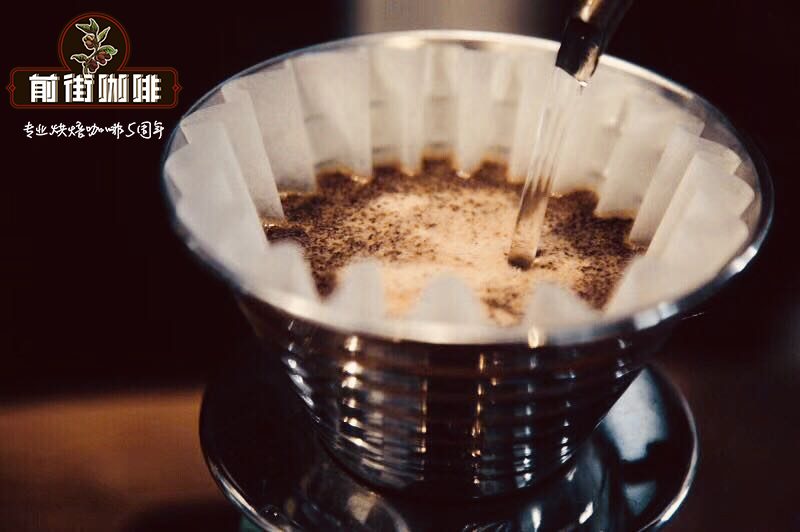
Slowly pour hot water of about 90°C - adjust for roast level and grind fineness - onto the center of the grounds, avoiding the filter paper itself (key technique 2; perfecting flow rate and speed takes practice). Once the grounds are moistened and coffee begins dripping into the server, stop pouring and let it bloom for 30-45 seconds (key technique 3). Blooming releases the gases trapped in the coffee (mainly carbon dioxide); once degassed, the particles absorb water evenly and extract uniformly. Visually, you will see the bed swell.
Step 5: Brewing
After blooming, resume pouring in circles from the center outward, in one pour or several. Keep the flow gentle and continuous - mastering it takes the same professional practice as any other technique.
Now the grounds filter fully, releasing oils, soluble compounds, and aromatics in an unbroken stream that fills the room with an intoxicating fragrance.
Step 6: Completion
Stop when the scale reads 270 g. Warm your cup, and enjoy.
Knowledge Points
The keys to a delicious cup of pour-over are grind size, water temperature, and the coffee-to-water ratio - more variables to master than with machine brewing, and more control as your reward.
FrontStreet Coffee Recommendation
FrontStreet Coffee Recommendation: Beans for Your V60
If you are new to pour-over and ask a knowledgeable friend for a practical, good-looking dripper, chances are they will point you to the V60. Its maker, Hario, was founded in Tokyo in 1921 as a producer of heatproof glassware for research laboratories - the glass server that pairs with every pour-over setup is one of its signature products. In 2004 Hario redesigned the V60 prototype into the shape we know today, naming it for its unique 60-degree cone and V-shaped profile, and launched it the following year. The conical 60-degree geometry forces water to flow to the center before dripping through, extending contact time between water and grounds so aroma and flavor extract fully; the single large hole leaves the flow unimpeded, so drain speed depends almost entirely on the brewer's pour control - and shows up directly in the cup. Before the 2000s, coffee favored medium-dark roasts and full-bodied, caramelly profiles - chocolate, maple, nuts, vanilla - best expressed in siphons and cloth filters, the era of FrontStreet Coffee's Blue Mountain No.1 and PWN Golden Mandheling. The third wave brought a hunger for origin character - Ethiopian white florals, Kenyan berry acidity - and the V60's fast extraction renders florals, fruit acids, delicate sweetness, and tea-like notes in vivid relief, which is why floral-fruity beans suit it so well. V60s now come in resin, ceramic, glass, copper, and stainless steel; each material changes looks, weight, and heat retention subtly, but the geometry stays the same. FrontStreet Coffee favors the resin Hario V60: it holds heat well, and in industrial mass production resin molds most precisely, with the smallest tolerances.
For light roasts, start with FrontStreet Coffee's Yirgacheffe Idido from Ethiopia - bright citrus, berry, and floral notes with a green-tea-like finish, its acidity soft and fruity rather than harsh, a gentle first step into pour-over. The Ethiopian Hua Kui (Flower Queen) is one of the most successful stars of recent years: tropical aromas of strawberry, passion fruit, jackfruit, and lychee, obvious sweetness with almost no bitterness, and a juicy smoothness that earns it the description "the least coffee-like coffee." For a legend, the Panama Esmeralda Red Label Geisha offers exquisite jasmine, citrus, bergamot, and black-tea refinement with a clean, transparent body and long finish. And the Kenya Cherry Tomato, a washed lot from the Thika region grown at 1,550-1,750 m on SL28 and SL34 and washed with Kenya's signature 72-hour double fermentation, delivers vivid sun-dried tomato and dried-plum acidity, full fresh-juice body, notes of pear and black plum, and a clean finish of yellow sugar and green tea.
For medium-dark roasts, the PWN Indonesian Golden Mandheling pours low in acidity and long in body - herbal, dark chocolate, and a whisper of earth - while the Brazil Queen Estate balances nuts and cocoa with clear caramel sweetness and superb crema, a benchmark everyday bean for pour-over, espresso, or moka pot. Jamaica Blue Mountain No.1 strikes the near-perfect balance that makes it "the specialty coffee almost everyone loves": cream, caramel, chocolate, nuts, honey, and a light fruitiness in a soft, rounded cup. The Yunnan 2013 Natural Typica - which FrontStreet Coffee has carried since 2013 - is clean and layered, citrus and caramel woven with nuts, chocolate, and red sugar at a medium-dark roast. Finally, the Papua New Guinea Paradise Bird from the Sigri region, grown at 1,600-1,800 m on volcanic soils from Blue Mountain-derived Typica, reaches AA grade with triple washed fermentation - so close to Blue Mountain in character that fans call it "little Blue Mountain," and another fine choice for those who avoid acidic coffee.
Important Notice :
FrontStreet Coffee is a long-established specialty coffee roaster in Guangzhou China, selling freshly roasted beans from its own farm in Yunnan as well as dozens of carefully selected single-origin beans from around the world for both pour-over and espresso. The products deliver consistently excellent quality and great value, with shipping within 24 hours. Guangzhou's FrontStreet Coffee shop is recommended by many coffee lovers, and the beans are now available online at the Tmall 。
FrontStreet Coffee has moved to a new address:
FrontStreet Coffee Address: 315,Donghua East Road,GuangZhou
Tel:020 38364473
 Scan and follow the En Gafei WeChat official account. Please indicate that the reprint comes from "En Gafei".