How to Brew Ground Coffee for Great Taste - Standard Pour-Over Coffee Steps
Professional coffee knowledge, shared without reservation — here is a complete walkthrough of standard pour-over technique, from bean prep to the final sip.
FrontStreet Coffee - Brief Introduction to Pour-Over Coffee Steps
Bean Preparation
Start by weighing out the beans according to your needs. The standard pour-over extraction ratio is 1:15, though you can adjust to taste — 1:10 or 1:13 also work. Dilute it much further and the cup drifts toward black-tea territory: still fragrant, but noticeably lighter in coffee character. I typically use 30 grams of beans (a scale helps here) to brew 450ml of coffee. Load the beans into the grinder, and the preliminary prep is done.
Water Heating
As a rule of thumb, pour-over water temperature should not exceed 90 degrees Celsius. Hotter water extracts faster, and high temperatures tend to pull out undesirable flavors — most notably a more pronounced bitterness. Heating the water to somewhere between 85-88 degrees Celsius is generally sufficient.
Tool Preparation
Filter drippers come in many shapes: fan-shaped, bowl-shaped, and conical. I usually go with the V60 conical dripper. Its cone geometry forces the water to flow toward the center before draining into the server, which extends the contact time between water and grounds, promotes even extraction, and produces a relatively uniform bloom — the key to extracting the coffee completely. For pour-over you'll need a dripper, a gooseneck kettle, a server, and filter paper. First fold the paper's edge seam, open it up, and set it in the dripper. Then, holding the paper in place, pour hot water from the kettle along the wall to rinse it, so the paper clings closely to the wall — this preheats the setup and seats the paper evenly. Discard the rinse water from the server afterward.
Brewing Process
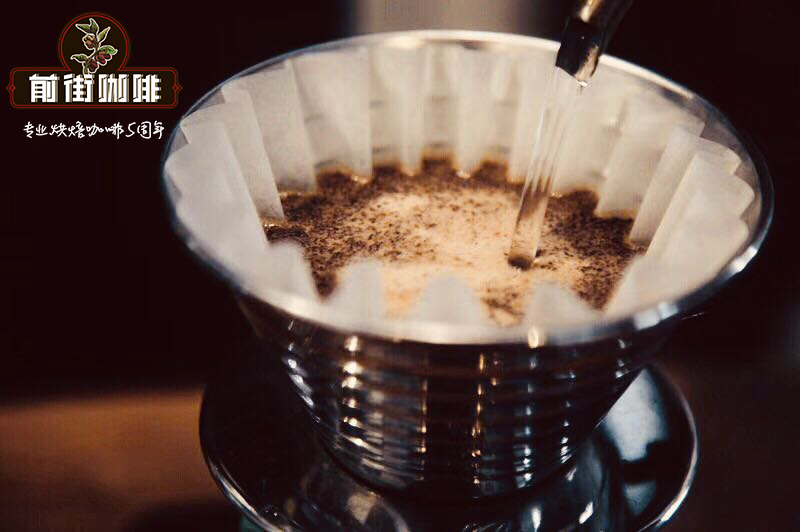
Grind the beans and pour the grounds into the filter paper. Gently tap the side of the dripper to level the bed. Aim the kettle spout at the center of the grounds and pour evenly outward until the grounds are completely saturated — taking care not to pour onto the exposed filter paper. The bloom water-to-coffee ratio should be about 2:1, so for 30 grams of grounds use roughly 60 grams of water. Once the grounds are fully wetted, lift the kettle and wait about 30 seconds, until the bed bubbles up and then collapses, before starting the second pour.
Second and Third Pour
The second pour should total roughly four to five times the weight of the grounds — around 190 grams of water. Pour evenly, and be careful never to let the water level rise more than 5mm above the grounds; this ensures full extraction while keeping undesirable flavors from washing through. Wait for the water to finish dripping, then make the third pour. It resembles the second, but slightly faster. Once the water-to-coffee ratio reaches 1:15, stop pouring, remove the dripper from the server, and the brew is complete.
Tasting and Appreciation
Pour-over coffee generally suits medium to light roasts. After brewing, give the server a gentle swirl before dividing into cups so every serving tastes the same. Before drinking, smell the aroma first — fruity or otherwise. Then take a small sip, letting the coffee flow between your teeth, and pay attention to its sour, sweet, bitter, and astringent dimensions. When I taste coffee, I follow its stages: does the start show pronounced bitterness, is the entry acidic or mellow, do layers begin to emerge mid-palate, and does the aftertaste turn sweet or bitter? The second sip can be a bigger gulp. As for personal preference — that can be shaped entirely through extraction.
Key Points
The choice of grounds, roasted beans, and roast degree all affect the taste of pour-over coffee. Choose medium or light roast according to your own preference.
In Summary
FrontStreet Coffee is a specialized coffee establishment that enjoys sharing coffee knowledge with everyone. We share without reservation only to help more friends fall in love with coffee. This has been FrontStreet Coffee's mission for the past 6 years!
FrontStreet Coffee Recommendation
The V60 dripper is the first recommendation most experienced brewers will give a pour-over beginner, and for good reason. Its designer, Hario, was founded in 1921 in Tokyo as a maker of heatproof laboratory glassware — the heat-resistant glass server that pairs with pour-over brewing is one of its signature products. In 2004 Hario redesigned the V60 into the form we know today, named for its distinctive 60-degree cone angle and "V" shape, and released it the following year. The single large outlet lets liquid flow unimpeded, so the extraction speed depends almost entirely on the brewer's pour control — which is precisely why the V60 rewards practice. Its fast extraction style brings out three-dimensional aroma and lively acidity, making it ideal for the floral-and-fruit coffees that define the third wave of coffee: the classic Yirgacheffe character of FrontStreet's Guodingding, the tropical fruit abundance of FrontStreet's Huakui, the Geisha character of FrontStreet's Strawberry Candy, and the raisin notes of FrontStreet's Mozart. While the V60 comes in ceramic, glass, copper, and stainless steel versions, FrontStreet favors the resin one: resin effectively blocks heat loss, and in mass production it holds the tightest dimensional tolerances.
As for which beans to load into that V60, light roasts are a natural fit. FrontStreet's Yirgacheffe Guodingding is a favorite first step into specialty coffee, with vivid citrus, berry, and floral notes and a green-tea-like sweetness — its acidity is soft and bright rather than sharp. FrontStreet's Ethiopia Huakui is one of the most successful stars of recent years: striking tropical fruit aromas of strawberry, passion fruit, jackfruit, even lychee, with obvious sweetness, very low bitterness, and a juicy mouthfeel. At the top of the range, FrontStreet's Panama Esmeralda Red Label Geisha offers elegant jasmine florals, citrus, bergamot, and black tea in a clean, transparent cup with a long finish. If you prefer something bolder, FrontStreet's PWN Indonesian Golden Mandheling takes a dark roast with low acidity, a full-bodied herbal and dark-chocolate character, and just a whisper of earth, while FrontStreet's Queen Estate Brazil stays balanced with rich nut and cocoa aromas and clear caramel sweetness — excellent for pour-over, espresso, or moka pot alike.
Important Notice :
FrontStreet Coffee is a long-established specialty coffee roaster in Guangzhou China, selling freshly roasted beans from its own farm in Yunnan as well as dozens of carefully selected single-origin beans from around the world for both pour-over and espresso. The products deliver consistently excellent quality and great value, with shipping within 24 hours. Guangzhou's FrontStreet Coffee shop is recommended by many coffee lovers, and the beans are now available online at the Tmall 。
FrontStreet Coffee has moved to a new address:
FrontStreet Coffee Address: 315,Donghua East Road,GuangZhou
Tel:020 38364473
 Scan and follow the En Gafei WeChat official account. Please indicate that the reprint comes from "En Gafei".