Which Brand of Single-Origin Black Coffee is the Purest? The Citrus & Tea-like Floral Aroma of Panama Emerald Red Label Geisha
FrontStreet Coffee - Introduction to Panama Finca La Esmeralda Red Label
Geisha is a rare coffee variety and the undisputed king of today's specialty coffee scene. It has repeatedly taken first place in green-bean competitions around the world and is frequently chosen by barista competitors who go on to place well.
Geisha's rise to fame is directly tied to Panama's Finca La Esmeralda. It was La Esmeralda that entered Geisha in the SCAA 2005 International Green Bean Competition, where it won first place and became known worldwide.
Each year, Finca La Esmeralda carefully selects Geisha from 12 different plots for a global online auction. Because the auction lots are marked in red, they are commonly known as Red Label Geisha. Their public auction mechanism has repeatedly set world records for the most expensive coffee beans.
At FrontStreet Coffee, we have long believed that for brands and intellectual property in consumer goods, the product itself is of course the most important factor. A single estate may produce large volumes and occasionally turn out a championship-level lot, but that only reveals its ceiling. What deserves closer inspection is its floor - the consistency that determines whether an estate is genuinely top-tier.
La Esmeralda's highest-grade beans are naturally its auction Geisha lots. Two auctions feature La Esmeralda's auction batches: the Esmeralda Special Auction, where we successfully bid on Es-W-1 and Es-N-1 this year, and the Best of Panama Auction (BOP Auction), where we successfully bid on BOP-GN-4 from La Esmeralda. On our packaging we have applied the golden circles of La Esmeralda's auction batches.
Before 2018, La Esmeralda Red Label was whatever remained after the auction lots were taken. Since then it has been completely separated by plot. It is designated as Geisha grown at altitudes of 1,600-1,800 meters above sea level, offered in three processing methods: washed, natural, and a special process. This year we purchased four Red Label varieties: Mario Natural, Fundador Natural, Mario Washed, and Leon SP.
Knowledge Expansion
The Geisha variety was discovered in the Geisha forest of Ethiopia in 1931 and later sent to the Coffee Research Institute in Kenya. From there it was introduced to Uganda, Tanzania, and Costa Rica, where it performed only modestly. It was not until it was transplanted to Panama in the 1960s that it made a spectacular breakthrough after nearly half a century of cultivation.
FrontStreet Coffee Recommendation
La Esmeralda's Red Label Gesha shows why plot-level traceability matters: a single estate can taste strikingly different from one parcel to the next. FrontStreet Coffee follows the same logic, offering several Gesha lots that let drinkers explore the variety from both Panama and its Ethiopian homeland.
At the top of the Panamanian line are the FrontStreet Emerald Red Label and Green Label Gesha. The Red Label, formally Esmeralda Special, is grown at 1,600-1,800 meters, must cup above 90 points for every lot, and comes from a single plot; the FrontStreet Red Label is drawn from the Harimiyo plot, so each batch carries its own fine distinctions. The Green Label, originally Private Collection, blends several plots and emphasizes the estate's signature high-altitude Gesha character at a friendlier price, making it the better value. Beginners who want a first taste of the famous Gesha profile can start with the FrontStreet Boquete Gesha, an entry-level Panamanian lot with orange-blossom honey, an oolong tea body, and delicate fruit acidity. On the Ethiopian side, the FrontStreet Gesha Village Gold Label is the Gesha 1931 variety, about 10% of the village's output and its finest non-auction coffee, while the FrontStreet Gesha Village Red Label is the Gori Gesha variety at roughly 15% of production and scores 88 or above on the SCA 100-point scale. Single-variety drinkers might also try the FrontStreet Grana Geisha from Ethiopia, whose cherries are dried on raised beds for 14-20 days and roasted medium-light for bright citrus acidity, ginger-flower aroma, and ripe fruit sweetness.
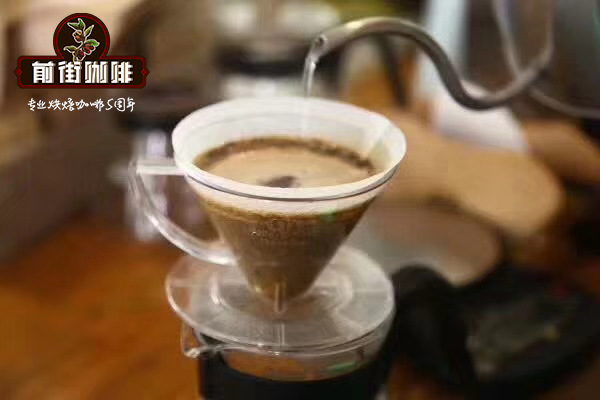
For a light-roasted Gesha, the biggest risk is a clogged filter and an uneven extraction, so grind a little coarser than usual. FrontStreet Coffee suggests a grind at about 78% passing a No. 20 sieve, water at 91 degrees Celsius, 15 g of coffee in a small Hario V60, and a 1:16 ratio, poured in three stages: 30 g to bloom for 30 seconds, then up to 125 g, then up to 225 g, for a total time of about 2:10-2:20. That keeps the floral aromatics and the clean, transparent body intact.
Important Notice :
FrontStreet Coffee is a long-established specialty coffee roaster in Guangzhou China, selling freshly roasted beans from its own farm in Yunnan as well as dozens of carefully selected single-origin beans from around the world for both pour-over and espresso. The products deliver consistently excellent quality and great value, with shipping within 24 hours. Guangzhou's FrontStreet Coffee shop is recommended by many coffee lovers, and the beans are now available online at the Tmall 。
FrontStreet Coffee has moved to a new address:
FrontStreet Coffee Address: 315,Donghua East Road,GuangZhou
Tel:020 38364473
 Scan and follow the En Gafei WeChat official account. Please indicate that the reprint comes from "En Gafei".