The Relationship Between Yirgacheffe Coffee Beans and Arabica Coffee Beans - Introduction to Yirgacheffe Coffee
Ethiopia: The Birthplace of Coffee

Ethiopia is the birthplace of world coffee, and every cultivated variety there is Arabica. Many coffee plants still grow wild in its forests. Ethiopia is the homeland of Arabica coffee, and much of what we drink today can trace its ancestry back through countless generations to this precious land. As coffee's birthplace, Ethiopia holds a central place in the specialty industry—a café menu might skip Geisha or Blue Mountain, but Ethiopian beans are always essential.
"Heirloom" Native Varieties
Ethiopia is a remarkable nation and the origin of Arabica coffee beans. The Kaffa Forest is where it all began, and Ethiopia remains one of Africa's major coffee-producing countries. As Arabica's birthplace, Ethiopia holds thousands of natural coffee varieties, with 99% of the species' genetic diversity found within its borders.
Because the varieties are so numerous, identification and classification are a challenge. The Ethiopian government, wanting to protect its natural coffee varieties, also declines to disclose information about them. Exported Ethiopian beans are therefore often grouped together as "Heirloom" native varieties. Arabica accounts for 70-80% of all coffee production, and its excellent flavor and aroma make it the finest of the native varieties. Have you noticed that Ethiopian beans are usually inconsistent in size and smaller than beans from other producing countries? They are relatively round and quite small, mostly between 14-15 screen size.
Arabica

Arabica, also known as small-grained coffee, originates from Ethiopia. Its major growing regions include South America (except parts of Argentina and Brazil), Central America, Africa (Kenya, Ethiopia, and other East African countries), and Asia (parts of Yemen, India, and Papua New Guinea).
Arabica coffee refers to the Coffea arabica species, which accounts for approximately 70-80% of world coffee production. Weaker resistance to pests and diseases, slower growth, and low annual yields make it better suited to high-altitude cultivation. Most is grown on volcanic slopes or plateaus between 500 and 1500 meters, and beans grown above 1500 meters show relatively better quality. The high-altitude environment slows maturation, and slower maturation means denser, richer beans—so Arabica naturally stands out as the highest-grade coffee bean. Through repeated mutation and breeding, it has given rise to numerous varieties; today it's said there are over seventy varieties of Arabica alone.

Arabica can be divided into two to three thousand varieties, all descended from Ethiopia's most ancient native varieties—Typica and Bourbon—after being planted in South America or Asia and undergoing variation. They are mainly cultivated in Brazil and Colombia in Central and South America, in Sidamo and among the Tikur varieties of Ethiopia, and as Sumatra Typica in Indonesia and Jamaica Blue Mountain in the Caribbean.
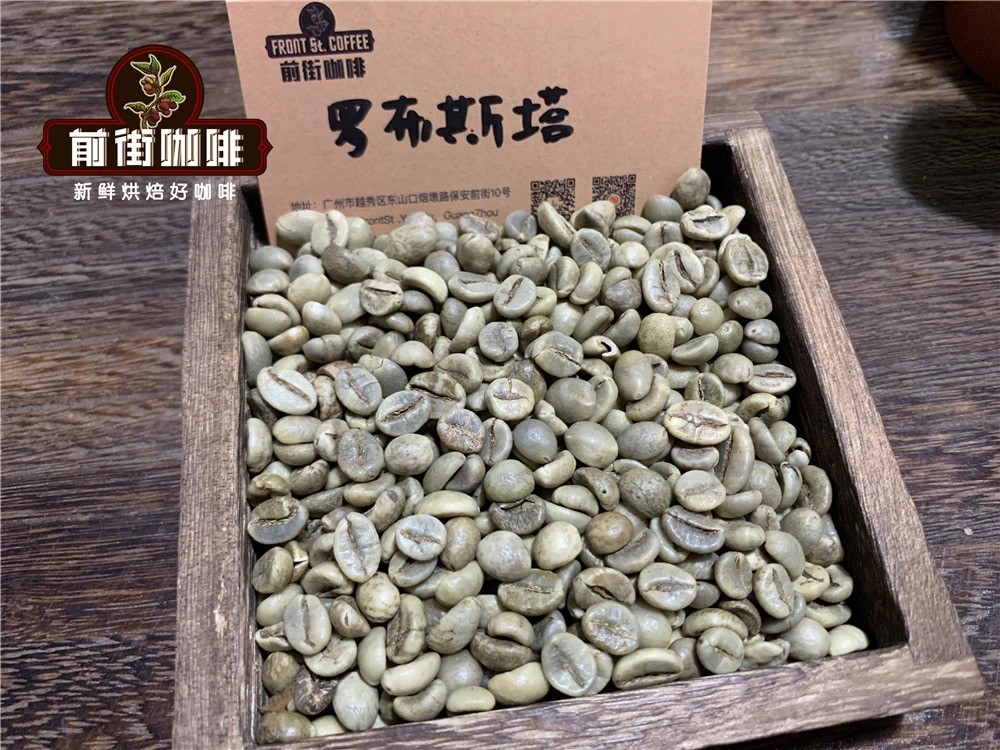
In appearance, Arabica beans are longer and flatter with an S-shaped center line, while Robusta beans are sturdier and rounder with a center line closer to straight. Even from the same Arabica tree, planting in different places—under different climate and soil—produces completely different flavors. Geisha planted in Ethiopia and Panama, for example, tastes entirely different.
Common Arabica varieties today include Typica, Bourbon, Caturra, Pacas, Villasarchi, Maragogipe, Pacamara, Mundo Novo, Catuai, Geisha, Timor, and Catimor, among others. Arabica mostly appears as specialty coffee.
Bourbon and Typica make up the world's most culturally and genetically important C. arabica coffee group. Historical records indicate that coffee seeds were carried from the coffee forests of southwestern Ethiopia to Yemen, where they were cultivated as a crop. Recent genetic testing confirms that Bourbon and Typica were the main seeds transported from Ethiopia to Yemen. Their descendants spread from Yemen around the world, forming the foundation of modern Arabica cultivation.
Bourbon
Bourbon: an ancient and excellent variety on par with Typica. The French made three attempts—in 1708, 1715, and 1718—to introduce this coffee from Yemen to Bourbon Island (now Réunion Island), and recent genetic research has confirmed this. Only a few plants from the second introduction and some from the third succeeded. Not until the mid-19th century did Bourbon coffee leave the island, spread to Africa by French missionaries known as Spiritans.

Bourbon is vigorous with outstanding flavor and often wins cupping competitions. Except for the pointed-bean variant, Bourbon is almost entirely round-beaned. Its beans are slightly smaller than Typica's and mature later, but yield 30% more than Typica. The drawback is that it bears fruit one year and rests the next.
Typica
Typica: Ethiopia's most ancient native variety, belonging to the elegant-flavored group of old coffees, though far less popular than Bourbon. Like all Arabica coffee, the Typica group should have originated in southwestern Ethiopia. At some point in the 15th or 16th century it was brought to Yemen, and by 1700 seeds from Yemen were being cultivated in India.

In 1696 and 1699, coffee seeds were sent from India's Malabar coast to Batavia Island (now Java). Those few seeds gave rise to the unique Typica variety we know today. Its descendants include Mandheling, Blue Mountain, Yunnan small-grain, and Geisha. Typica beans are larger, forming pointed ellipses or slender pointed shapes, unlike Bourbon's round beans. This is why Blue Mountain coffee tastes so excellent—not only because of its growing environment, but also because of its ancient Typica lineage.
Yirgacheffe
Ethiopia is Africa's largest coffee-producing country. There, coffee is not only an important source of income but has become part of the entire national culture and daily life. According to official Ethiopian data, of an annual production of nearly 6.5 million bags, about half is consumed domestically, with only about 3.5 million bags exported worldwide. Yirgacheffe is a small town in eastern Ethiopia at an altitude of 1800-2000m. In the ancient language, "Yirga" means "to settle down" and "Cheffe" means "wetland." Yirgacheffe belongs to the Sidamo producing region and is highly favored by specialty coffee enthusiasts worldwide for its unique jasmine fragrance and citrus acidity. That special taste is even acclaimed as the "Yirgacheffe" flavor.
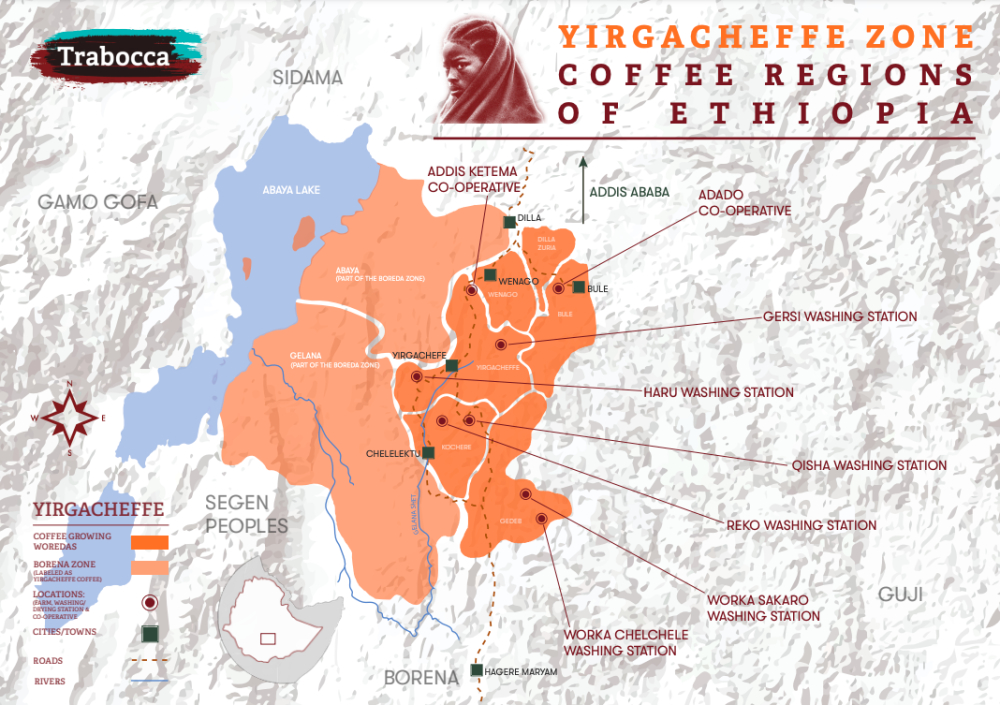
Yirgacheffe was originally a medium-sized town in Ethiopia's Sidamo province used for coffee collection and transport. Its higher altitude than other areas of Sidamo province (on ancient volcanic rock soil), its location in southern Ethiopia, and the influence of the Indian Ocean's southeast monsoon give it a terroir of distinct wet and dry seasons and rich minerals—almost tailor-made for Arabica beans, an excellent cultivation paradise.

Central and South America mostly use large estates for systematic, large-scale coffee cultivation, while planting in the Yirgacheffe area mostly involves intercropping with other short-cycle, easily monetizable crops, with yields varying greatly with the annual climate and pest conditions. Yield per hectare ranges from 200-700 kg, and this cultivation method accounts for about 50% of Ethiopia's total coffee production.
The Yirgacheffe region has high altitude, mountainous terrain, and tropical vegetation. But unlike Sumatra Mandheling and countless other Arabica varieties that grow in constant tropical climates near the equator, Ethiopian beans grow under distinctly different wet and dry seasons. This changes the taste and texture of the beans, giving them citrus flavors and vibrant fruit aromas.
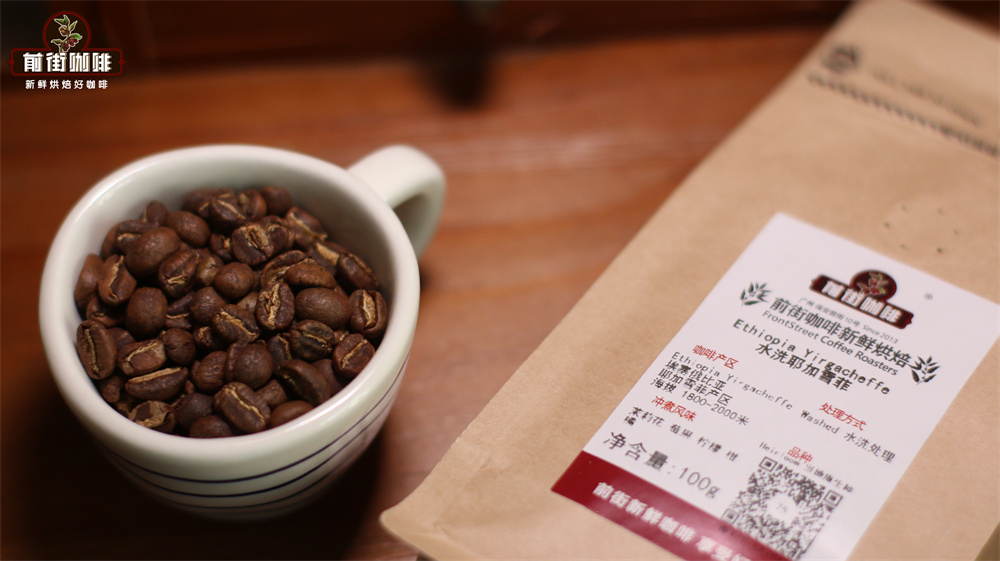
Ethiopia's Yirgacheffe coffee, though small in size, is gentle, elegant, sweet, and delightful. As coffee's birthplace, Ethiopia's thousand-year cultivation history and processing traditions have created high-quality washed Arabica beans. Light roasting reveals unique lemon, floral, and honey-like sweet aromas, with soft fruit acidity and citrus flavors, creating a fresh and bright taste. Without adding milk or sugar, let the rich texture and unique soft floral notes brush across your taste buds, leaving an endless aftertaste.
Flavor Profile
Ethiopian Yirgacheffe is definitely a coffee with a classic flavor. It tastes great whether brewed with hot water or as cold brew, and it is highly versatile in flavor expression. With its delicate floral and citrus aromas, it has become a world-renowned coffee-producing region riding the third wave of specialty coffee.

Beyond delicate floral and citrus aromas, the sugarcane aroma and fruity, acidic taste offer a delicate and elegant flavor distinct from the bold, angular flavors of Central and South American coffees, standing out among the many specialty coffee flavors.
Yirgacheffe Coffee Bean Processing Methods
The processing method for Yirgacheffe coffee is the most ancient natural method. However, because early natural-processed beans were mostly dried spread on the ground, they inevitably picked up earthy and dusty off-flavors, and a lack of proper screening meant natural-processed beans generally had poor quality. In 1972, Ethiopia introduced Central and South American washing techniques to improve quality, making Yirgacheffe's jasmine fragrance and citrus-lemon clarity even sharper and brighter, and it quickly became one of the representatives of world specialty coffee.

FrontStreet Coffee's Brewing Parameters for Yirgacheffe Coffee Beans
FrontStreet Coffee uses a higher water temperature and a finer grind to fully extract the fruit acidity characteristic of Yirgacheffe and Sidamo. To avoid over-extraction from the high temperature, a faster-flowing dripper such as the V60 is used. The V60 has a 60° conical shape, and this angle lets the coffee grounds concentrate. When pouring, it also lets the water flow converge toward the center of the dripper, ensuring sufficient contact time between water and grounds for proper extraction.

V60 dripper, water temperature 90°C, water-to-coffee ratio 1:15, coffee amount 15g, grind size (80% pass-through rate on China No. 20 standard sieve).
Using segmented extraction, bloom with 2 times the coffee weight in water, i.e., bloom with 30g water for 30 seconds. Blooming lets the grounds release trapped carbon dioxide so that subsequent extraction is more stable. Pour in a small circular stream until 125g, then continue pouring to 225g and stop. Remove the dripper after the water has finished dripping. Start timing when pouring begins; extraction time is 2'00". Then pick up the whole cup, shake it evenly, and pour it into cups for tasting.

[Washed Yirgacheffe Coffee Flavor] The acidity is brighter and more lively, with lemon acidity, citrus aroma, a fresh taste, and some black tea sensation in the aftertaste.
[Natural Red Cherry Coffee Flavor] Berries, lemon, strawberry, fermented wine aroma.
FrontStreet Coffee's Brewing Recommendations
Whatever type of coffee you brew, the freshness of the beans matters. FrontStreet Coffee has always believed that freshness greatly affects flavor, so FrontStreet Coffee ships beans roasted within 5 days. Its roasting philosophy is "Freshly Roasted Good Coffee," ensuring every customer who places an order receives the freshest coffee when it arrives. The coffee resting period is about 4-7 days, so by the time customers receive it, it's at peak flavor.
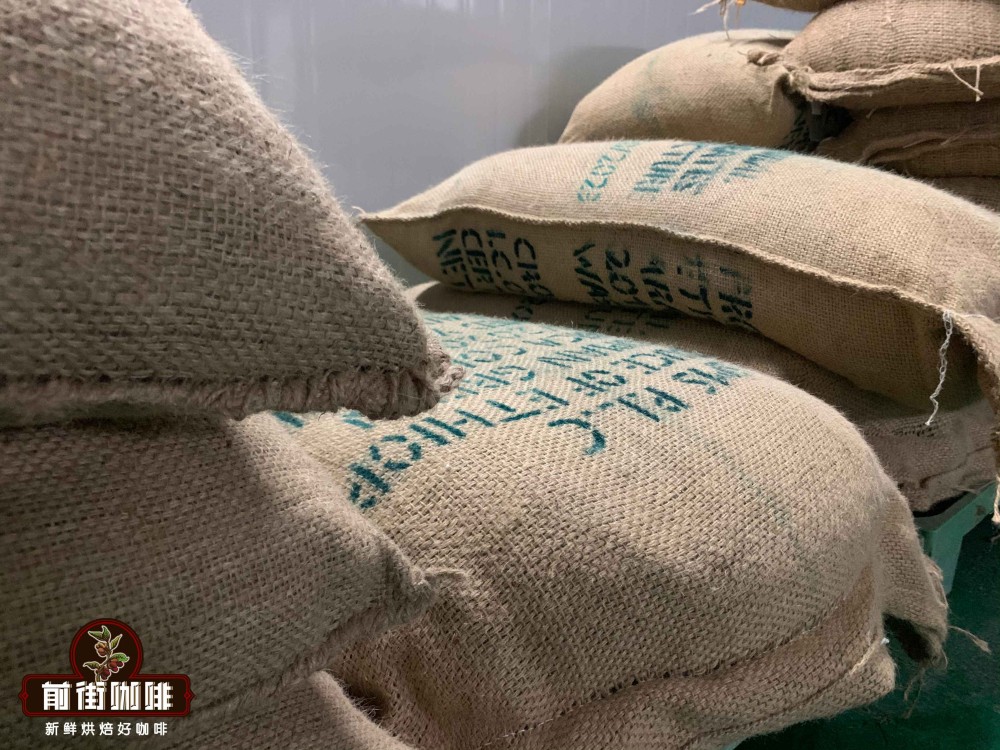
For those who need ground coffee, FrontStreet Coffee kindly reminds you: once beans are ground in advance, no resting is needed, because during transport the pressure from carbon dioxide inside the packaging also helps round out the flavor, so you can brew a cup as soon as the ground coffee arrives. Ground coffee should be brewed promptly, though, because it oxidizes quickly when exposed to air—meaning the flavor dissipates faster and the coffee won't taste as good. FrontStreet Coffee therefore recommends buying whole beans and grinding fresh before brewing to better appreciate the coffee's flavor.
FrontStreet Coffee Recommendation
If you want to taste the Yirgacheffe profile described here, the FrontStreet Washed Yirgacheffe is the ideal first stop—the classic entry point to Ethiopian specialty coffee, known for white jasmine florals, bright citrus and lemon acidity, and a tea-like body, all at a friendly price. It's the reference point for what "Yirgacheffe" means.
For a slightly more refined expression of the same region, the FrontStreet Yirgacheffe Gudingding Cooperative comes from Gudingding village, once part of the Worka cooperative under the Yirgacheffe union, and uses traditional washed processing to bring out clean, bright citrus and lemon acidity with jasmine fragrance. If you'd rather explore the natural side, the FrontStreet Yirgacheffe Sun-Dried Red Cherry is made from fully ripe red cherries and layers tropical fruit and a full fermented sweetness over Yirgacheffe's signature citrus-and-honey character. Brew any of them as pour-over with a V60 at 90-91°C, 15g of coffee at a 1:15 ratio, ground to a fine-sugar consistency (about 80% through a No. 20 sieve).
Important Notice :
FrontStreet Coffee is a long-established specialty coffee roaster in Guangzhou China, selling freshly roasted beans from its own farm in Yunnan as well as dozens of carefully selected single-origin beans from around the world for both pour-over and espresso. The products deliver consistently excellent quality and great value, with shipping within 24 hours. Guangzhou's FrontStreet Coffee shop is recommended by many coffee lovers, and the beans are now available online at the Tmall 。
FrontStreet Coffee has moved to a new address:
FrontStreet Coffee Address: 315,Donghua East Road,GuangZhou
Tel:020 38364473
 Scan and follow the En Gafei WeChat official account. Please indicate that the reprint comes from "En Gafei".