Central American Coffee Bean Recommendations: Honduras Oak Barrel Fermented Lychee Lan Sherry Coffee Bean Flavors
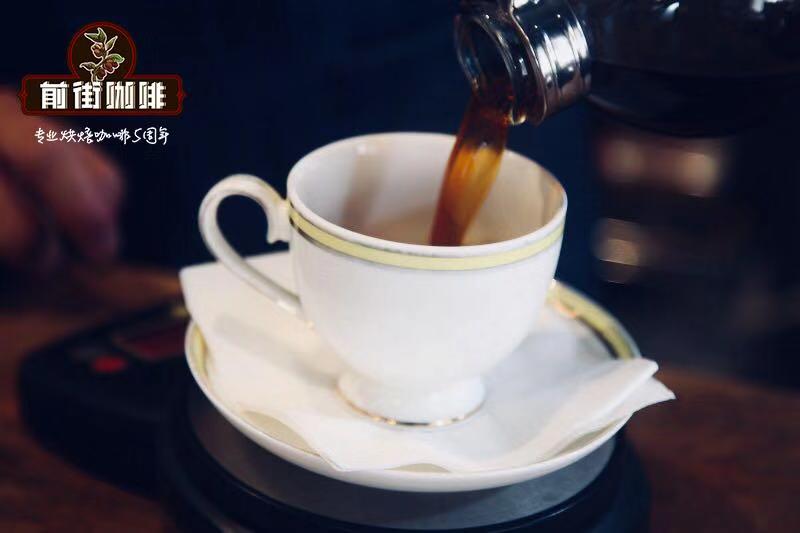
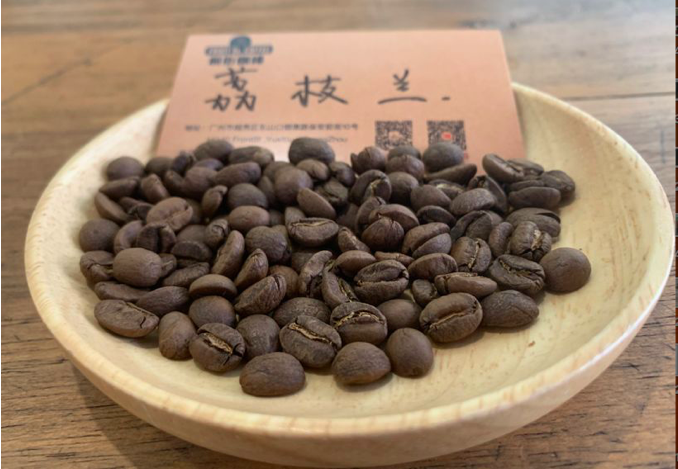
Honduras Finca Mocha Lychee Lan
Basic Information
Country: Honduras
Region: Masaguara
Estate: Finca Mocha
Altitude: 1500-1700m
Varieties: Caturra, Catuai
Processing: Refined Washed + Brandy Barrel Fermentation
Honduras
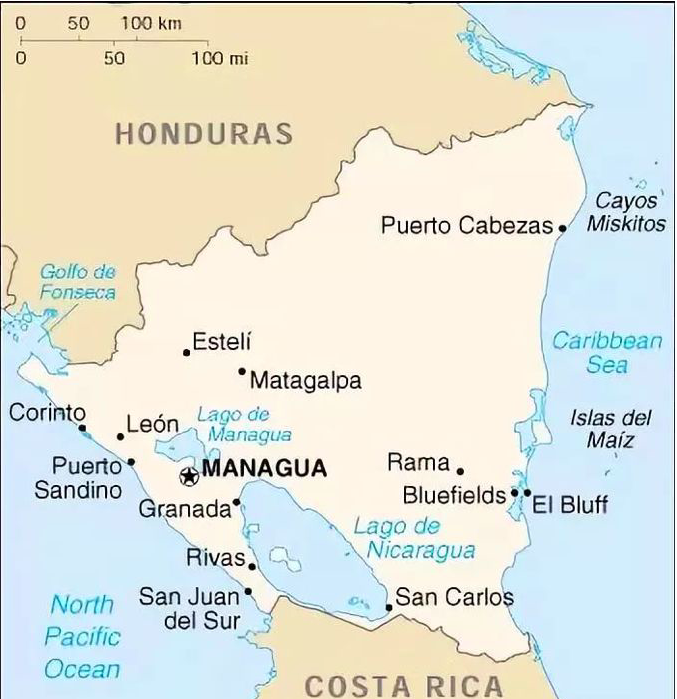
Honduras lies in northern Central America, bordering the Caribbean Sea to the north and the Gulf of Fonseca in the Pacific to the south. It shares borders with Nicaragua and El Salvador to the east and south and Guatemala to the west. The country is predominantly mountainous and plateau, with a tropical climate of moderate temperatures and abundant rainfall, making it an ideal region for coffee cultivation.
Honduras has approximately 280,000 hectares of coffee plantations, primarily small-scale farms with most coffee plots smaller than 3.5 hectares. These small plantations account for sixty percent of Honduras' total coffee production.
Honduran coffee has undergone significant improvements in processing techniques and transportation, achieving remarkable development in the coffee market over the past 20 years. On the plantations, the mountainous terrain means coffee beans are hand-picked and carefully processed to produce higher-quality coffee. Honduras harvests three million bags of coffee annually, providing coffee lovers with abundant, high-quality beans, and has now become one of the world's top ten coffee exporting countries.
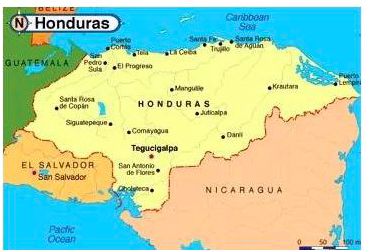
Honduras has six main coffee producing regions: Copán, El Paraiso, Comayagua, Opalaca, Montecillos and Agalta. The average growing altitude ranges from 1000-1600m, with main cultivated varieties including Bourbon, Caturra, Typica, Catuai and Pacas.
Honduran coffee beans are characterized by their large, uniform size and consistent, glossy color. For harvesting convenience, farmers prune coffee trees to not exceed 150 centimeters in height, since taller trees would require ladders for picking, which is time-consuming and can damage the trees when branches are bent. Because each coffee fruit matures at a different time, manual harvesting is essential to maintain quality, followed by careful selection of ripe red cherries. Coffee fruits on the same branch often take several weeks to harvest completely.
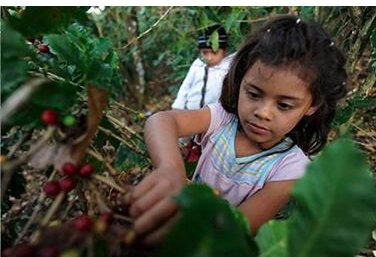
Honduran coffee offers a rich, mellow flavor that is neither astringent nor acidic, with excellent body and aroma, giving it a quite distinctive character. It can reveal multi-layered flavor profiles depending on the roast level.
Masaguara
Masaguara is a municipality in the Intibucá department of Honduras, in the southern part of the Jesús de Otoro valley, surrounded by mountains and hills. The region is primarily dedicated to coffee growers, who are the main economic engine for the area; the corresponding valley areas focus on growing basic grains and livestock. The name comes from Alberto Membreño's "Indigenous Place Names," in which Masaguara means "place of deer."
Varieties: Caturra, Catuai
Caturra is a natural variant of Bourbon, discovered in Brazil in 1937. Its plant structure is shorter and more compact than Bourbon. While inheriting Bourbon's lineage, it has relatively weak disease resistance but higher yields than Bourbon. Although discovered in Brazil, Caturra is not well suited to Brazilian growing conditions and was therefore not widely cultivated there. Instead, it became popular in Central and South American regions such as Colombia, Costa Rica and Nicaragua. The higher the altitude where Caturra is grown, the better the quality, but correspondingly the lower the yield.
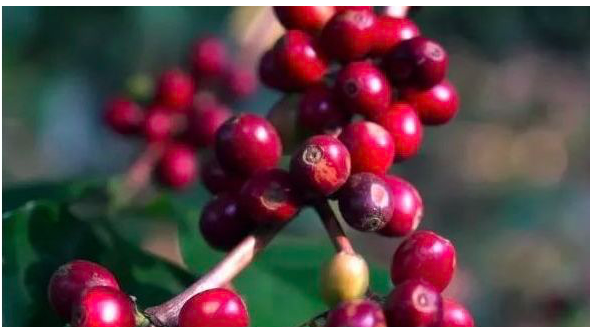
When lightly roasted, Caturra shows prominent acidity with overall brightness. With proper processing it can display excellent sweetness. Compared with Bourbon, however, Caturra has a relatively lower body and a slightly less clean cup. Typically, Caturra produces red cherries, but in very rare regions yellow Caturra can be found, such as the minimal yellow Caturra cultivation in Hawaii.
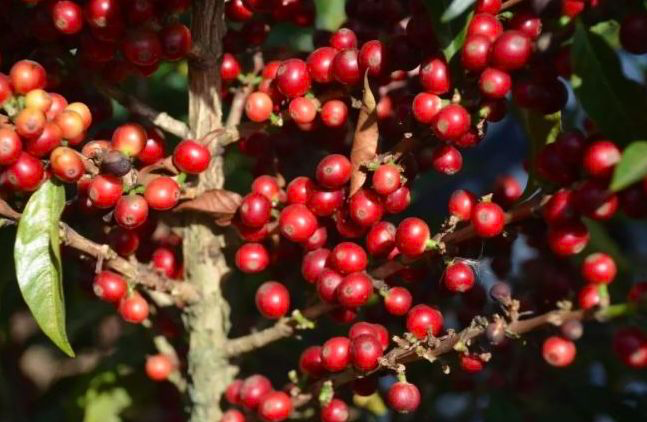
Catuai is a coffee variety resulting from artificial hybridization between Caturra and Mundo Novo. It shows good resistance to natural disasters, particularly strong resistance to wind and rain. The Catuai tree is relatively low-growing, and compared with other coffee trees its fruit grows more densely and is harder to harvest. The fruits come in both red and yellow varieties.
Processing Method
What is barrel fermentation?
Barrel fermentation is borrowed from winemaking. Its greatest impact on wine is that moderate oxidation through the barrel stabilizes the wine's structure and infuses barrel flavors into it. It plays a similar role in the coffee fermentation process.
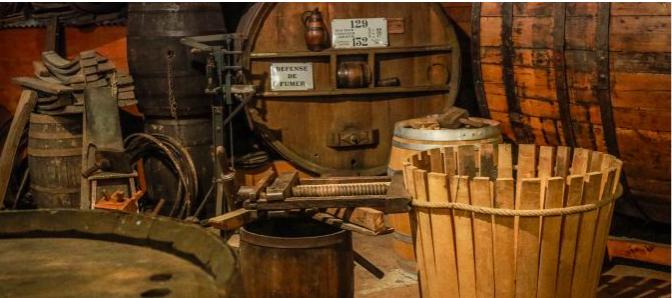
Barrels allow minimal amounts of air to pass through the barrel walls, penetrating inside and causing moderate oxidation of the coffee beans. The appropriate amount of oxygen entering also accelerates coffee fermentation, smoothing the tannins while gradually transforming fresh fruit aromas into rich, complex mature wine aromas. The barrel's moderate hardness ensures good waterproofing and storage safety. In addition, barrels contain certain amounts of tannins, which during the storage of green coffee beans penetrate into the beans, giving the coffee layered complexity and rich wine-like aromas.
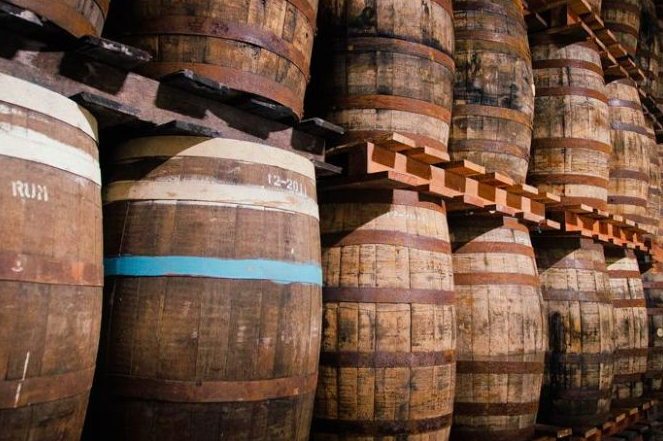
This refined washed, brandy barrel-fermented Lychee Lan coffee bean first undergoes refined washing of freshly picked cherries, then is placed in brandy oak barrels for low-temperature fermentation for 30-40 days (at approximately 15-20°C), allowing the green beans to absorb the barrel's flavors, followed by shade drying.
Beans processed through brandy barrel fermentation have delicate lychee and honey sweetness, while also integrating full-bodied brandy aromas and oak barrel fragrances.
Roasting Profile Analysis
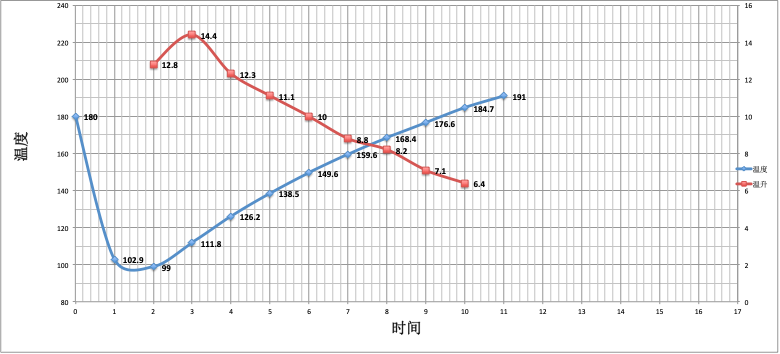
Heat the roaster to 220°C, with the damper at 4 and heat at 200. Return temperature point at 1'32"; when the roaster temperature reaches 140°C, maintain heat and open the damper to 6. At this point the bean surface turns yellow, the grassy aroma completely disappears and the roast enters the dehydration stage. At 151°C, reduce heat to 120, and at 176°C, reduce heat to 80, keeping the damper unchanged.
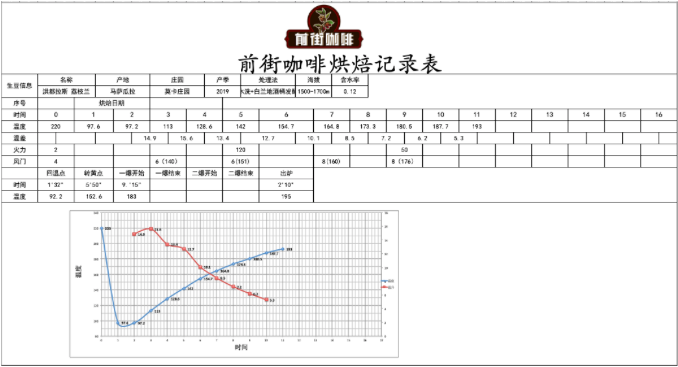
At 8'28", ugly wrinkles and black spots appear on the bean surface, and the toast aroma distinctly transforms into coffee aroma, which can be defined as the prelude to first crack. At this moment, listen carefully for the sound of first crack. At 9'15", first crack begins; adjust the damper to 8 (adjust heat very carefully, not so low as to eliminate the cracking sounds). After first crack, develop for 2'10", then drop at 195°C.
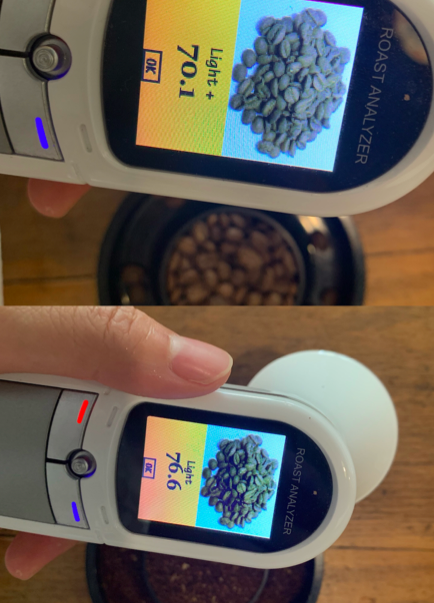
Agtron bean color value 70.1 (upper image), Agtron ground color value 76.6 (lower image), Roast Delta value 6.5.
Cupping Profile
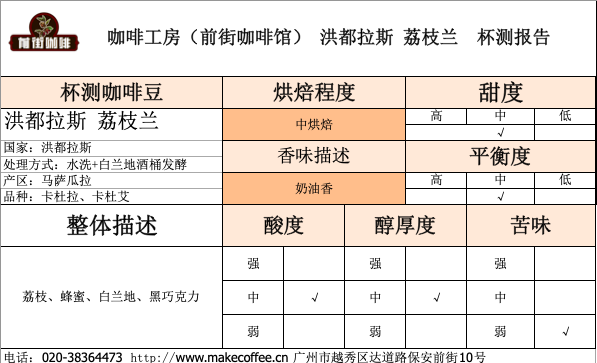
Lychee Lan coffee bean flavor notes: Lychee, honey, brandy, dark chocolate.
Brewing
FrontStreet Coffee shares brewing parameters:
Recommended brewing method: Pour-over
Filter: Hario V60
Water temperature: 90°C
Dose: 15 grams
Ratio: 1:15
Grind size: Medium-fine grind (BG 6k: 58% pass-through rate on China standard #20 sieve)
Brewing technique: Segmented extraction
Use 34g of water for a 36-second bloom, then continue pouring in small circular motions to 120g for segmentation. When the water level drops and is about to expose the coffee bed, continue pouring to 229g and stop. Wait for the water level to drop and, just before the coffee bed is exposed, remove the filter cup. Extraction time is 2'00" (timing starts from the bloom).
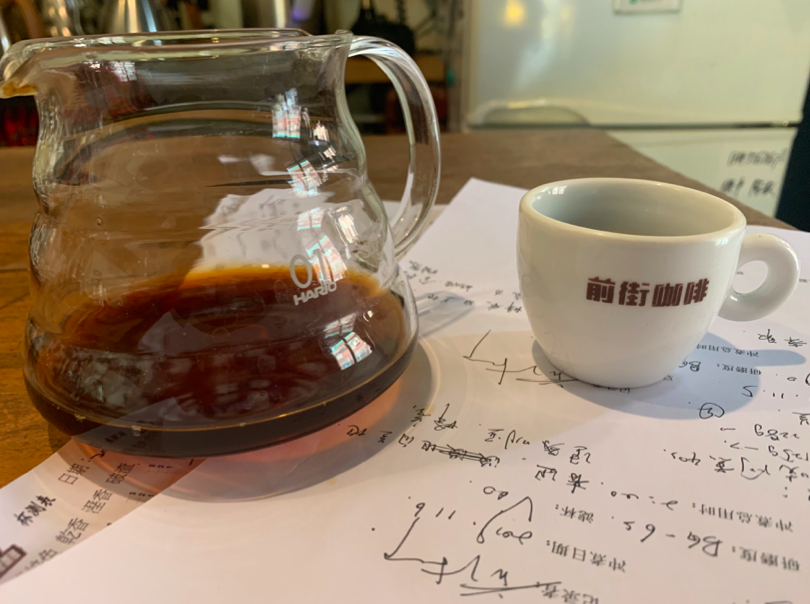
Lychee Lan coffee bean flavor profile: Initial notes of lychee and brandy with a creamy texture. As the temperature changes, wine notes and dark chocolate become prominent, with a thick mouthfeel and obvious honey sweetness in the aftertaste.
FrontStreet Coffee Recommendation
The clean base under all that barrel character comes from washing, and it is worth understanding what the method does. Washed processing is a traditional way of handling coffee fruit that relies on water. The steps generally run through flotation, pulp removal, soaking and fermentation to strip the mucilage, washing or further soaking, and drying before hulling. Because washed beans sit in water for a long time, chemical changes occur inside the bean and a large share of the monosaccharides (fructose and glucose) is consumed, lowering the coffee's sugar content while increasing various organic acids. Washed coffee therefore tends to keep more of the bean's own aroma while carrying bright fruit acidity and a clean, fresh character.
A clear example is FrontStreet Yirgacheffe Gotiti Cooperative. Yirgacheffe is well known, but fewer people realize that small local yields are sent to a cooperative for unified processing and sale; Gotiti is one such team from Gotiti village, with skilled processing and a cup refined and clean enough to have made its name. The washed process lets it express jasmine florals and bright citrus acidity to the fullest, and after a medium-light roast it takes on green tea and honey notes, suiting pour-over, cold brew and espresso alike.
For a fruitier washed profile, FrontStreet Kenya Small Tomato is one of the best-known references, since Kenya excels at double-washed processing. A second wash is added to the usual sequence: flotation, soaking the beans in water, washing residual mucilage from the surface, soaking again, drying in the sun, then hulling and storage. The repeated rinsing and soaking draws out the juice-like quality to the extreme, giving rich aromas of cherry tomato, smoked plum, snow pear, black plum and yellow sugar, with a sweet-sour, juicy body that many coffee drinkers count among their favorites.
Important Notice :
FrontStreet Coffee is a long-established specialty coffee roaster in Guangzhou China, selling freshly roasted beans from its own farm in Yunnan as well as dozens of carefully selected single-origin beans from around the world for both pour-over and espresso. The products deliver consistently excellent quality and great value, with shipping within 24 hours. Guangzhou's FrontStreet Coffee shop is recommended by many coffee lovers, and the beans are now available online at the Tmall 。
FrontStreet Coffee has moved to a new address:
FrontStreet Coffee Address: 315,Donghua East Road,GuangZhou
Tel:020 38364473
 Scan and follow the En Gafei WeChat official account. Please indicate that the reprint comes from "En Gafei".