Which Brand of Yunnan Small Bean Coffee is Best? How Much Does a Can of Yunnan Small Bean Coffee Cost?
In the world's major coffee-drinking countries, the average person gets through 30 to 40 cups a year. In China, the figure is only 3 to 4 cups.
Yet China's annual coffee consumption is growing at 20%, far above the global average of 2%. The market potential is enormous — so where are the local Chinese coffee brands?
Understanding Yunnan's Premium Coffee
To begin with, what does a high-altitude, pure-bred, washed Typica from Baoshan, Yunnan actually taste like? Is Yunnan small-grain coffee any good to drink?
Judging whether a bean will taste good comes down to a handful of basic factors — variety, altitude, processing method, roasting and extraction.
1. Variety: Typica, an Original Cultivar
In the world of specialty coffee, Blue Mountain and Kona are both Typica. Seen through the lens of lineage, we have to admit that good bloodlines account for a large part of what makes a good bean.
2. Growing Altitude: 1200 Meters
For Arabica coffee, 1200 meters is the quality watershed. This Yunnan Baoshan Typica is cultivated at 1200 meters.
3. Processing Method: Washed
Processing essentially runs in two directions: toward a cleaner cup, as with washed processing, or toward richer flavor, as with natural processing.
4. Roasting Approach
FrontStreet Coffee has specialized in roasting for 5 years, and uses a medium roast here to express the regional flavor that Yunnan specialty coffee ought to have.
Below is some basic information about this Yunnan coffee, how to brew it once you have it, and the flavors we found in cupping.
Yunnan Baoshan Typica Coffee Profile
Product Name: Flower Fruit Mountain
Coffee Origin: China, Yunnan, Baoshan
Coffee Variety: Typica
Production Altitude: 1200M
Quality Grade: AA
Processing Method: Washed
Coffee cultivation in Yunnan can be traced back to 1892, when a French missionary brought coffee seeds into the province from abroad and planted them successfully in a valley in Binchuan County, Yunnan. The main variety was Typica, known as small-grain coffee — which is what people in China commonly call Yunnan small-grain coffee. It belongs to the Rubiaceae family, genus Coffea.
Good bloodlines account for a large share of what makes a good bean. Choosing the right variety, planting it at the right altitude, and developing processing methods that can express a distinctive flavor after ripening all matter. Yunnan's Typica growing areas are distributed mainly across Lincang, Baoshan, Simao, Xishuangbanna and Dehong.
The path to specialty coffee is neither too difficult nor too easy. Yunnan's current shift toward specialty coffee faces a real challenge: most plantations grow Catimor, a hybrid of Caturra — a Bourbon-lineage branch of Arabica — and Robusta varieties. This variety was chosen because its Robusta genes give it stronger disease resistance than the old single varieties and a better harvest. Faced with delicate, low-yielding heirloom varieties, farmers naturally prefer Catimor, and that preference has created a Catimor trend across the whole province.
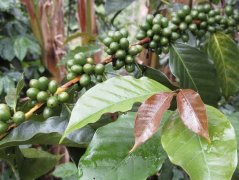
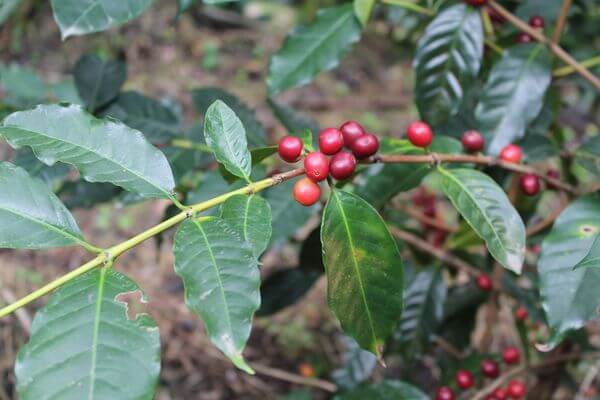
Once you look closely, Catimor is easy to pick out in a vast plantation. Every variety has its own look: Catimor's leaves droop downward and the tree appears to be wearing a cloak, whereas Typica's branches grow upward and its new leaves are copper-colored at the tips.
Typica is an old variety within the Arabica lineage, and the well-known Hawaii Kona is also a Typica. Among masses of Catimor it is easy to recognize: Typica is one of the most ancient varieties of Arabica, with oval or slender-pointed beans, elegant flavors, a weak constitution, poor disease resistance and a low yield.
Typica Coffee Beans
Typica beans are oval in shape and thin and flat when viewed from the side. Both ends are slightly upturned, and even when grown at different altitudes there is no significant difference in the thickness of the green beans.
Planting Altitude
For Arabica coffee, 1200 meters is the quality watershed. Above 1200 meters, Baoshan has an average temperature of 21.5°C, reaching up to 40.4°C, and with essentially no frost all year it forms a protective microclimate for coffee growing — which is why it is recognized as one of the finest small-grain coffee producing areas. Planting areas are distributed mainly across Lincang, Baoshan, Simao, Xishuangbanna and Dehong. The small-grain coffee grown here is rich but not bitter and fragrant without being overpowering, with small yet uniform beans, a mellow, full aroma and fruit notes.
Coffee grown in Yunnan's distinctive geography and climate is not a foreign import; it originates from Chinese cultivation. The province's specialty coffee industry still has a long and challenging road ahead, but with a clear direction, locked goals and a collective effort, there is every reason to believe that the future of Yunnan specialty coffee will be brighter.
FrontStreet Coffee Recommendation
To taste Yunnan for the first time, start with FrontStreet Yunnan Small Bean Coffee. Grown in the Baoshan region and washed, then medium-roasted, it shows soft nutty and chocolate sweetness with a light plum acidity. Its very approachable price has made it the introduction to Yunnan coffee for a great many drinkers.
To go a step further into the region, choose FrontStreet 2013 Natural Typica. FrontStreet planted this Typica on its own estate to chase the original terroir of Yunnan, the same variety the first French missionaries brought to the province. Only fully ripe red cherries are used, naturally processed and medium-roasted for balance. The result has deep-berry character along with caramel sweetness, chocolate and a hint of dried apricot, finishing with a black tea aftertaste.
And to drink Yunnan as espresso, try FrontStreet Black Cocoa Blend, which pairs Yunnan small beans with Brazilian Cerrado. The Brazilian portion supplies mixed-nut aroma and a balanced body, while the Yunnan beans contribute chocolate and citrus. Pulled as an Americano it is balanced across sweet, sour and bitter with nut and brown sugar sweetness, and with milk it turns smooth and almond-creamy — an easy choice for beginners.
Important Notice :
FrontStreet Coffee is a long-established specialty coffee roaster in Guangzhou China, selling freshly roasted beans from its own farm in Yunnan as well as dozens of carefully selected single-origin beans from around the world for both pour-over and espresso. The products deliver consistently excellent quality and great value, with shipping within 24 hours. Guangzhou's FrontStreet Coffee shop is recommended by many coffee lovers, and the beans are now available online at the Tmall 。
FrontStreet Coffee has moved to a new address:
FrontStreet Coffee Address: 315,Donghua East Road,GuangZhou
Tel:020 38364473
 Scan and follow the En Gafei WeChat official account. Please indicate that the reprint comes from "En Gafei".