
What are the Flavor Differences Between Yunnan Typica and Catimor? What Coffee Varieties Exist in Yunnan?
Customers often ask us: "Your Yunnan Huaguoshan and Yunnan Xiaoli both come from Yunnan, so what is the difference?" Today FrontStreet Coffee tastes both beans side by side and works through their differences.
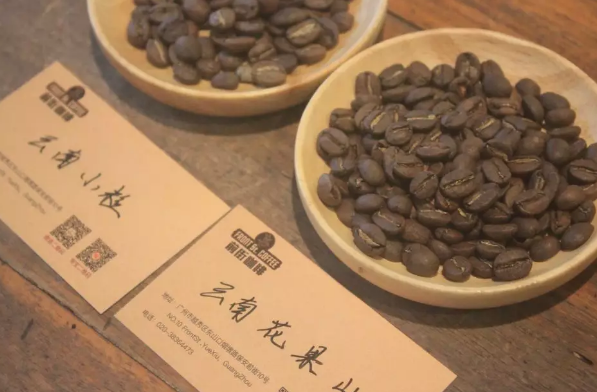
Yunnan
Both beans come from Baoshan, Yunnan. In the past, Yunnan coffee was mostly destined for instant coffee, which gave it a poor reputation. In recent years, though, it has emerged like a dark horse and is steadily finding its place in the specialty coffee market.

Coffee has been cultivated in Yunnan for a long time. As early as 1892, a French missionary brought coffee seeds to the province and successfully planted the first coffee tree in a place called Zhukula.
The western and southern parts of Yunnan Province lie between 15° north latitude and the Tropic of Cancer. Most of the area sits between 1,000 and 2,000 meters of elevation, with mountainous, sloping terrain that varies greatly. Fertile soil, abundant sunshine, plentiful rainfall, and large day-to-night temperature swings give Yunnan small-bean coffee its signature character: strong but not bitter, aromatic but not overpowering, with a touch of fruitiness.
Baoshan has a long history of coffee cultivation and is recognized as the finest small-bean growing area, making it one of the best coffee regions in the country and the world.
Washed Processing
Both beans are washed, which is a relatively common processing method in Yunnan.
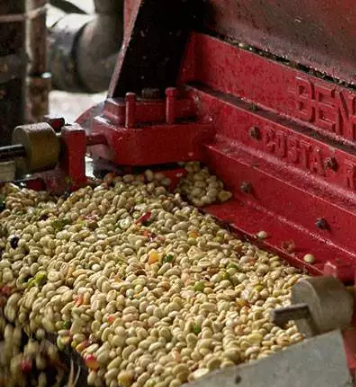
Harvested cherries run through a depulper to separate most of the fruit pulp from the beans, and the parchment beans are then placed in a clean tank and soaked in water to ferment away the remaining pulp layer.
Because washed processing removes underripe and defective beans through differences in buoyancy and makes fermentation easier to control, the beans are less likely to develop off-flavors than sun-dried ones. Instead they show clear fruit acidity, slightly greater complexity, and cleaner cupping characteristics.
Variety Introduction
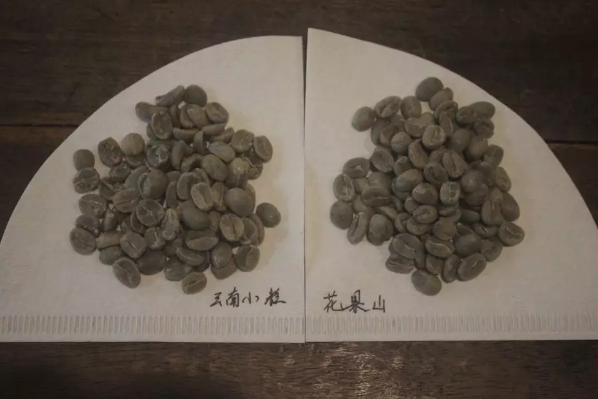
The variety of Yunnan Huaguoshan is Typica, while the variety of Yunnan Xiaoli is Catimor.
Typica
Typica is one of the old coffee varieties that Baoshan locals in Yunnan talk about. It is an ancient original variety from Ethiopia.
The terminal leaves of Typica are bronze-colored, with opposite, long elliptical leaves, smooth leaf surfaces, long terminal branches, and few side branches. Although Typica offers an elegant flavor, its constitution is weak, its disease resistance is poor, it is susceptible to leaf rust, and its yield is limited.
Catimor
In 1959, the Portuguese brought the Bourbon mutation Caturra from Brazil to East Timor and hybridized it with the Robusta-blooded Timor, successfully creating Catimor, which has extremely strong disease resistance and productivity. As leaf rust swept coffee-growing countries around the world, international organizations helped producing nations promote Catimor widely to resist the disease and raise output.
FrontStreet Coffee compared the green beans of Yunnan Huaguoshan and Yunnan Xiaoli and found that Huaguoshan's green beans are relatively more slender, while Xiaoli's are rounder.
Flavor Comparison
FrontStreet Coffee made pour-over coffee from each to see how they differ.
Parameters: Filter: Hario V60; Dose: 15g; Water temperature: 89°C; Grind: medium-fine (BG 6M: 58% pass-through on a China standard 20-mesh sieve); Ratio: 1:15; segmented extraction.
Use 30g of water for a 30-second bloom, then pour with a small, centered stream to 124g for the first stage. Continue pouring to 225g when the water level drops and the coffee bed is about to show, then remove the dripper when the bed is about to be exposed (timing starts from the bloom). Extraction time is 1'50".
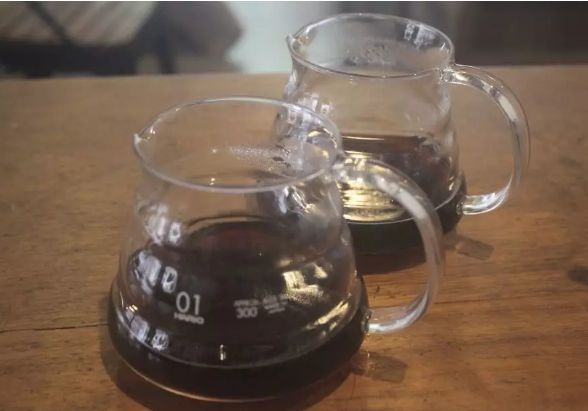
Yunnan Huaguoshan has a subtle citrus acidity and a nutty aroma in its dry fragrance. On the palate it offers plum and citrus acidity with nutty flavors, melon and fruit aromas, and brown sugar sweetness, with black tea in the aftertaste. The overall flavor layers are quite rich.
Yunnan Xiaoli has a nutty dry fragrance. On the palate it presents chocolate, nut, and cream flavors with brown sugar sweetness. The overall profile is relatively balanced.
FrontStreet Coffee Recommendation
If you want to taste the difference for yourself, FrontStreet Coffee's Yunnan Xiaoli is the ideal first step into the region. Sourced from Baoshan and washed then roasted to a medium level, it shows soft nut and chocolate sweetness with a gentle plum acidity, all at a friendly price. For a clearer, more evolved expression of the same terroir, step up to FrontStreet Coffee's 2013 Sun-Dried Typica, grown on its own Yunnan estate from fully ripe all-red cherries. Sun-dried and roasted medium, it brings out dark berry notes, caramel sweetness, chocolate, and a hint of dried apricot, finishing on black tea. Together the two beans map the range of Yunnan: one approachable, one complex, both unmistakably of the place.
Important Notice :
FrontStreet Coffee is a long-established specialty coffee roaster in Guangzhou China, selling freshly roasted beans from its own farm in Yunnan as well as dozens of carefully selected single-origin beans from around the world for both pour-over and espresso. The products deliver consistently excellent quality and great value, with shipping within 24 hours. Guangzhou's FrontStreet Coffee shop is recommended by many coffee lovers, and the beans are now available online at the Tmall 。
FrontStreet Coffee has moved to a new address:
FrontStreet Coffee Address: 315,Donghua East Road,GuangZhou
Tel:020 38364473
 Scan and follow the En Gafei WeChat official account. Please indicate that the reprint comes from "En Gafei".

