Introduction to Colombia San Jose Estate Rum Barrel Fermented Washed Process Castillo Coffee

Among common coffee varieties are Arabica and Robusta. Arabica dominates the single-origin market, while Robusta goes into espresso blends and instant coffee. Today, FrontStreet Coffee will discuss Castillo, a hybrid variety that bridges the two species.
What is Castillo Coffee Variety?
Castillo is a variety released in 2005 by Colombia's coffee research institution to improve disease resistance, and it is now the country's main cultivated variety.
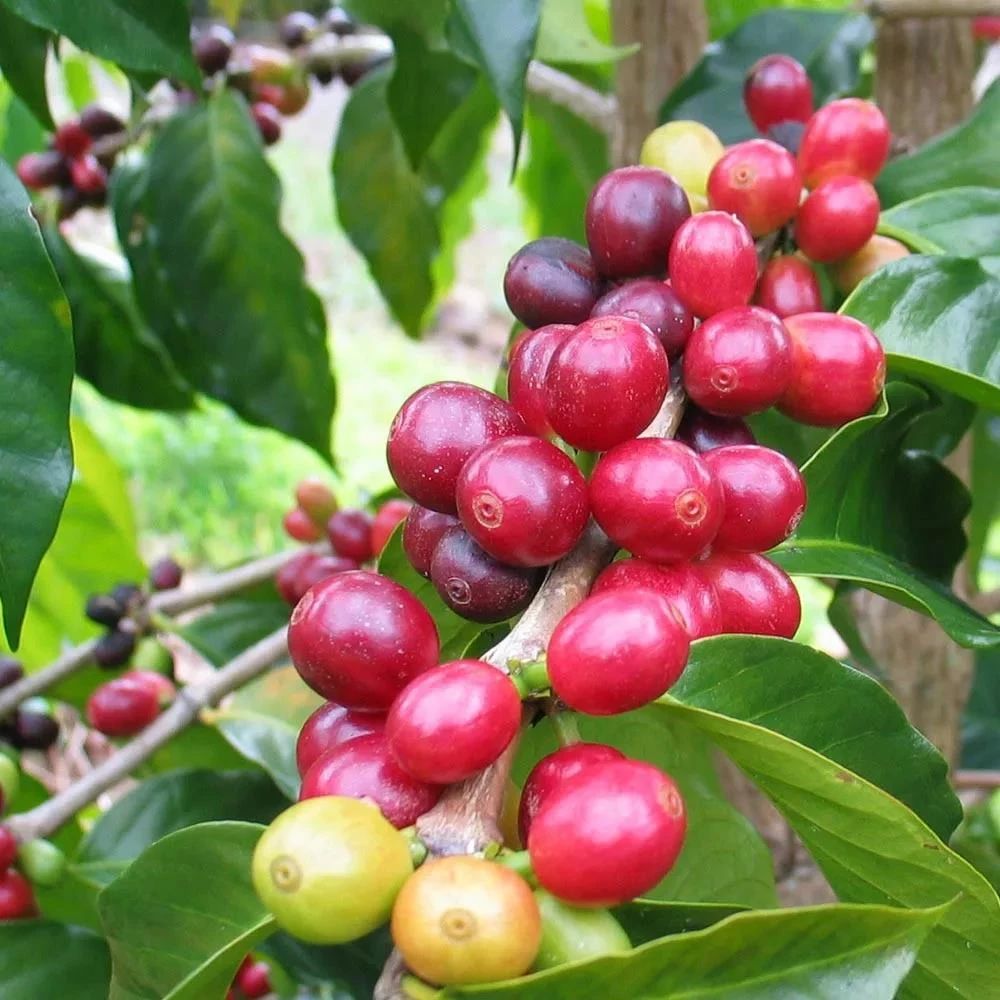
According to FrontStreet Coffee's understanding, Castillo is the product of five generations of hybrid breeding between the Timor and Caturra varieties. Timor is a natural hybrid of Arabica and Robusta—a tall, leaf-rust-resistant plant. Caturra is a natural mutation of Bourbon: compact, higher-yielding than Typica and Bourbon, inheriting Bourbon's excellent flavor, and close enough in spacing to allow denser planting, though it remains susceptible to leaf rust.
Colombian Coffee Growing Conditions
Colombia sits in northwestern South America, bordering Panama in Central America. A tropical country whose climate shifts with terrain, it offers rich volcanic soil, annual rainfall of 2000-3000mm, mild temperatures, and humid air—ideal conditions for high-quality Arabica. That climatic diversity gives Colombia harvests year-round, and much of its coffee excellence flows from it.

Colombia has "four treasures": flowers, gold, emeralds, and coffee—which says everything about coffee's place in the country.
Colombian Coffee Regions
Colombia's coffee regions concentrate in the south at altitudes above 1500 meters, mainly across Huila, Cauca, Nariño, and Tolima provinces—areas known for delicate acidity, berry sweetness, and full sweetness.
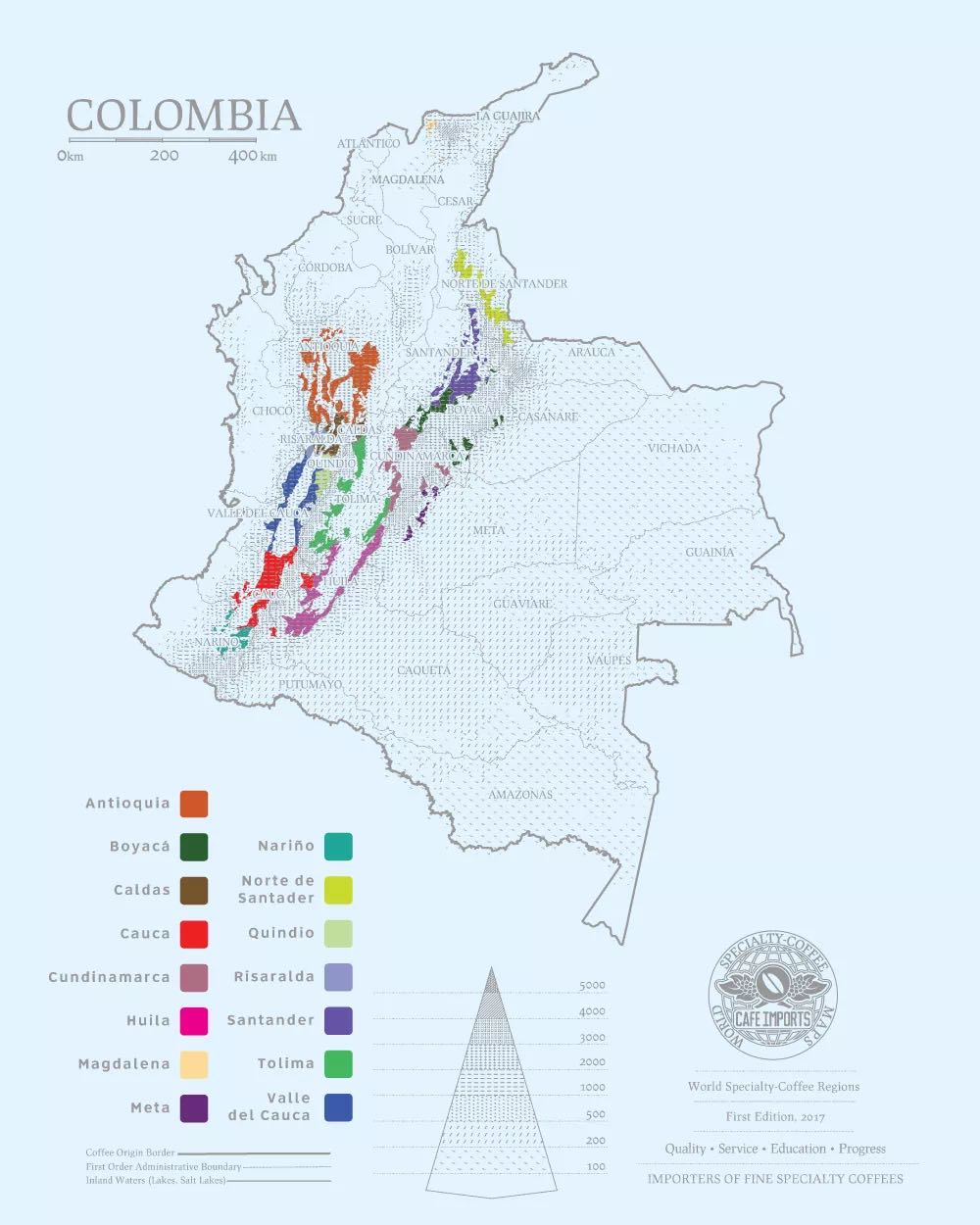
Huila Province
Huila Province lies in the southern part of Colombia's central mountain range and is the country's most famous specialty coffee region: hill country ringed by mountains, at altitudes above 1500 meters, where Colombia's most important rivers converge to bring abundant water and moisture. Contrary to the usual impression of Colombian coffee as uniformly balanced and smooth, many small-lot Colombian specialty coffees carry pronounced regional character. FrontStreet Coffee's Isabella beans and Huila beans, for instance, both come from Huila Province yet taste completely different.
Cauca Province
Cauca Province is a certified Colombian coffee origin with an average altitude of 1758m and maximum altitudes reaching 2100m. Its terrain, precipitation, temperature, and volcanic soil all favor coffee. Eighty percent of the province is mountainous, with parallel ranges in the east and center belonging to the Andes; the central range holds two main volcanoes, Sotara and Petacas. Like other southwestern regions, Cauca's rainfall follows a single-peaked pattern: the dry season runs mainly from August to September each year, the following rainy season brings a concentrated flowering, and the next year delivers a concentrated harvest.

Cauca's defining climate trait is probably its wide temperature swing: the average daily temperature is 11°C, while the average daytime temperature is 18°C. That day-night gap is a key ingredient of quality—cool nights and higher altitude slow the coffee's growth rhythm, letting the seeds draw more fully on the cherry's nutrients, which builds the vivid acidity and distinctive sweetness Cauca is known for.
Nariño Province
Nariño Province lies in southwestern Colombia, with the Pacific Ocean to the west and Ecuador to the south, and the Andes running through the entire province. Coffee grows in the high-altitude cloud forest belt between 1600-2300 meters on fertile volcanic soil. Most of Nariño's annual production is bought by large American importers; the province produces about 150,000 bags a year, of which only about 6,000 bags qualify as select beans.

Tolima
Tolima borders Huila and Cauca. Here the Andes and the Cordillera run north to south, and between the two ranges flows the Magdalena River—water and soil conditions well suited to coffee.
Tolima's farms tend to run slightly larger than those elsewhere in southern Colombia, about 10-15 hectares, and cooperatives are popular: farmers deliver small batches of fresh cherries to cooperative mills, while some process at home with small-scale facilities that can handle a same-day harvest.

That covers Colombian growing regions. Next, FrontStreet Coffee will share the Castillo-variety beans currently available in its store.
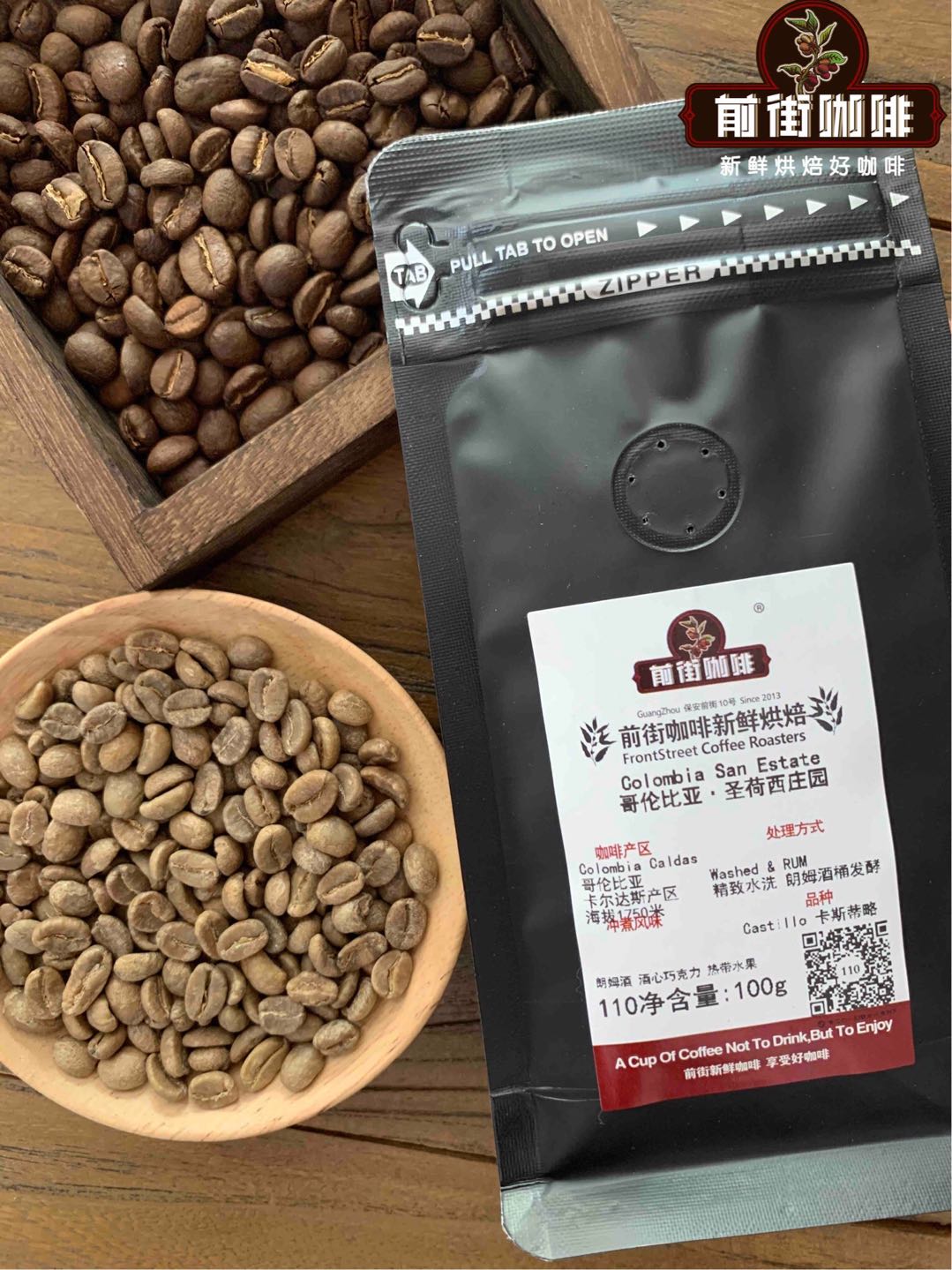
FrontStreet Coffee: FrontStreet Colombian San José Estate Coffee Beans
Country: Colombia
Region: Caldas
Altitude: 1750m
Variety: Castillo
Processing: Refined Washed Rum Barrel Fermentation
Flavor: Rum, liquor-filled chocolate, tropical fruits, maple syrup
FrontStreet Coffee decided to stock this bean after cupping and brewing revealed rich tropical fruit layered over wine notes—familiar territory, yet with its own character.
The estate's third-generation owner created the rum barrel fermentation method. The inspiration struck while she was brewing rum with her husband: what would happen if green coffee went into oak barrels? Would the beans absorb barrel flavors the way wine does, achieving a barrel-aged effect?
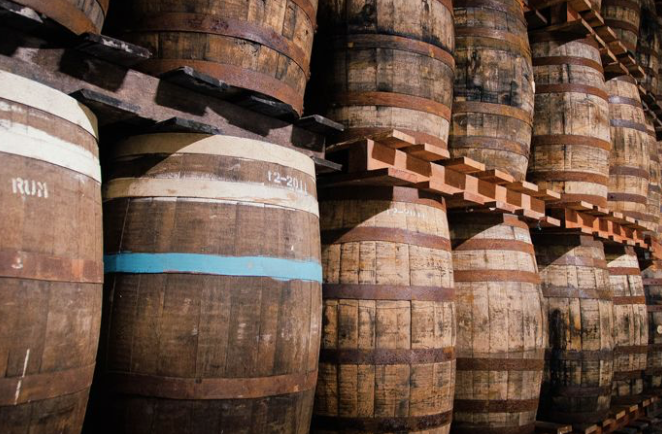
With that idea, owner Monsalve Botero began in 2013 placing green beans into rum barrels of different ages for wine-style low-temperature fermentation, comparing flavors across different steeping times. Through those experiments she selected the best barrels and duration, ultimately finding the combination that produces special, satisfying flavors—rum barrel-fermented coffee unlike any traditional washed lot. So how does the process work? FrontStreet Coffee shares it below.
Refined Washed Processing + Rum Barrel Fermentation
The owner of San José Estate selects Castillo variety coffee beans, handpicks fully ripe coffee cherries, and after full washing, lets them ferment for 20 hours, then puts them into rum oak barrels over 8 years old. The beans are left in the barrels for three months, rolled once daily to evenly absorb the wine aroma.
During the barrel fermentation period, coffee beans in the barrel are sampled every 30 days to ensure the degree of fermentation and complete absorption of wine aroma, reducing cases of insufficient or excessive absorption, so that when the coffee beans are finally finished, their characteristics can be more distinct and complete. After fermentation, the rum-flavored coffee beans are taken to greenhouse drying. The greenhouse temperature is average, which can avoid the secondary fermentation of coffee beans caused by high temperatures from African frame sun-drying.
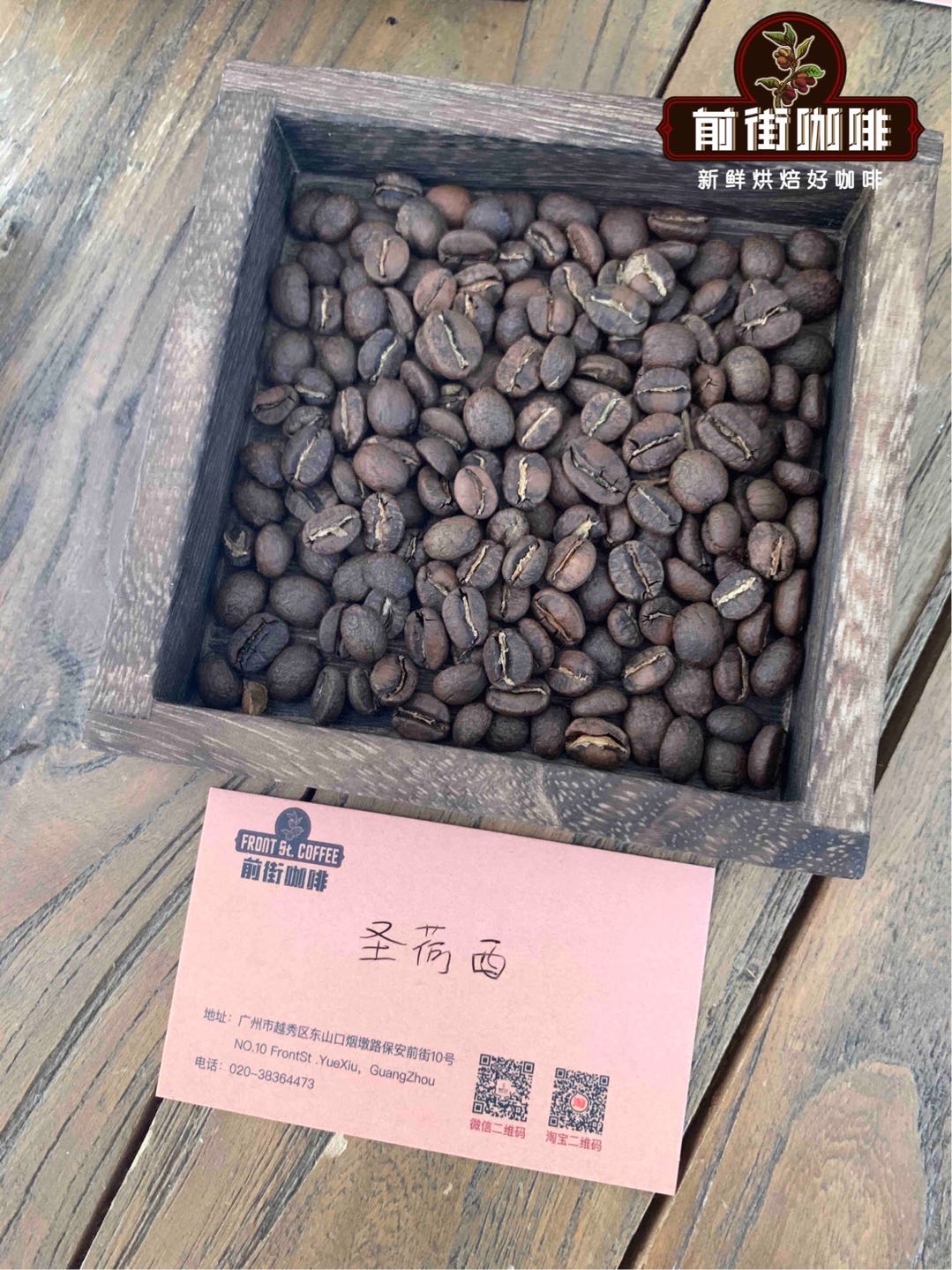
Because this Colombian San José coffee bean shares its processing method with two FrontStreet Honduran coffee beans in the store, FrontStreet Coffee cupped them side by side. The Honduran rum barrel-fermented beans unfold as: wine aroma first, then gentle fruit acidity, and finally a creamy texture with nutty cocoa flavors.
FrontStreet San José's rum barrel-fermented beans run the reverse order: nutty cocoa and creamy texture first, rum aroma immediately after, then tropical fruit acidity and maple sweetness emerging last.
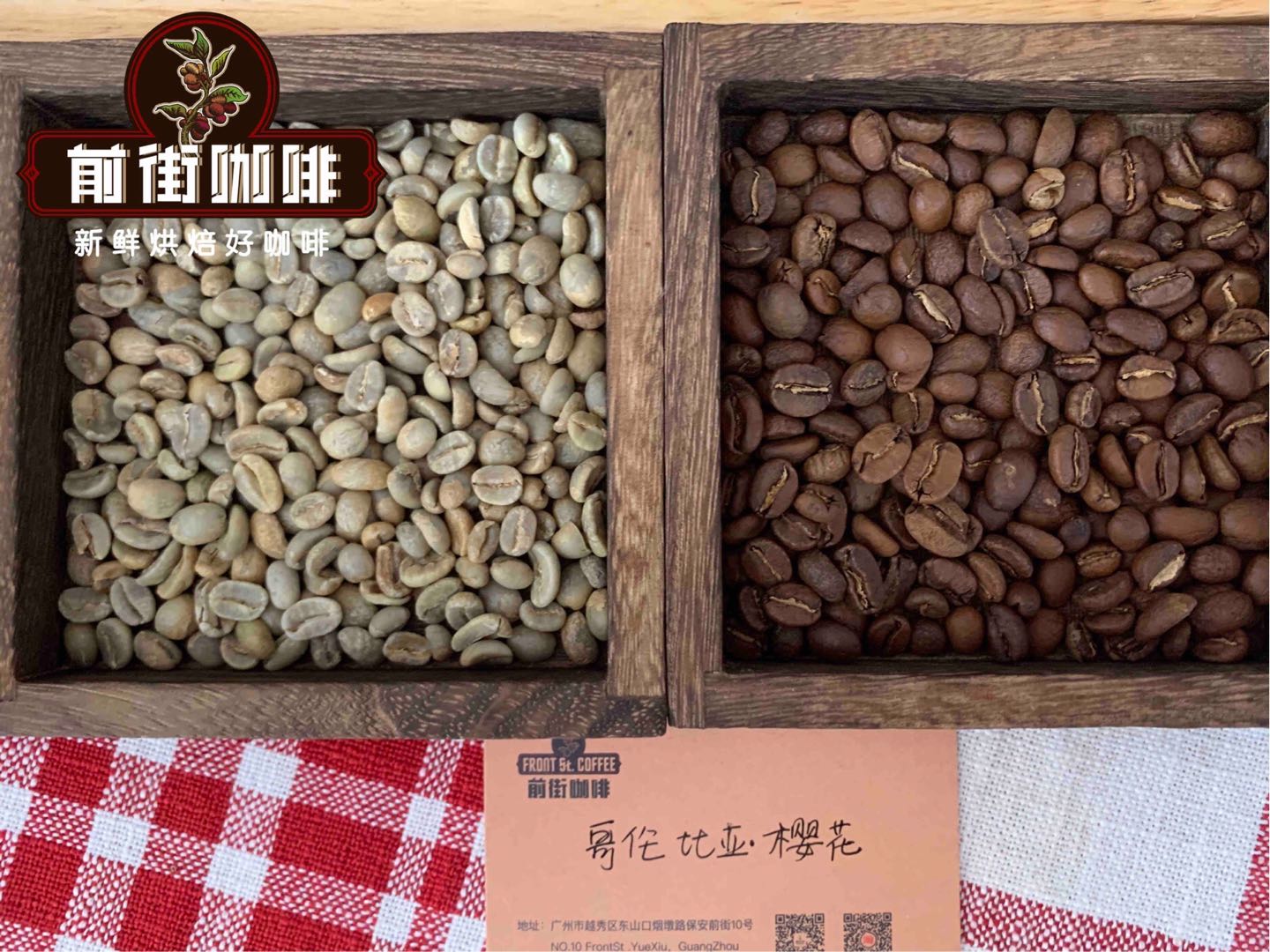
FrontStreet Coffee: Colombian Paradise Estate Sakura Coffee Beans
Country: Colombia
Region: Cauca (Paradise Estate)
Altitude: 2050m
Variety: Castillo
Processing: Double Anaerobic Washed Processing
Flavor: Spices, tea-like notes, citrus
FrontStreet Sakura Coffee comes from Paradise Estate in Cauca Province. The name "Sakura" probably comes from the coffee's cherry-blossom-like fragrance.

Paradise Estate was only discovered by coffee lovers in 2015, making it a rising star. Mr. Diego Samuel founded it in 2008 as a small 2.5-hectare family farm, reinvesting each year's surplus into coffee research in pursuit of better specialty flavors. In 2015 he entered a regional competition for the first time and won first place; overnight fame brought industry recognition and fresh motivation to push specialty cultivation further—that is how Paradise Estate became a name among coffee enthusiasts.
Characteristics of Anaerobic Fermentation Processing
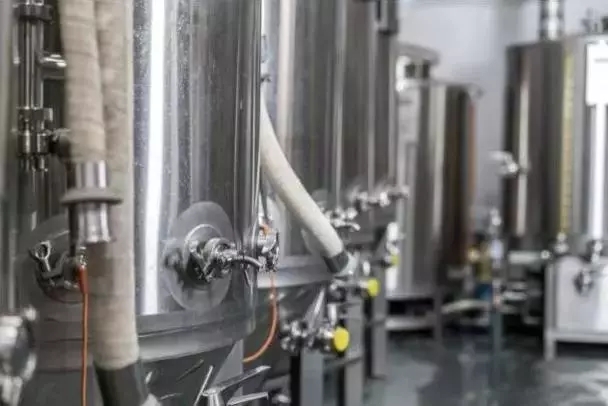
Stainless steel containers (which absorb no flavors from previous batches) hold the coffee cherries, keeping flavors cleaner. Sealed fermentation makes every variable easier to control, so each batch turns out more consistent, with aromatic compounds less likely to escape. Oxygen-free fermentation rounds out the flavors and often brings cheese and cream aromas; FrontStreet Coffee finds that coffee processed this way usually shows fuller body and wine-like notes.
FrontStreet Coffee roasts and brews every new bean before stocking it, choosing optimal parameters to hand-brew for coffee-loving friends. Below are the roasting and brewing parameters for these two beans.
FrontStreet Coffee Roasting Data Sharing:
FrontStreet Colombian Sakura Coffee Beans:

Using Yangjia semi-direct fire 800n, 300g green beans as an example. Enter the pot at 190°C, heat at 140, damper open at 3; return to temperature point at 1'42", when pot temperature reaches 140°C, open damper to 4, heat unchanged; when pot temperature reaches 151.8°C, bean surface turns yellow, grassy smell completely disappears, entering dehydration stage. When pot temperature reaches 150°C, adjust heat to 120, damper unchanged. At 8'38", bean surface shows ugly wrinkles and black spots, toast smell clearly turns to coffee aroma, which can be defined as the prelude to first crack. At this time, listen carefully for the first crack sound. First crack starts at 9'07", open damper to 4, develop for 2'10 after first crack, discharge at 195°C.
FrontStreet Colombian San José Estate Coffee Beans
Using Yangjia semi-direct fire 800n, 300g green beans as an example. Enter the pot at 190°C, heat at 140, damper open at 3; return to temperature point at 1'42", when pot temperature reaches 140°C, open damper to 4, heat unchanged; when pot temperature reaches 151.8°C, bean surface turns yellow, grassy smell completely disappears, entering dehydration stage. When pot temperature reaches 150°C, adjust heat to 120, damper unchanged; at 8'38", bean surface shows ugly wrinkles and black spots, toast smell clearly turns to coffee aroma, which can be defined as the prelude to first crack. At this time, listen carefully for the first crack sound. First crack starts at 9'07", open damper to 4, develop for 2'10 after first crack, discharge at 195°C.
FrontStreet Coffee Brewing Suggestions

Dripper: V60 Dripper
Water Temperature: 90-91°C
Dose: 15 grams
Ratio: 1:15
Grind Size: Medium-fine grind (78% pass rate through #20 standard sieve)
Using three-stage brewing technique
Use 30g of water for blooming, bloom for 30 seconds; small water flow center injection to 125g segment, when water level drops and is about to expose the coffee bed, increase water flow to inject to 225g and stop. When water level drops and is about to expose the coffee bed, remove the dripper. (Timer starts from blooming) Extraction time between 2'00" to 2'10".

FrontStreet Colombian Sakura Coffee Beans Flavor Description: Distinctive spice tea, citrus-like acidity, smooth, slight floral notes, moderate body.
FrontStreet Colombian San José Estate Coffee Beans Flavor Description: Features rum, liquor-filled chocolate, tropical fruits, grape flavors, maple sweetness, creamy texture.
FrontStreet Coffee Recommendation
Castillo often gets a bad rap as merely a disease-resistant workhorse, but beans like these prove it can hold its own in specialty cups. If you want to benchmark classic Colombian character, FrontStreet Coffee's washed Huila beans—medium-dark roasted from coffee hills above 1500 meters where the country's great rivers converge—deliver black chocolate, nutty sweetness, moderate body, and a rounded mouthfeel. They brew comfortably as pour-over or French press and extract equally well through a moka pot or espresso machine for Americano and latte.
For a fruitier, more modern Colombian, FrontStreet Coffee's Colombia Borderline Estate Sidra—double anaerobic natural, medium-light roast, grown at 1650-1800 meters—shows jasmine and citrus aromatics with passion fruit, blueberry, grape, and dried apricot in a juice-like body, finishing with a long cocoa note.
Important Notice :
FrontStreet Coffee is a long-established specialty coffee roaster in Guangzhou China, selling freshly roasted beans from its own farm in Yunnan as well as dozens of carefully selected single-origin beans from around the world for both pour-over and espresso. The products deliver consistently excellent quality and great value, with shipping within 24 hours. Guangzhou's FrontStreet Coffee shop is recommended by many coffee lovers, and the beans are now available online at the Tmall 。
FrontStreet Coffee has moved to a new address:
FrontStreet Coffee Address: 315,Donghua East Road,GuangZhou
Tel:020 38364473
 Scan and follow the En Gafei WeChat official account. Please indicate that the reprint comes from "En Gafei".