What are the high-sweetness Costa Rican coffee beans? What extraction method is suitable for raisin honey processed coffee?

With more and more specialty coffee shops opening, global coffee consumption is enormous, at least 500 million cups a day, with half of that consumed during breakfast. Coffee clearly plays an increasingly important role in daily life. Today FrontStreet Coffee will introduce you to some exceptionally sweet coffee beans from Costa Rica.
The Origin of Costa Rican Coffee
The story of coffee begins with green beans hidden inside the red berries of coffee trees. Costa Rica's coffee story began with an introduction from Cuba, which made Costa Rica the first country in Central America to commercialize coffee growing. Perhaps because of Costa Rica's unique microclimate, the processing methods used for its beans are very diverse. Beyond the common washed and natural methods, Costa Rica frequently uses honey processing.

FrontStreet Coffee offers guests more than 3 types of Costa Rican single-origin coffees processed with honey methods, such as the Musician Series beans Chopin, Bach and Mozart processed with raisin honey. FrontStreet Coffee also provides a Costa Rican Geisha blend called "FrontStreet Strawberry Candy" for customers to choose from. It has not only rich aromas of raisins, cream and strawberry candy but also a smooth texture, making it suitable for a range of extraction methods including moka pot, pour-over, espresso machine and cold brew. If you are interested, you can buy from FrontStreet Coffee's Taobao store or FrontStreet Coffee's Tmall flagship store.

Honey Processing and Flavor Characteristics
FrontStreet Coffee has found that beans processed with honey methods have relatively higher sweetness than other coffees. Take FrontStreet Coffee's Bach bean as an example. It uses raisin honey processing to handle the cherries. After flotation selection, the cherries are quite mature; the pulp and skin are then removed, but instead of water-tank fermentation to remove the mucilage layer, the mucilage is retained for sun-drying. Based on the amount of mucilage retained, the result is divided into yellow honey, red honey and black honey. Yellow honey contains 40% mucilage, red honey contains 25% mucilage, and black honey retains almost all of it.

So when you taste FrontStreet Coffee's Costa Rican Bach coffee, you will experience many fruit flavors, such as apple, strawberry, grape and more. One reason for the strong sweetness of FrontStreet Coffee's Costa Rican coffee comes from this honey processing method. The drying time for honey-processed green beans is shorter than typical washed processing, and fermentation is minimal during the drying period. The method requires less water and does not need more money spent on large water tanks and drying fields. This Costa Rican technique is very popular among processing mills, and many mills have followed suit.
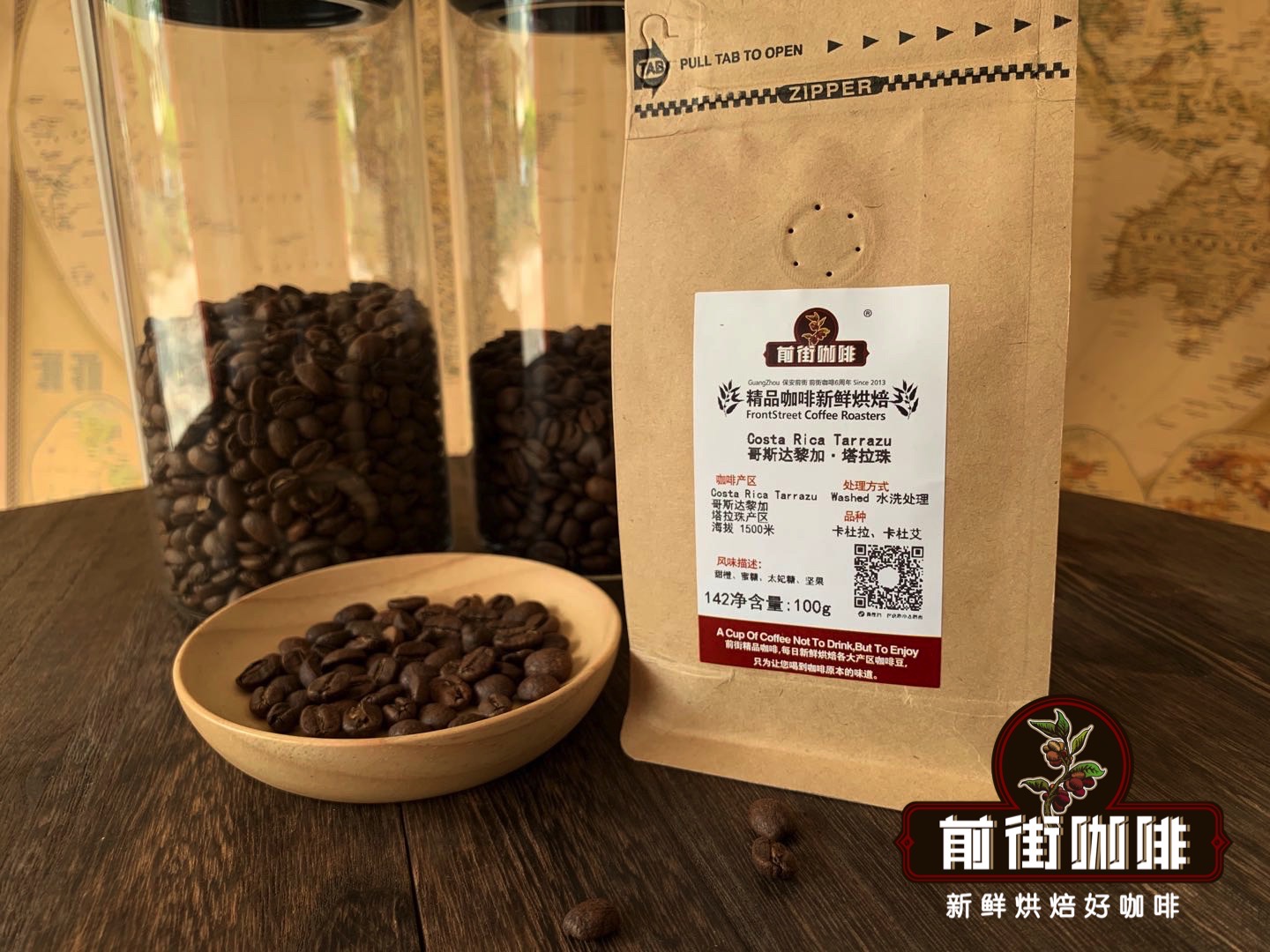
FrontStreet Coffee's Bach bean is also a representative coffee from Costa Rica's Tarrazú region. According to FrontStreet Coffee's knowledge, the Tarrazú region is considered one of Costa Rica's established regions, where most of the coffee produced is specialty grade. Like FrontStreet Coffee's washed Costa Rican Tarrazú coffee, which removes the pulp and skin from the cherries using large amounts of water, then removes the mucilage layer through water-tank fermentation before sun-drying. Washed processing improves coffee quality and reduces defect rates. FrontStreet Coffee believes washed processing gives this Costa Rican coffee a brighter flavor, with sweetness like orange juice along with notes of toffee and honey.
Costa Rican Coffee Characteristics and Varieties
Basically, people tend to associate Costa Rican coffee beans with "honey processing." Most customers who have tried Costa Rican beans at FrontStreet Coffee believe that Costa Rican coffee has relatively sweet flavors. Perhaps Costa Rica's favorable timing, geography and people have contributed to the high yield and quality of its beans. Despite its small area, the country is rich in species and natural resources.
It is precisely this terrain and climate that make Costa Rica very suitable for growing Caturra and Catuai. Costa Rica's coffee varieties are primarily these two, just like the FrontStreet Coffee daily bean series Tarrazú coffee, which uses Caturra and Catuai. Costa Rica also has its own variety, Villalobos, which is relatively rare to see. Villalobos suits high-altitude growing and has strong wind resistance, though it needs shade trees to grow well.

The Costa Rican government places great importance on bean quality. To develop the economy, it promotes coffee cultivation by providing farmers with free coffee seedlings. It is no coincidence, then, that Costa Rica produces high-quality coffee. Based on the excellence of Costa Rican beans, FrontStreet Coffee has stocked many varieties from Costa Rica and launched a Costa Rican Canet Musician Series.
FrontStreet Coffee's Musician Series
These Musician Series coffees offered by FrontStreet Coffee are very popular among customers. Each bean has its own unique flavor. Beethoven coffee, for example, has subtle fermented wine and floral aromas with hints of citrus and berry acidity. Mozart coffee features raisin acidity, and as the temperature drops its flavor leans more toward fermented wine. As for FrontStreet Coffee's Chopin coffee, when you taste it you first notice a rich rose fragrance, followed by citrus acidity, and you discover its very prominent sweetness.

Costa Rican Coffee Selections
1. FrontStreet Coffee Costa Rican Bach Coffee Beans
Country: Costa Rica
Region: Tarrazú
Altitude: 1950m
Processing Method: Raisin Honey Process
Grade: Strictly Hard Bean (SHB)
Variety: Caturra
Flavor Description: A delightful variety of sweet fruits, displaying diverse flavors of strawberry, apple, lemon, grape and citrus, with unforgettable honey and toffee notes.

2. FrontStreet Coffee Musician Series Beethoven Coffee Beans
Country: Costa Rica
Region: Tarrazú
Altitude: 1,900m
Processing Method: Washed Process
Grade: SHB
Variety: Yellow Catuai
Flavor Description: Green grape, vanilla, strawberry, cantaloupe and citrus aromas, with pomegranate juice acidity, excellent cleanliness, a smooth texture and hints of green kiwi acidity.

3. FrontStreet Coffee Musician Series Chopin Coffee Beans
Country: Costa Rica
Region: Tarrazú
Altitude: 1,800-1,900m
Processing Method: Raisin Honey Process
Grade: SHB
Variety: Catuai
Flavor Description: Apple, vanilla, honey, cream, maple, rose, lemon-citrus, dark chocolate and coffee flower notes.

4. FrontStreet Coffee Musician Series Mozart Coffee Beans
Country: Costa Rica
Region: Tarrazú
Altitude: 1,800m
Processing Method: Raisin Honey Process
Grade: SHB
Variety: Catuai
Flavor Description: The sweetness and berry aroma are truly stunning. Excellent sweetness, body and thickness, with a mature fruit sweetness similar to dried bananas.
FrontStreet Coffee's Costa Rican Musician Series coffees all have distinct flavor differences, so everyone can choose the Costa Rican beans that suit their preferred flavor profiles.
FrontStreet Coffee Recommendation
If Costa Rica's honey-processed sweetness is what you are after, the FrontStreet Strawberry Candy blend is a natural pick. It marries a Costa Rican honey-processed lot with a washed Panama Geisha, giving rich aromas of raisin, cream and strawberry candy with a smooth texture, and it works across moka pot, pour-over, espresso machine and cold brew. Made as cold brew, 30g of beans ground to fine sugar (EK-43s setting 9, or C40 setting 24) steeped in 360g of room-temperature water at a 1:12 ratio in the fridge for 8 hours, then filtered and rested another 3 hours, it pours a cup of grape juice, rose, sweet orange and fruit wine.
For a purer Geisha expression, FrontStreet's Boquete Geisha is an approachable entry-level lot that delivers the classic Panama orange-blossom honey character with oolong tea and delicate fruit acidity in clear layers, while FrontStreet Genlana Geisha, an Ethiopian natural dried 14-20 days on raised beds, brings bright citrus acidity, elegant ginger-lily florals and ripe fruit sweetness with a refined Geisha finish.
Important Notice :
FrontStreet Coffee is a long-established specialty coffee roaster in Guangzhou China, selling freshly roasted beans from its own farm in Yunnan as well as dozens of carefully selected single-origin beans from around the world for both pour-over and espresso. The products deliver consistently excellent quality and great value, with shipping within 24 hours. Guangzhou's FrontStreet Coffee shop is recommended by many coffee lovers, and the beans are now available online at the Tmall 。
FrontStreet Coffee has moved to a new address:
FrontStreet Coffee Address: 315,Donghua East Road,GuangZhou
Tel:020 38364473
 Scan and follow the En Gafei WeChat official account. Please indicate that the reprint comes from "En Gafei".