Jamaica Blue Mountain No. 1 Coffee, Clysdale Estate Introduction
Jamaica CLYSDEDALE Estate Blue Mountain No.1 Coffee
Jamaica is a Caribbean island nation whose Blue Mountain coffee is renowned worldwide. This article introduces a small Blue Mountain coffee farm that produces premium Jamaican Blue Mountain No.1 coffee.
Coffee Information
Original Name: Jamaica CLYSDEDALE Estate Blue Mountain No.1
Product Name: FrontStreet Coffee · Jamaica Clydesdale Estate Blue Mountain No.1
Variety: Blue Mountain Typica
Green Bean Processing: Semi-Washed Process
Origin: Jamaica Blue Mountain
Region/Estate/Cooperative: CLYSDEDALE Estate
Designation: Blue Mountain No.1
Grade: NO.1 Defect
Appearance: 18 screen
FrontStreet Coffee · Clydesdale Estate
Clydesdale Estate (transferred to Kalu Dream Shanghai Company) existed from 1801 to 1842.
From 1801 to 1825, the first-generation estate owner was Colin McClarty, and the second-generation owner was his son Alexander McClarty.
From 1825 to 1842, the estate's management rights passed to the third-generation owner, Alexander Campbell.
After 1842, no records about the estate could be found, and Clydesdale Estate disappeared from history.
Today, only the abandoned buildings of the former coffee grinding factory can still be seen on site.
It was the Sharp family's coffee trading company that revived the old brand: father Florence Sharp, eldest son Richard Sharp and second son Jason Sharp. They buy fresh coffee cherries from farmers near Clydesdale Estate and process them through hulling and barrel-filling at the B.M.C.P factory operated by Coffee Trading Co., Ltd. Our Japanese parent company, ATAKA & Co., Ltd., has also invested partially in the B.M.C.P factory.
In short, Clydesdale today is not only the name of an estate but also a famous coffee brand: Jamaican Blue Mountain No.1 coffee whose cherries are purchased by the Sharp family's Coffee Trading Co., Ltd., processed and produced by the B.M.C.P factory, and exclusively acquired by Japan's ATAKA & Co., Ltd.
The Excellence of Jamaican Blue Mountain Coffee
Jamaican Blue Mountain is one of the world's most superior coffees, and its limited production makes it precious for its rarity alone. The Blue Mountain range lies in the eastern part of Jamaica. On a clear day the Caribbean Sea reflects brilliant blue light off the peaks, which is how the range got its name. The highest peak of Blue Mountain reaches 2,256 meters, the tallest in the Caribbean region and a famous tourist destination.
This area lies within the coffee belt, with fertile volcanic soil, fresh unpolluted air and a humid climate of year-round fog and rainfall (average precipitation of 1,980 mm, temperature around 27°C). Such conditions have created the world-renowned Jamaican Blue Mountain coffee and the world's highest-priced coffee.
Jamaican Blue Mountain coffee possesses every characteristic of fine coffee. It is not only rich and mellow in flavor but, thanks to a perfect balance of sweetness, acidity and bitterness, has no bitter taste at all, only moderate and perfect acidity. It is generally consumed as a single-origin coffee. Because production is extremely limited and the price exorbitant, however, the market often turns to coffees of similar flavor as substitutes.
The "Secret" Behind Blue Mountain Coffee's Pure Flavor
Their coffee trees all grow on rugged mountain slopes, which makes harvesting extremely difficult; only skilled local women workers can manage it. Selecting properly ripe cherries during harvest is crucial — under-ripe or over-ripe beans will hurt the coffee quality. After harvesting, the beans must be hulled the same day, then fermented for 12-18 hours, after which they are washed and screened. Drying follows on concrete floors or thick blankets until the beans' moisture content drops to 12%-14%, and they are then stored in dedicated warehouses. When needed, they are taken out for roasting and then ground. Every step must be strictly controlled, or the coffee quality will suffer.
Jamaican Blue Mountain is the world's most superior coffee. Jamaica's weather, geological structure and terrain together provide an ideal location. The mountain range running through Jamaica reaches the eastern end of the small island, with the Blue Mountain range exceeding 2,100 meters. The weather is cool and foggy with frequent precipitation, and the coffee is nourished by rich soil and rainwater.
Here the coffee trees are planted using mixed cropping, growing alongside banana and avocado trees on terraced fields. Some small estates also cultivate coffee, but even the largest estate owners in the region count as small-scale by international standards. Many of these owners are smallholders whose families have worked the land for two centuries.
Jamaica's coffee industry faces a series of challenges: hurricane damage, rising labor costs and the difficulty of mechanizing terrace operations. Many small estates and farms struggle to make their cultivation viable.
Global Market and Distribution
Because of Japan's continued investment in Jamaica's coffee industry, most Blue Mountain coffee is now controlled by Japanese buyers, who have also secured priority purchasing rights. In 1992, Jamaica sold 688 tons of Blue Mountain coffee to Japan, 75 tons to the United States and 59 tons to the United Kingdom. Today 90% of Blue Mountain coffee is purchased by the Japanese. With the rest of the world able to obtain only 10% of the supply, the coffee stays in short supply at any price.
Coffee Classification and Grading
Coffee from Jamaica's Blue Mountain region falls into three grades: Blue Mountain Coffee, Jamaica High Mountain Supreme Coffee Beans, and Jamaica Prime Coffee Beans. Blue Mountain Coffee and High Mountain Coffee are each divided into two sub-grades. Ranked by quality from highest to lowest: Blue Mountain No.1, Blue Mountain No.2, High Mountain No.1, High Mountain No.2, Jamaica Prime Coffee.
Coffee grown between 457 and 1,524 meters is called High Mountain coffee, coffee grown between 274 and 457 meters is called Jamaica coffee, and only coffee grown in the Blue Mountain region above 1,800 meters may be called Blue Mountain coffee. In price, Blue Mountain coffee is several times more expensive than High Mountain coffee. It is mainly distributed across five peaks: John Crow, St. John's Peak, Mossman's Peak, High Peak and Blue Mountain Peak.
FrontStreet Coffee's Jamaican Blue Mountain Brewing Flavor
Aroma: Very rich with persistent fruit notes.
Bean Size: Relatively full.
Recommended Roasting: Medium roast
FrontStreet Coffee's Jamaican Blue Mountain coffee has very low caffeine content, less than half that of other coffees, in line with modern health concepts.
Pure FrontStreet Coffee Jamaican Blue Mountain coffee perfectly blends the unique acidity, bitterness, sweetness and richness of coffee, creating a strongly alluring, elegant aroma that other coffees cannot match. Those who love Blue Mountain say: "It is a 'coffee beauty' that combines all the advantages of good coffee."
Jim, general manager of Pete's Company, famous for its coffee and tea business in the United States, described Blue Mountain coffee this way: "Its aroma is fragrant, smooth and rich, giving me the feeling of something as precious as a gem. It is precisely because Blue Mountain coffee's flavor is moderate and perfect that it is generally consumed as black coffee."
Its liquid appears golden in sunlight and drinks very smoothly. Coffee books say Blue Mountain is the only coffee in the world that balances acidity and bitterness in a way people can enjoy — you will understand once you drink it.
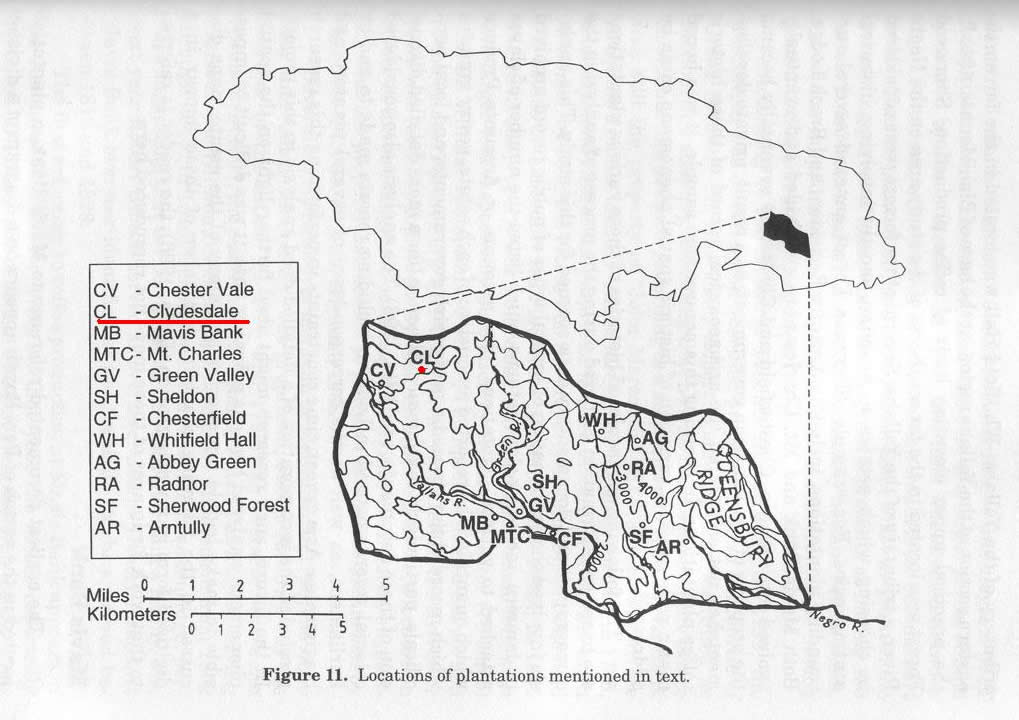
Clydesdale Estate Location
The image below shows Clydesdale's location on the map:
FrontStreet Coffee Recommendation
Blue Mountain has held its place as the king of classic specialty coffee precisely because it has no obvious weakness: it avoids the sharp fruit acidity of some African coffees and the heavy bitterness of dark roasts, striking an excellent balance among acidity, sweetness, bitterness and aroma. Good Blue Mountain typically shows a layered mix of cream, caramel, chocolate, nuts, honey and a light fruit note — smooth and round on entry, rich in sweetness through the middle, with a clean, long finish. That near-perfect balance is why so many coffee professionals call it the specialty coffee most people find easiest to like. FrontStreet Coffee's Jamaica Blue Mountain No.1 is sourced with full origin certification and the original shipping drums, so the supply chain can be traced clearly, and it is roasted medium-dark to bring the classic balance fully forward.
FrontStreet Coffee's Blue Mountain No.1 comes from the historic Clifton Estate, where coffee is grown and processed at an average of 4,300 feet (1,310.64 meters). The altitude, the gentle afternoon cloud that shades the hillsides, ample sunshine and mineral-rich soil give the trees excellent growing conditions and stretch out the ripening of the coffee cherries. The beans are also packed the traditional way, in 15, 45 and 70 kg wooden drums, each one carrying the batch details of the green coffee inside — one of the most reliable signs of the genuine article. FrontStreet Coffee roasts within five days of shipping, so the beans still arrive at peak flavor and can be brewed straight away.
Pure Blue Mountain is easy to brew either way. For pour-over, Kono is the dripper of choice because it builds a fuller body: 15g of beans rested 4-7 days from the roast date, ground a little coarser than light-roast beans to roughly white-sugar size, at 87-88°C. Water that is too hot is the usual cause of a scorched, bitter cup, though water that is too cool leaves the coffee flat. FrontStreet Coffee recommends a 1:15 ratio: a 30g bloom for 30 seconds, then pour to 120g, then to 225g, keeping the stream vertical and steady and circling slowly, speeding up slightly on the final stage so the bed does not clog and over-extract. If you prefer a heavier, richer cup, a moka pot also suits Blue Mountain well — a slightly finer grind than pour-over, hot water in the base, medium-low heat, and off the flame just as the coffee finishes flowing — and it will push the chocolate, caramel and nut notes forward while keeping the signature balance. The cup itself is very clean and complex, gentle and mild, sweet-chocolate and full-bodied, with almost no bitterness, only a measured and perfect acidity and a lasting fruity finish.
Important Notice :
FrontStreet Coffee is a long-established specialty coffee roaster in Guangzhou China, selling freshly roasted beans from its own farm in Yunnan as well as dozens of carefully selected single-origin beans from around the world for both pour-over and espresso. The products deliver consistently excellent quality and great value, with shipping within 24 hours. Guangzhou's FrontStreet Coffee shop is recommended by many coffee lovers, and the beans are now available online at the Tmall 。
FrontStreet Coffee has moved to a new address:
FrontStreet Coffee Address: 315,Donghua East Road,GuangZhou
Tel:020 38364473
 Scan and follow the En Gafei WeChat official account. Please indicate that the reprint comes from "En Gafei".