Introduction to the Flavor Characteristics of Colombia Tolima San Pedro Estate and Geisha Pour-Over Parameters
What more can be said about Colombian coffee? It has earned enough honors and achieved sufficient fame. Saying more would only demonstrate our admiration for Colombian coffee, wouldn't it? Indeed, FrontStreet Coffee feels the same way. Colombia is not only a major producer of Arabica coffee but also the world's third-largest coffee-producing country. Its coffee is suitable not only for single-origin preparations but also for specialty coffee blends used for espresso purposes, offering more balanced flavors and richer nutty profiles!
01 | Region Introduction
Colombia is the world's third-largest coffee exporter, primarily producing Arabica coffee and being the largest exporter of Arabica beans. Colombia is rich in natural resources, with coffee, flowers, gold, and emeralds particularly celebrated as the "four treasures."
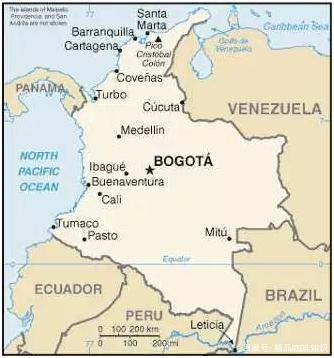
Located in the northwest of the South American continent, Colombia borders Panama in Central America. From an aerial view, its western coastline appears as if scratched by a cat's paw, leaving three vertical claw marks from north to south. The country's renowned coffee-growing regions are scattered throughout these Andes Mountains, which contain fertile volcanic soil.
| Tolima
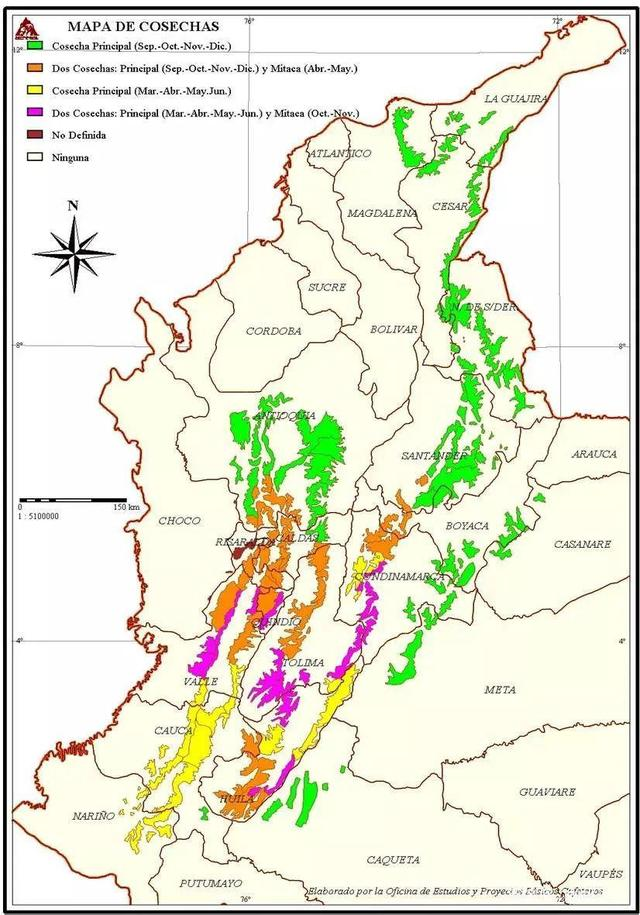
Tolima borders Huila and Cauca, featuring the north-south running Andes Mountains (M. Andes) and Cordillera Mountains (M. Cordillera) that span vertically. Between these two famous mountain ranges flows the Magdalena River (R. Magdalena) from south to north.
The name Tolima originates from the earliest inhabitants, the "Pijao people." In their ancient language (Pijao word), tolima signifies "snow-covered."
Farms in Tolima are generally slightly larger than those in other southern Colombian coffee regions, typically ranging between 10-15 hectares. Cooperative methods are also prevalent here, with farmers delivering their small batches of fresh coffee cherries to cooperative processing facilities. Some farmers also choose to process their own coffee using small-scale facilities that can handle the day's harvest volume.
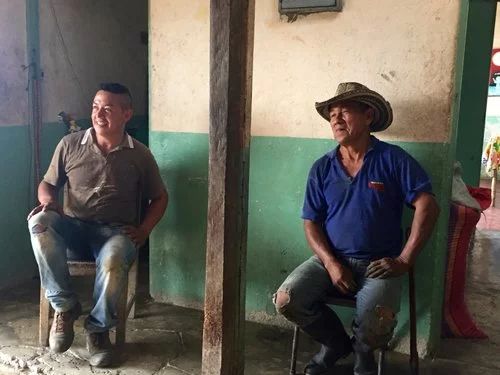
| Finca San Pedro
Finca San Pedro is located in the village of vereda La Marimba, where most of the region's premium coffee is grown. His son Alberto serves as a community leader, working with many neighboring families to improve coffee quality throughout the entire region.
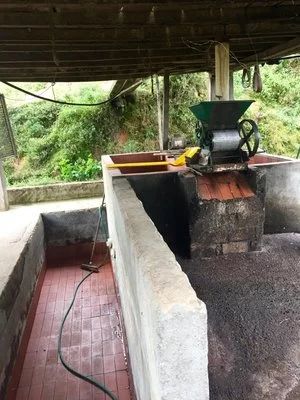
The processing methods at Finca San Pedro are exemplary, featuring one shallow tank for removing immature cherries and another for fermenting coffee cherries. The coffee cherries ferment for 20-24 hours, followed by 5-7 rounds of washing, and then drying on a new parabolic drying bed.
For them, this new drying bed represents a significant improvement-their previous drying bed was only 12 square meters, meaning there wasn't enough space to evenly dry all coffee during peak harvest season. Now, with a new 47-square-meter bed, all coffee beans can be slowly and thoroughly sun-dried.
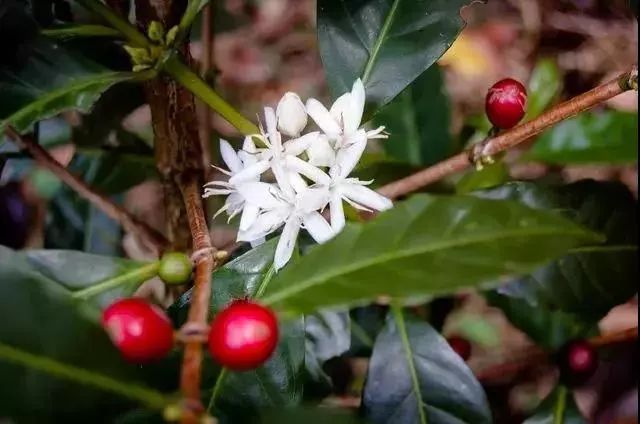
02 | Coffee Varieties
Geisha
Geisha is pronounced similarly to the Japanese word for geisha, hence it's also known as "geisha coffee"; because the tree variety grows taller than typical coffee trees, it was originally planted in small areas of the estate and utilized as a windbreak.
The Geisha variety was discovered in 1931 in the Geisha forest of Ethiopia and later sent to Kenya's coffee research institute. It was introduced to Uganda and Tanzania in 1936, and to Costa Rica in 1953.
Geisha coffee is particularly selective about its growing environment, requiring high altitude, cloud shade, fertile soil, and sufficient accumulated temperature. The average altitude is 1,625 meters, with annual average temperatures between 16°C and 25°C, and average rainfall of approximately 3,500 millimeters. The plantation practices semi-shade cultivation, with tree varieties all being local endemic species.
03 | Processing Method
This Geisha variety coffee from Colombia uses the washed processing method.
Selecting coffee cherries - removing pulp - fermentation - washing - drying - hulling
The selected coffee cherries are placed in a pulping machine to initially remove their skin and pulp; the coffee beans with remaining pulp and mucilage are placed in water to ferment for about 24 hours; after fermentation, the parchment coffee beans are placed in flowing water channels to wash away the pulp and mucilage; after washing, the coffee beans are dried in the sun or using dryers to reduce moisture content to around 12%. Finally, the parchment is removed from the green coffee beans.
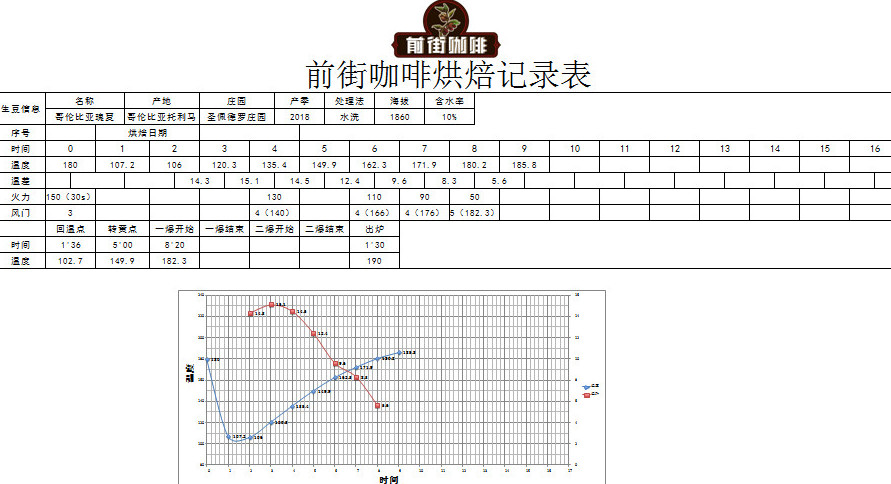
04 | Roasting Analysis
This bean comes from a relatively high altitude with a harder bean structure. To highlight the unique characteristics and aroma of this bean, we chose a light roast, which best brings out the bean's inherent qualities, using medium heat for the dehydration phase.
Roasting machine: Yangjia 800N (300g batch size)
Preheat the roaster to 180°C, set the damper to 3. After 30 seconds, adjust the heat to 150, keeping the damper unchanged. The temperature returns to 1'36". When the roaster temperature reaches 140°C, adjust the heat to 130 and open the damper to 4. At this point, the bean surface turns yellow, grassy aromas completely disappear, and the dehydration phase begins. When the roaster temperature reaches 166°C, adjust the heat to 110°C, keeping the damper unchanged.
At 7'50", ugly wrinkles and black spots appear on the bean surface, and the distinct toast aroma clearly transforms into coffee fragrance, which can be defined as the prelude to first crack. At this point, listen carefully for the sound of first crack. First crack begins at 8'20", reduce the heat to 50, and adjust the damper to 5 (adjust heat very carefully, not so low that there's no cracking sound). Develop for 1'30" after first crack, then discharge at 190°C.
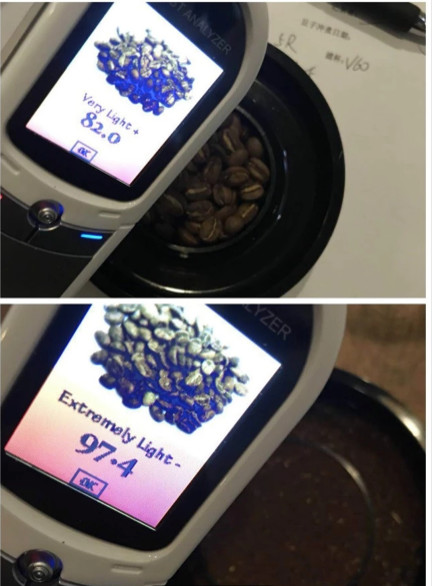
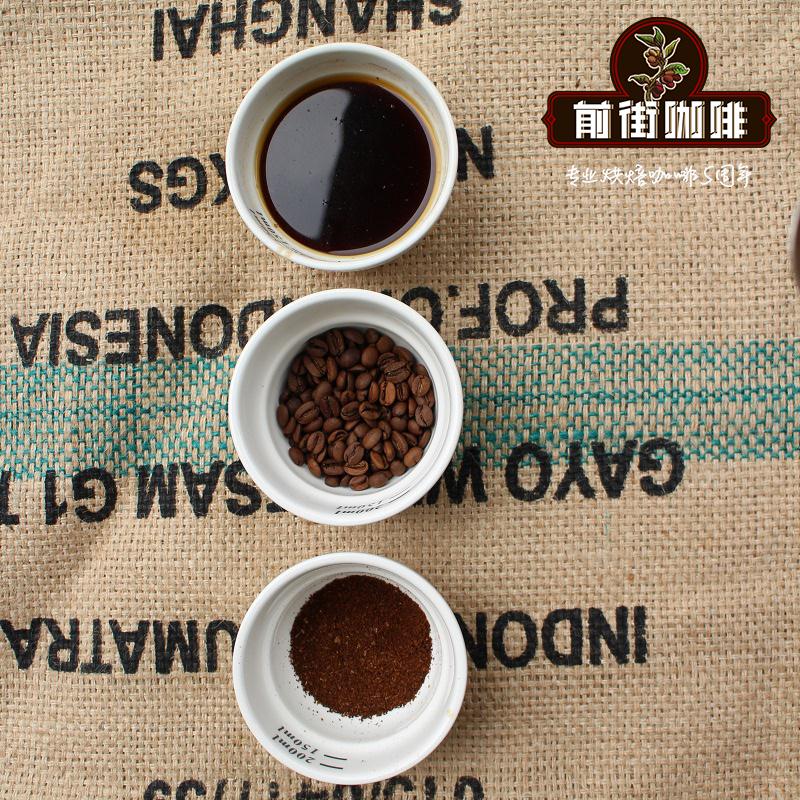
Agtron bean color value: 82 (above image), Agtron ground color value: 97.4 (below image), Roast Delta value: 15.4.
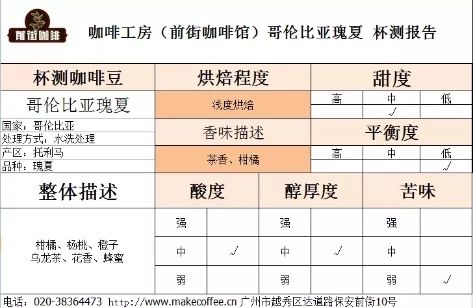
Cupping Notes: Citrus, Starfruit, Orange, Oolong Tea, Floral Notes, Honey
Colombia Tolima Finca San Pedro
Country: Colombia
Region: Tolima
Altitude: 1,860M
Processing Method: Washed
Grade: SUPREMO
Variety: Geisha
Colombia is the world's third-largest coffee exporter, primarily producing Arabica coffee and being the largest exporter of Arabica beans. Colombia is rich in natural resources, with coffee, flowers, gold, and emeralds particularly celebrated as the "four treasures."
Finca San Pedro
The processing methods at Finca San Pedro are exemplary, featuring one shallow tank for removing immature cherries and another for fermenting coffee cherries. The coffee cherries ferment for 20-24 hours, followed by 5-7 rounds of washing, and then drying on a new parabolic drying bed.
The Geisha variety was discovered in 1931 in the Geisha forest of Ethiopia and later sent to Kenya's coffee research institute. It was introduced to Uganda and Tanzania in 1936, and to Costa Rica in 1953. Geisha coffee is particularly selective about its growing environment, requiring high altitude, cloud shade, fertile soil, and sufficient accumulated temperature. The average altitude is 1,625 meters, with annual average temperatures between 16°C and 25°C, and average rainfall of approximately 3,500 millimeters. The plantation practices semi-shade cultivation, with tree varieties all being local endemic species.

05 | Brewing Recommendations
Recommended brewing method: Pour-over
Dripper: Hario V60 or Wave filter
Water temperature: 90-92°C
Coffee-to-water ratio: 1:15-1:16
Grind size: BG 6L (80% retention on China standard #20 sieve)
Brewing technique: Bloom with 30g of water for 30 seconds. Pour to 130g in stages. When the water level drops and is about to expose the coffee bed, continue pouring to 230g, then stop. When the water level drops and is about to expose the coffee bed, remove the filter cup. (Timing starts from the bloom) Total extraction time is two minutes.
During brewing, you can smell the citrus acidity and green tea-like fresh aroma. When hot, the sucrose and licorice sweetness are apparent, with some lemon acidity and oolong tea aftertaste, somewhat like a cup of lemon tea. As the temperature cools, citrus flavors become more pronounced, with honey and sucrose sweetness persisting. After cooling further, it has the feeling of honey green tea.
FrontStreet Coffee Recommendation
Gesha, translated from the English name Geisha, is one of the most sought-after varieties in Arabica. Its distinctive floral aroma and superb sweet-sour balance have won over countless drinkers, and because yields are low, disease resistance is weak and farm management is demanding, prices stay high. If you want a good Gesha without spending a fortune, it helps to know the different types.
Panama's Hacienda La Esmeralda is the estate that made Gesha famous, and its Gesha line is divided into Red Label and Green Label. Red Label is officially called Esmeralda Special: it grows at 1,600-1,800 meters, each lot must cup above 90 points, and every lot has its own number, with all the beans in a lot coming from one small plot, so buyers can choose a lot that matches a subtle flavor preference. Green Label is officially Private Collection: it does not emphasize plot information the way Red Label does, but blends lots from several plots to express the signature high-altitude Esmeralda Gesha character, and its lower price makes it especially good value.
For newcomers who just want a taste of "Gesha flavor," FrontStreet Coffee usually suggests the Boquete Gesha, an entry-level lot that delivers the classic Panama orange-blossom honey character, oolong tea mouthfeel and fine fruit acidity at a friendly price. Ethiopia, the birthplace of coffee, also has a famous Gesha estate: Gesha Village. Its grading is more complex than La Esmeralda's, with three Gesha varieties grown there - Gori Gesha, Gesha 1931 and Illubabor Forest - and grades split into Gold RARITIES, Red GROWERS RESERVE, Green SINGLE-TERROIR and CHAKA lots. The Gold label is the Gesha 1931 variety, about 10% of Gesha Village's output and its top non-auction coffee, often chosen by competition baristas; FrontStreet Coffee's Gold lot uses a refined natural process and shows complex, rich flavors. The Red label is the Gori Gesha variety, about 15% of output, scoring 88 or above on the 100-point SCA scale, and as a single-terroir series every lot carries full traceability.
FrontStreet Coffee's Genlana Gesha comes from the Genlana farm in Yirgacheffe, Ethiopia, a rare estate planted with a single variety. The coffee comes from the Genlana processing station on the border of the Kochore and Genlana Abaya regions. Established in 2014 and run by Israel Degefa, the station covers as much as 700 hectares of coffee, most of it uncultivated, with fertile soil and abundant shade trees. Fully ripe cherries are hand-picked and dried on raised beds for 14-20 days depending on the weather. Roasted medium-light, it shows bright citrus acidity, an elegant ginger-flower aroma, full ripe-fruit sweetness, a delicate, silky body and the refined finish that marks the Gesha variety.
Gesha is a medium-light roasted floral and fruit type with a hard bean that tends to sink and clog the dripper. FrontStreet Coffee suggests a grind of about 78 percent passing a China-standard No. 20 sieve (roughly fine sugar) and a brew temperature of 91°C. For pour-over, use 15g of coffee, a small Hario V60 and a 1:16 ratio. Start the timer and pour the first stage to 30g for a 30-second bloom, then pour the second stage in small circles to 125g. When the water in the bed drops by half, pour the third stage in small circles to 225g. When everything has drained, total extraction time is about 2 minutes 10 seconds to 2 minutes 20 seconds.
Important Notice :
FrontStreet Coffee is a long-established specialty coffee roaster in Guangzhou China, selling freshly roasted beans from its own farm in Yunnan as well as dozens of carefully selected single-origin beans from around the world for both pour-over and espresso. The products deliver consistently excellent quality and great value, with shipping within 24 hours. Guangzhou's FrontStreet Coffee shop is recommended by many coffee lovers, and the beans are now available online at the Tmall 。
FrontStreet Coffee has moved to a new address:
FrontStreet Coffee Address: 315,Donghua East Road,GuangZhou
Tel:020 38364473
 Scan and follow the En Gafei WeChat official account. Please indicate that the reprint comes from "En Gafei".