Differences in Flavor and Taste Characteristics Between Natural and Washed Yirgacheffe Coffee Beans - The Story of Yirgacheffe Coffee

For more specialty coffee knowledge, follow FrontStreet Coffee.
Ethiopia is best known as the birthplace of Arabica coffee. When FrontStreet Coffee selects Ethiopian beans, it focuses above all on the Yirgacheffe region, though there are other regions too. This year, for example, when the COE was held in Ethiopia, FrontStreet Coffee auctioned a Sidamo bean that ranked 22nd. Whether Yirgacheffe or Sidamo, both are among Ethiopia's most important specialty regions. (FrontStreet Coffee mentions these two because they are the most famous; there are others that also produce specialty coffee.)
FrontStreet Coffee's Yirgacheffe is regarded as specialty coffee because of its light, bright citrus-lemon acidity and its delicate floral and fruity aromas. Such distinctive flavors make Yirgacheffe not just a region name but a symbol of a whole style of coffee.
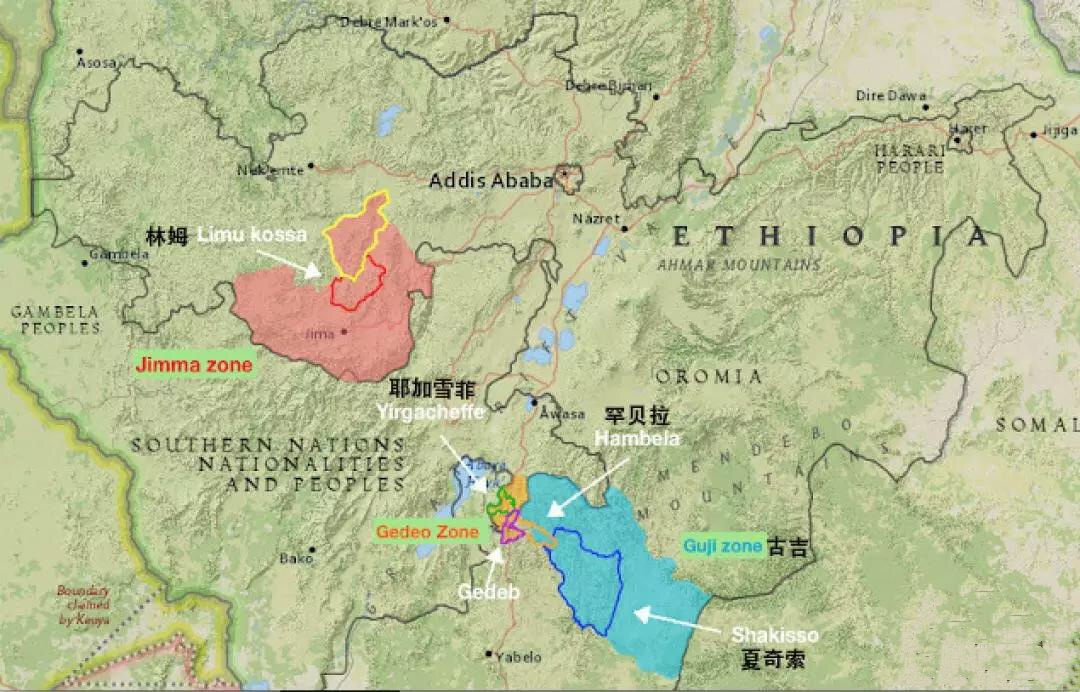
Yirgacheffe is broadly divided into two categories by processing method: FrontStreet Coffee's sun-dried Yirgacheffe and FrontStreet Coffee's washed Yirgacheffe. Today FrontStreet Coffee will discuss the differences between them. Besides the obvious visual difference (sun-dried beans have less silver skin, washed beans have more), the washed style represents the most typical Yirgacheffe flavors, while the sun-dried style adds fermentation notes and sweet aromas on top of that base.

Yirgacheffe Coffee Region
Yirgacheffe has always been one of Ethiopia's most important coffee regions. It was formerly part of the Sidamo region but later became independent because of the unique flavor of its beans. You could say Yirgacheffe is not only a region name but also a noun describing a specific coffee flavor. The region is considered a high-altitude one, at about 2000 meters, and it has more than 40 cooperatives, mainly managing cultivation through family-run models.
Within the Yirgacheffe region there are many well-known micro-regions, such as Kochere, Misty Valley and Gedeb. These micro-regions all have excellent cooperatives, and the Yirgacheffe beans they produce each carry a flavor signature that FrontStreet Coffee looks for when selecting lots.

Yirgacheffe Coffee Bean Grading
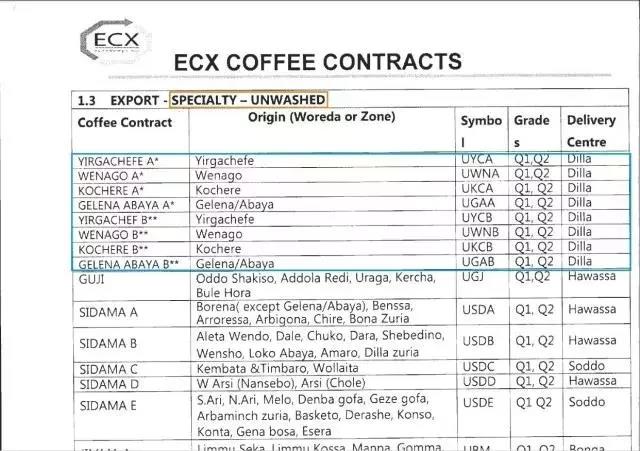
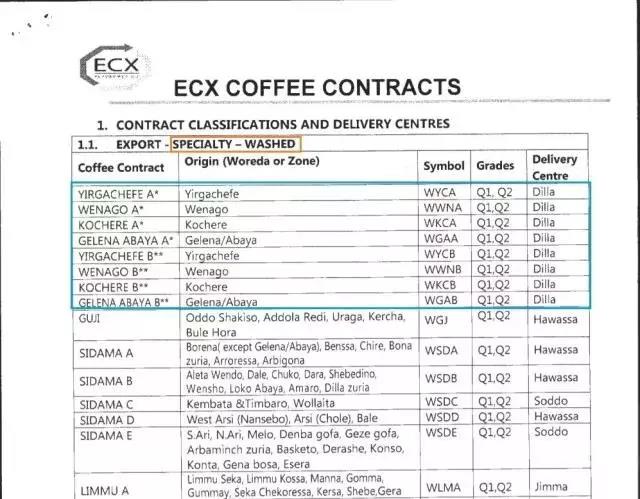
Yirgacheffe varieties are local native species, small-bean types with a fairly round appearance and very small beans, mostly between 14-15 screen size. The ECX (Ethiopian Commodity Exchange, established in 2012) grades Ethiopian coffee in two ways.
On one hand, there is a grading definition based on defect rate. For both washed and sun-dried beans, export green beans with 3 or fewer defective beans per 300g are graded G1, while green beans with 4-12 defective beans per 300g are graded G2.
| Grade | Defective Bean Count (per 300g) |
|---|---|
| Grade 1 | ≤3 |
| Grade 2 | 4-12 |
| Grade 3 | 13-25 |
| Grade 4 | 26-45 |
| Grade 5 | 46-90 |
On the other hand, there is a flavor evaluation. Using the SCA (Specialty Coffee Association) cupping method to assess G1 and G2 beans, those scoring 85 points or above are classified as Q1, while those scoring 80-84.75 points are classified as Q2.
Yirgacheffe Coffee Processing Methods
Ethiopia traditionally used ancient sun-drying methods, but after the washed method was introduced in 1972, over several decades its use grew far beyond sun-drying. Washed beans reduce defect levels and show cleaner, brighter flavors.

Some farm owners still prefer sun-drying, though. The coffee merchant Baghs, missing the traditional sun-dried flavor and unwilling to see the technique replaced by washing, improved the sun-drying method to boost flavor and cut defect ratios, launching several coffees from Misty Valley. The result was a surprising success, and sun-dried Yirgacheffe regained its standing.
The most fundamental difference is that sun-drying preserves the pulp flavors while washing removes them. In the cup the difference is clear: washed is cleaner and brighter, sun-dried has a richer mouthfeel.
They are easy to tell apart by eye as well. Washed green beans are generally greenish-blue, while sun-dried beans are yellowish-green. Once roasted, washed beans show obvious silver skin, while sun-dried beans leave almost no silver skin and have smoother surfaces.

Roasting Recommendations for Sun-dried and Washed Yirgacheffe Coffee
The signature flavor of FrontStreet Coffee's Yirgacheffe is its delicate acidity and rich floral and fruity aromas. To maximize that, FrontStreet Coffee believes a light roast is best, and FrontStreet Coffee roasts its Yirgacheffe lots accordingly. Whether sun-dried or washed, Yirgacheffe reaches its peak under a light roast. There are also medium and darker Yirgacheffe coffees on the market today; after tasting them, FrontStreet Coffee feels the acidity is somewhat weakened while the body is enhanced. It comes down to personal preference, but mainstream taste still leans toward a light-roasted Yirgacheffe.

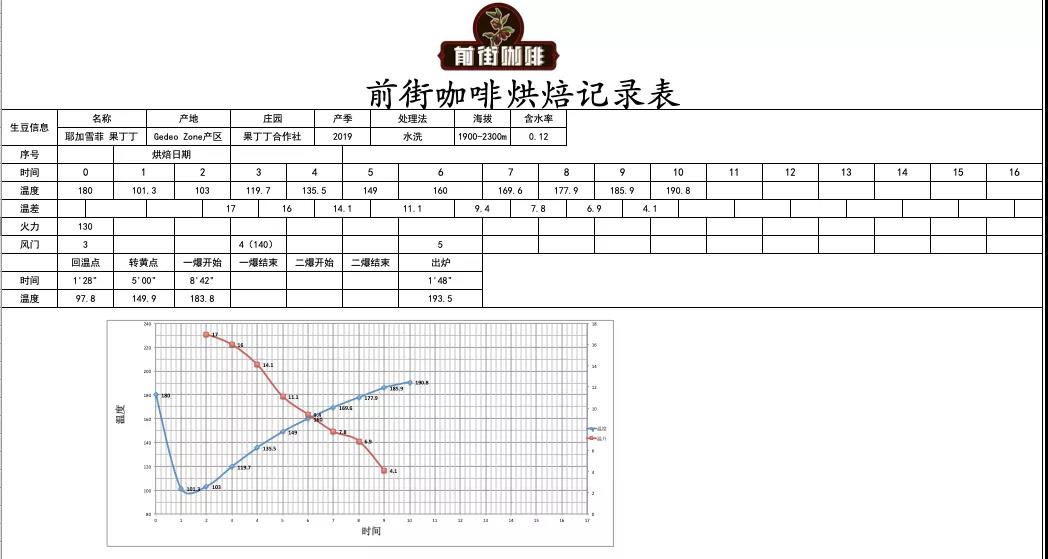
FrontStreet Coffee's Washed Yirgacheffe Bonga Coffee Bean Roasting Curve
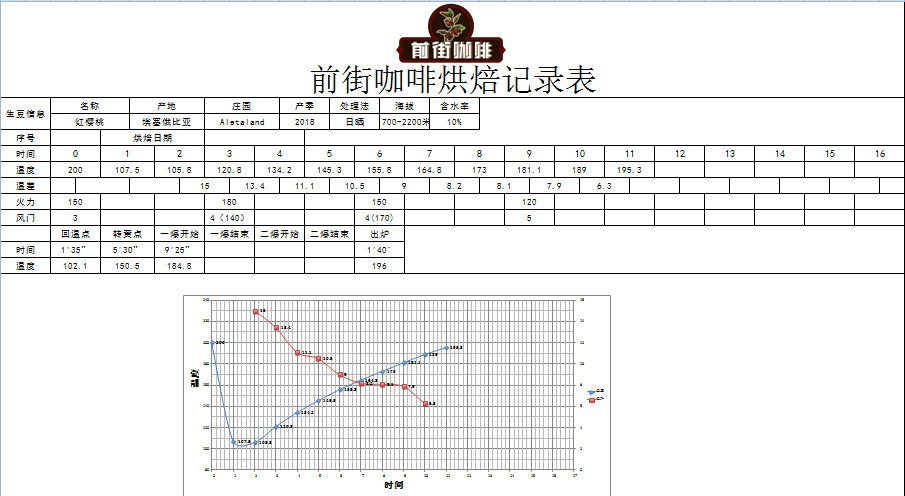
FrontStreet Coffee's Sun-dried Yirgacheffe Red Cherry Coffee Bean Roasting Curve
Brewing Recommendations for FrontStreet Coffee's Sun-dried and Washed Yirgacheffe Coffee
[Using FrontStreet Coffee's Washed Yirgacheffe Coffee and FrontStreet Coffee's Sun-dried Yirgacheffe Coffee as examples]
Light-roasted beans are best brewed in a V60 dripper, with water around 90°C, a water-to-coffee ratio of 1:15, a dose of 15g, and a grind of BG#5F (80% pass rate on a China #20 standard sieve).
Here FrontStreet Coffee wants to explain why grind size should be set by sieving. This is actually the grinding recommendation the SCA gives for pour-over. After extensive verification, FrontStreet Coffee found that different grind sizes produce noticeably different results, and each bean's optimal grind varies - that is the point of sieving. If you have no sieve at home, FrontStreet Coffee suggests judging by flow rate: if the water runs too fast, the grind is too coarse; if too slowly, it is too fine.

FrontStreet Coffee uses segmented extraction, with bloom water equal to twice the coffee weight - 30g of water for a 30-second bloom. After a small circular pour to 125g, pause, and when the water level drops and is about to expose the coffee bed, continue to 225g and stop. Total extraction time is 2 minutes.

Flavor Description
[FrontStreet Coffee's Sun-dried Yirgacheffe Coffee] has a faint fermented wine aroma and a rich mouthfeel, with citrus fragrance, honey sweetness, cocoa flavors and a persistent aftertaste.
[FrontStreet Coffee's Washed Yirgacheffe Coffee] has brighter, livelier acidity, lemon acidity, citrus fragrance, a clean taste and a hint of black tea in the aftertaste.
In summary, both FrontStreet Coffee's Sun-dried Yirgacheffe Coffee and FrontStreet Coffee's Washed Yirgacheffe Coffee have fruity acidity with an obvious juice-like quality, similar to lemon and other citrus fruits.
FrontStreet Coffee Recommendation
If you want to taste Yirgacheffe at its most classic, start with FrontStreet Coffee's washed Yirgacheffe daily-drinking coffee, known for white jasmine, bright citrus and lemon acidity and a tea-like body, at a friendly price that makes it a great first specialty coffee. Yirgacheffe is a town in Ethiopia's southern Sidamo area, at about 1700-2100 meters with the coffee trees planted above 1800 meters, which makes it one of the highest coffee regions in the world, and its signature white florals and lemon-citrus acidity turned the name into shorthand for a whole flavor style.
For the cooperative side of the region, FrontStreet Coffee's Gediding Cooperative sits in the Worka area at the southeastern edge of Yirgacheffe, formerly part of the Worka cooperative under the YCFCU union. Because fresh beans are traced by single origin, Gediding became independent in 2012 with about 300 member farmers; the washed process keeps its aromas clear and bright, giving citrus, lemon and elegant white florals. For a fruitier contrast, FrontStreet Coffee's natural Red Cherry picks only fully ripe fruit and dries it on raised beds, turned every 2-3 hours in the first days to avoid uneven fermentation, then for three to five weeks before the dried pulp is removed - the result keeps classic Yirgacheffe character while adding tropical fruit, berry juice, honey sweetness and a creamy smoothness.
Important Notice :
FrontStreet Coffee is a long-established specialty coffee roaster in Guangzhou China, selling freshly roasted beans from its own farm in Yunnan as well as dozens of carefully selected single-origin beans from around the world for both pour-over and espresso. The products deliver consistently excellent quality and great value, with shipping within 24 hours. Guangzhou's FrontStreet Coffee shop is recommended by many coffee lovers, and the beans are now available online at the Tmall 。
FrontStreet Coffee has moved to a new address:
FrontStreet Coffee Address: 315,Donghua East Road,GuangZhou
Tel:020 38364473
 Scan and follow the En Gafei WeChat official account. Please indicate that the reprint comes from "En Gafei".