Panama Hacienda La Esmeralda Diamond Mountain Coffee Bean Growing Region Flavor Profile

When it comes to Hacienda La Esmeralda, everyone immediately thinks of Geisha coffee beans. Without question, without Geisha coffee beans, Hacienda La Esmeralda would still be an obscure small farm. Without Hacienda La Esmeralda, Geisha coffee would have struggled to become popular worldwide. However, you might not know that Hacienda La Esmeralda didn't actually start by growing Geisha coffee. Like many countries in Central America, it originally grew Catuai. This time, FrontStreet Coffee will introduce Hacienda La Esmeralda's non-Geisha coffee—the Diamond Mountain series.
Hacienda La Esmeralda
Before 2004, Hacienda La Esmeralda's main coffee was primarily Catuai, while Geisha coffee at that time merely served as a windbreak on the borders of Hacienda La Esmeralda. Panama's Boquete region is the main coffee-producing area in Panama. Coffee in the Boquete growing region is cultivated at altitudes between 1400 to 1900 meters. It's a town in Chiriquí Province, located near the border between Panama and Costa Rica, close to the famous Barú Volcano. With its beautiful scenery, rich and fertile soil, and climate and soil conditions highly suitable for producing quality coffee.

This is not only due to the mild climate conditions of Panama's Boquete region and the fertile volcanic ash soil of the Barú Volcano area. In addition, there's another important factor: the diverse microclimates found in Panama's Boquete highlands. Panama's east-to-west environment causes cold air currents to converge through the central mountain range at elevations between 1200 to 2000 meters. The mountain fog, rain, and variable wind patterns create multiple microclimates in the Boquete region, making its temperature and rainfall highly suitable for plant growth. Therefore, coffee trees planted here grow exceptionally well.

Hacienda La Esmeralda divides its coffee into two parts based on Geisha and Catuai varieties. The Geisha section has three brands: Esmeralda Special, Private Collection, and Geisha 1500 (commonly known as Red Label, Green Label, and Blue Label).

The Catuai section is divided into Diamond Mountain and Palmyra. This coffee from FrontStreet Coffee is precisely a natural processed Catuai coffee from Diamond Mountain.
Diamond Mountain is cultivated in the Canas Verdes and Jaramillo regions, with overall coffee cultivation distributed at elevations of 1400-1600 meters. Diamond Mountain brand coffee is environmentally friendly (Eco-friendly) and Rainforest Alliance Certified.
FrontStreet Coffee Diamond Mountain Series
This Diamond Mountain coffee variety is Catuai. Catuai comes from the Guaraní word "multo mom," meaning "very good." There are Yellow Catuai and Red Catuai varieties. The Catuai variety was hybridized in 1949 from Yellow Caturra and Mundo Novo varieties, initially named H-2077.
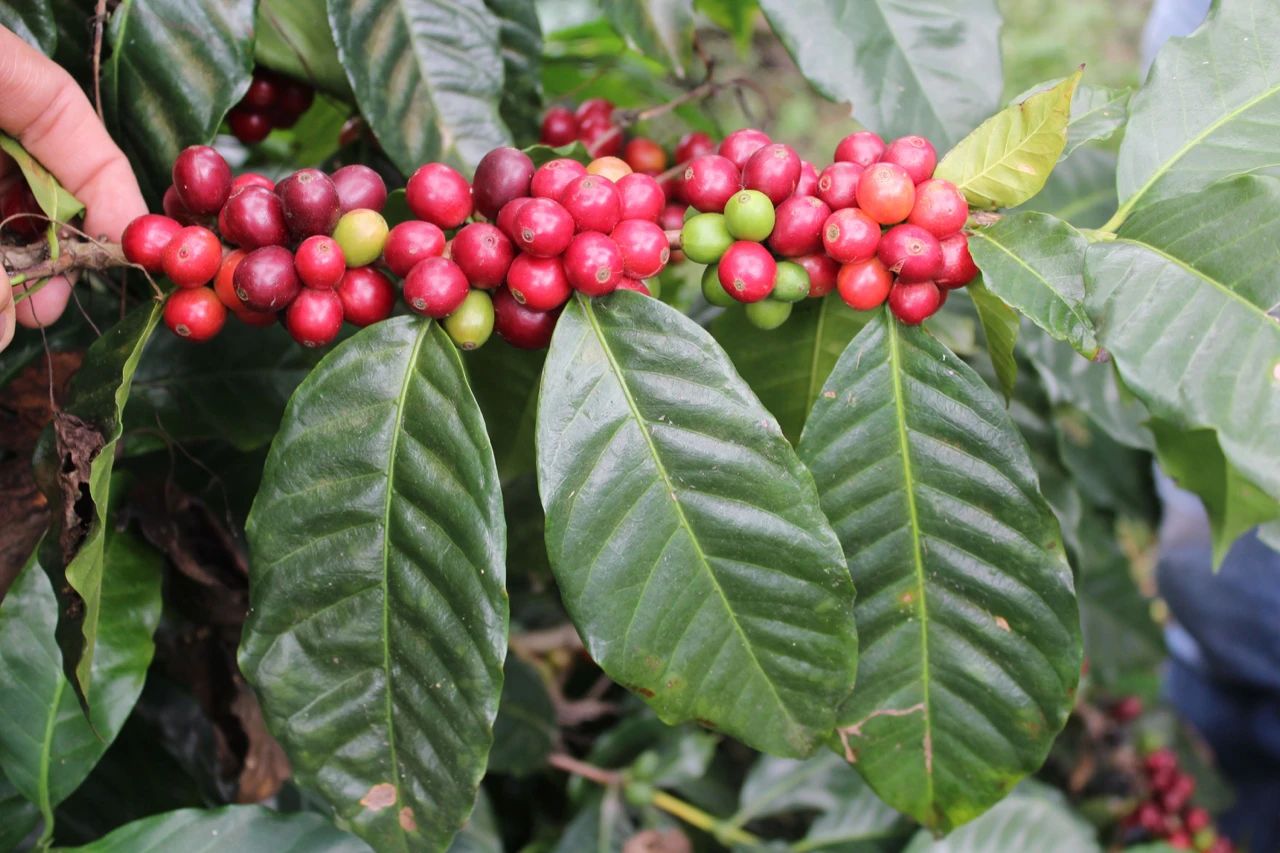
Catuai variety coffee has been cultivated in Panama for a long time. This variety is widely loved for its high yield, disease resistance, and clean, bright flavor. Compared to the Bourbon variety, Catuai's yield is very high. One reason is that the plants are small, allowing shorter spacing between plants. The planting density of Catuai is almost twice that of Bourbon.
Processing Method
This Diamond Mountain coffee uses natural processing.
Hacienda La Esmeralda's natural processing is not complicated. The first step is to send harvested coffee cherries to the courtyard for screening, aiming to remove unripe or defective particles that don't meet standards. Then, after rinsing in clean water, they are spread evenly on drying beds to dry.

Depending on weather and site conditions, the coffee cherries will dry on the platforms for 3 to 5 days (8 hours per day). When the coffee cherries are dried to a certain degree, they are then placed in a Guardiola dryer and rotated for 72 hours to complete the drying process and prevent fermentation. After drying is complete, the coffee cherries are mechanically processed to remove the skin and pulp.

FrontStreet Coffee Roasting Analysis
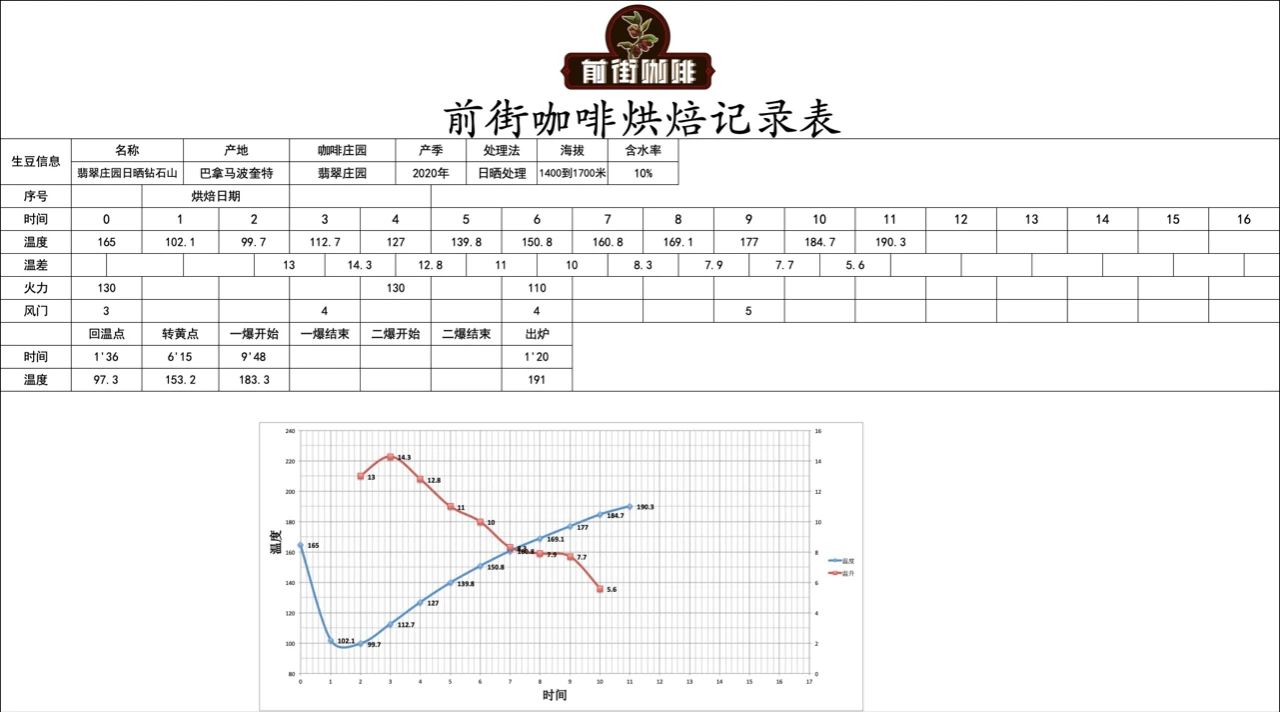
Preheat the roaster to 165°C, heat setting 130, damper at 3; return to temperature point at 1'36", when the drum temperature reaches 112°C, open the damper to 4, heat setting unchanged; when drum temperature reaches 153.2°C, the bean surface turns yellow, grassy aroma completely disappears, entering the dehydration stage. When drum temperature reaches 150°C, adjust heat to 110, damper unchanged.
At 8'38", ugly wrinkles and black spots appear on the bean surface, the toast aroma clearly transitions to coffee aroma, which can be defined as the prelude to first crack. At this point, listen carefully for the sound of first crack. At 9'48", first crack begins, open damper to 4. Develop for 1'20" after first crack, discharge at 191°C.
FrontStreet Coffee Brewing Suggestions
Although this Diamond Mountain coffee from Hacienda La Esmeralda may not compare to Geisha coffee beans in terms of variety, it still benefits from Hacienda La Esmeralda's high-quality management and is excellent in quality. This coffee's sweetness is outstanding, so FrontStreet Coffee will highlight this coffee's fruit-like sweetness in brewing.
Dripper: V60#01
Water Temperature: 90-91°C
Coffee Amount: 15g
Coffee-to-Water Ratio: 1:15
Grind Size: Medium-fine grind (Chinese standard #20 sieve with 80% pass-through)
Brewing Method: Three-stage extraction. Use 30g of water for a 30-second bloom. When the water level drops to just expose the coffee bed, continue pouring in small circular motions to 125g, then segment. When the water level drops again to just expose the coffee bed, continue pouring to 225g and stop. When the water level drops to just expose the coffee bed, remove the dripper. (Timing starts from bloom) Total extraction time is 2'00".
Flavor Description: Citrus, bright acidity, almond, honey, slight fermentation sensation, smooth mouthfeel, cocoa aftertaste.
FrontStreet Coffee Recommendation
Diamond Mountain proves that Hacienda La Esmeralda's Catuai can stand on its own, but the estate is, of course, best known for the variety that made it famous. If you would like to taste that side of the farm, FrontStreet Coffee's Panama Esmeralda Special (Red Label) Geisha is grown at 1,600–1,800 meters and every lot is cupped above 90 points, each one traceable to a single plot so you can chase the finest variations between harvests. The Esmeralda Private Collection (Green Label) blends several plots into one lot, showcasing the estate's signature high-altitude Geisha profile at a much friendlier price.
Both reward a gentle pour-over: a Hario V60 with a 1:16 ratio and 91°C water, beginning with a 30 g bloom for 30 seconds, brings out the jasmine, citrus and bergamot notes and the long, clean finish. FrontStreet Coffee roasts these Geshas to a light-medium level so the floral aromatics and juicy acidity arrive intact in the cup.
Important Notice :
FrontStreet Coffee is a long-established specialty coffee roaster in Guangzhou China, selling freshly roasted beans from its own farm in Yunnan as well as dozens of carefully selected single-origin beans from around the world for both pour-over and espresso. The products deliver consistently excellent quality and great value, with shipping within 24 hours. Guangzhou's FrontStreet Coffee shop is recommended by many coffee lovers, and the beans are now available online at the Tmall 。
FrontStreet Coffee has moved to a new address:
FrontStreet Coffee Address: 315,Donghua East Road,GuangZhou
Tel:020 38364473
 Scan and follow the En Gafei WeChat official account. Please indicate that the reprint comes from "En Gafei".