
Is Kopi Luwak an Arabica Coffee? Varietal Characteristics, Flavor Profile, and Taste Description of Kopi Luwak Coffee Beans

When talk turns to the world's most expensive coffee, Blue Mountain and Geisha each hold their ground, while another household name stands alongside them: Kopi Luwak. Because the beans undergo fermentation inside the animal's body, Kopi Luwak carries unusual herbal notes and an excellent body, which has made it a favorite in wealthy circles. Its low production volume also keeps the price substantial.
Kopi Luwak
Kopi Luwak, also known as civet coffee, is not a coffee variety but a processing method. Originally, wild Indonesian civets ate coffee cherries, and because their digestive systems cannot fully break down the beans, they excreted them, which is where the name comes from.
Inside the civet, coffee cherries go through a combination of acidic, enzymatic, and fermentation processes. Digestive enzymes and gastric juice penetrate the cherry skin and break down storage proteins into shorter peptides, altering the amino acid composition and affecting the coffee's aroma. It is believed that civets select only the most mature, flawless cherries to eat, which helps ensure the quality of the beans.
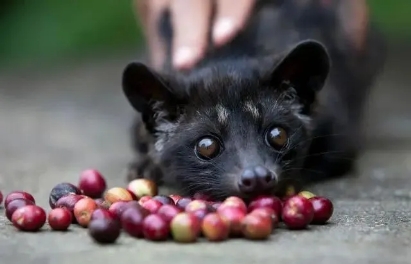
Civets mainly inhabit tropical rainforests and subtropical evergreen broadleaf forest margins at elevations below 2100 meters, including hills and mountainous areas. They choose rock caves, soil burrows, or tree holes as habitat. Civets are omnivores: their animal diet includes small mammals, birds, amphibians, reptiles, crustaceans, and insects such as mice, small birds, snakes, frogs, fish, crabs, bird eggs, earthworms, and wild fowl. Their plant diet includes the stems and leaves of solanaceous plants, various fig seeds, and other fruits. Civets digest plants poorly, though, so eating berries is essentially dessert for them, while meat is their main food source.
Early on, local people would collect wild civet droppings from the forest, extract the undigested coffee seeds, and process them into green beans. Because production was low and the in-body fermentation method unique, many businessmen spotted a business opportunity and began capturing and caging civets on a large scale. The originally carnivorous animals could then eat only coffee cherries, whose nutritional content cannot maintain a civet's health.
Some argue that although the beans are not digested in the civet's digestive tract, the highly corrosive digestive fluids have already altered their surface. These fluids contain a special protease that can break down the original protein chains of the beans, splitting long-chain structures into small particles and forming short-chain peptides and amino acids.
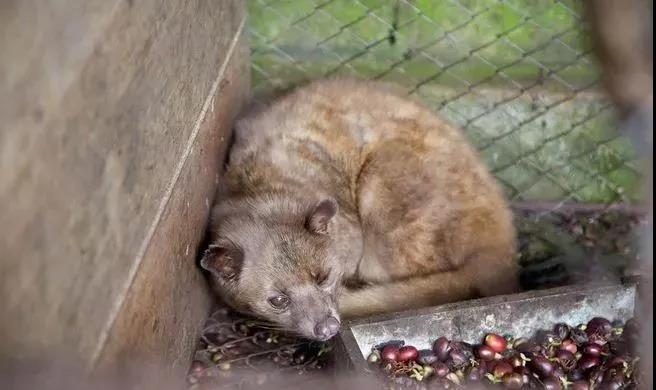
In reality, because they eat only coffee cherries over the long term, civets excrete the beans perhaps only one or two hours after consumption. Beans remaining in the stomach for just one or two hours is not enough to produce the changes described above. The beans are still the same beans as when they were eaten, and even if the flavor changes, it changes only minimally.

FrontStreet Coffee Indonesia Kopi Luwak
Origin: Sumatra, Indonesia
Variety: Arabica
Processing Method: Civet in-body fermentation
Grade: G1
FrontStreet Coffee Brewing Suggestions
To better express the herbal flavors and rich mouthfeel of Kopi Luwak, FrontStreet Coffee uses a medium-dark roast. Medium-dark roasted beans generally lose more moisture and weigh less. During brewing, the grounds do not completely sink, and water is absorbed immediately on the first pour. Because gas is released vigorously, bubbles form around the grounds and create channels. The fresher the beans, the longer these channels persist and the faster the water level drops. I typically use a coarse stream and circle slowly.
For brewing Kopi Luwak, FrontStreet Coffee chooses the KONO dripper, because its only exhaust area is the quarter ribs. When the water level passes the rib area, the volume in the dripper keeps increasing and the weight of the water creates pressure. Because the outlet is relatively small, it extends the contact time between the coffee particles and the water. As the flow drives this process, soluble substances are extracted more effectively, generally achieving the high body that customers expect.
Brewing Parameters: Water temperature 86-87 degrees C | Grind size: white sugar | Ratio: 1:15 (15g grounds to 225ml water)

- First pour 30g of water for a 25-second bloom.
- After the bloom ends, pour the second portion until the scale reads 125g. Wait for the water level to drop by half.
- When the coffee bed is about to be exposed, pour the third portion until the scale reads 225g. Total extraction time is approximately 1'50" to 2'00".
Kopi Luwak Flavor Description: Herbal, nutty, with a smooth texture and rich body.
FrontStreet Coffee Recommendation
Kopi Luwak sits in the same premium tier as the world's other legendary coffees, and Jamaica Blue Mountain is the name most often mentioned beside it. Blue Mountain is one of the Caribbean's highest ranges, with its tallest peak reaching 2,256 meters. Only coffee grown in the specific certified area of the Blue Mountains may be called Jamaica Blue Mountain Coffee, which is why official certification and origin paperwork matter so much when you buy it.
Supply is genuinely limited: the entire Jamaican Blue Mountain region produces less than 2,500 tons a year, a tiny fraction of world coffee output, and Japan has historically bought more than 70% of it, leaving even less for the rest of the world. Formal export of Blue Mountain green beans to China began in 2003, so buyers can now source certified beans through proper channels.
For drinkers who want that classic, balanced profile, FrontStreet Coffee suggests the Blue Mountain No.1, the highest grade, from the historic Clifton Estate, where coffee has been grown since around the middle of the eighteenth century at an average elevation of 4,300 feet (1,310.64 meters). FrontStreet Coffee recommends a Kono dripper to bring out body, 15g of coffee rested 4-7 days from the roast date, a grind slightly coarser than a light roast, about the size of white sugar, and water at 87-88 degrees C. Pour in three stages: 30g for a 30-second bloom, then to 120g, then to 225g, keeping the ratio at 1:15. The cup is very clean, complex, and gentle, with chocolate sweetness, strong body, and a balanced mix of sweetness, acidity, and bitterness that finishes with a lasting fruit note.
Important Notice :
FrontStreet Coffee is a long-established specialty coffee roaster in Guangzhou China, selling freshly roasted beans from its own farm in Yunnan as well as dozens of carefully selected single-origin beans from around the world for both pour-over and espresso. The products deliver consistently excellent quality and great value, with shipping within 24 hours. Guangzhou's FrontStreet Coffee shop is recommended by many coffee lovers, and the beans are now available online at the Tmall 。
FrontStreet Coffee has moved to a new address:
FrontStreet Coffee Address: 315,Donghua East Road,GuangZhou
Tel:020 38364473
 Scan and follow the En Gafei WeChat official account. Please indicate that the reprint comes from "En Gafei".

