Flavor Profile and Taste Characteristics of Jamaica Blue Mountain No.1 Coffee Beans - Clifton Estate Authentic Blue Mountain Coffee Price and Story

FrontStreet Coffee Jamaica Blue Mountain No. 1 Coffee Beans
Farm: Clifton Farm
Estate Owner: The Sharp Family
Certification: Rainforest Alliance Certified
Location: Newcastle Region
Total Area: 250 acres
Coffee Cultivation Area: 180 acres
Average Altitude: 4,300 feet (1,310.64 meters)
Processing Method: washed
Variety: 100% Arabica Typica

Why Jamaica Blue Mountain Is So Famous
Jamaica Blue Mountain coffee is renowned for its quality, limited production, and long history — even people who have never touched specialty coffee have heard of it. Below, FrontStreet Coffee introduces the four major estates behind Jamaica's Blue Mountain production.
A Brief History of Jamaica Blue Mountain Coffee
Jamaican coffee dates back to the 18th century. In 1717, King Louis XV of France ordered coffee cultivation established in Jamaica. In the mid-1720s, Jamaica's Governor Sir Nicholas Lawes imported Arabica seeds from Martinique and began promoting cultivation in the St. Andrew region. The trees eventually spread into the Blue Mountains, and Jamaican coffee came to be tiered into high-altitude Jamaica Blue Mountain, High Mountain, and plain Jamaica coffee — with each grade commanding a different price.

The Unique Environment of the Blue Mountains
The Blue Mountains sit in eastern Jamaica, ringed by the Caribbean Sea. On clear days, when sunlight strikes the azure water, the peaks reflect a brilliant blue glow — hence the name. The range's highest point reaches 2,256 meters (coffee may only be grown below 1,700m; everything above is protected forest), making it the tallest peak in the Caribbean region and a famous tourist destination.
Deep in the coffee belt, the area enjoys fertile volcanic soil, clean unpolluted air, a humid climate, and year-round fog and rain. Average rainfall approaches 2,000 millimeters and temperatures hover around 27°C — conditions that created the world-famous Jamaica Blue Mountain and, for a long stretch, the world's highest-priced coffee.
By the official definition of the Jamaica Coffee Industry Board (CIB), only Typica coffee grown in forest reserves at altitudes between 910 and 1,700 meters may be called genuine "Jamaica Blue Mountain coffee." Typica needs high-altitude conditions to express its best flavor; it also has poor disease resistance and low per-tree yields, demanding intensive care. The rugged terrain of the high Blue Mountains makes management and harvesting difficult, requiring highly skilled pickers — which further caps production. In recent years, less than 15% of all coffee grown in Jamaica qualifies for the Blue Mountain name — roughly 900 tons.

Processing Method
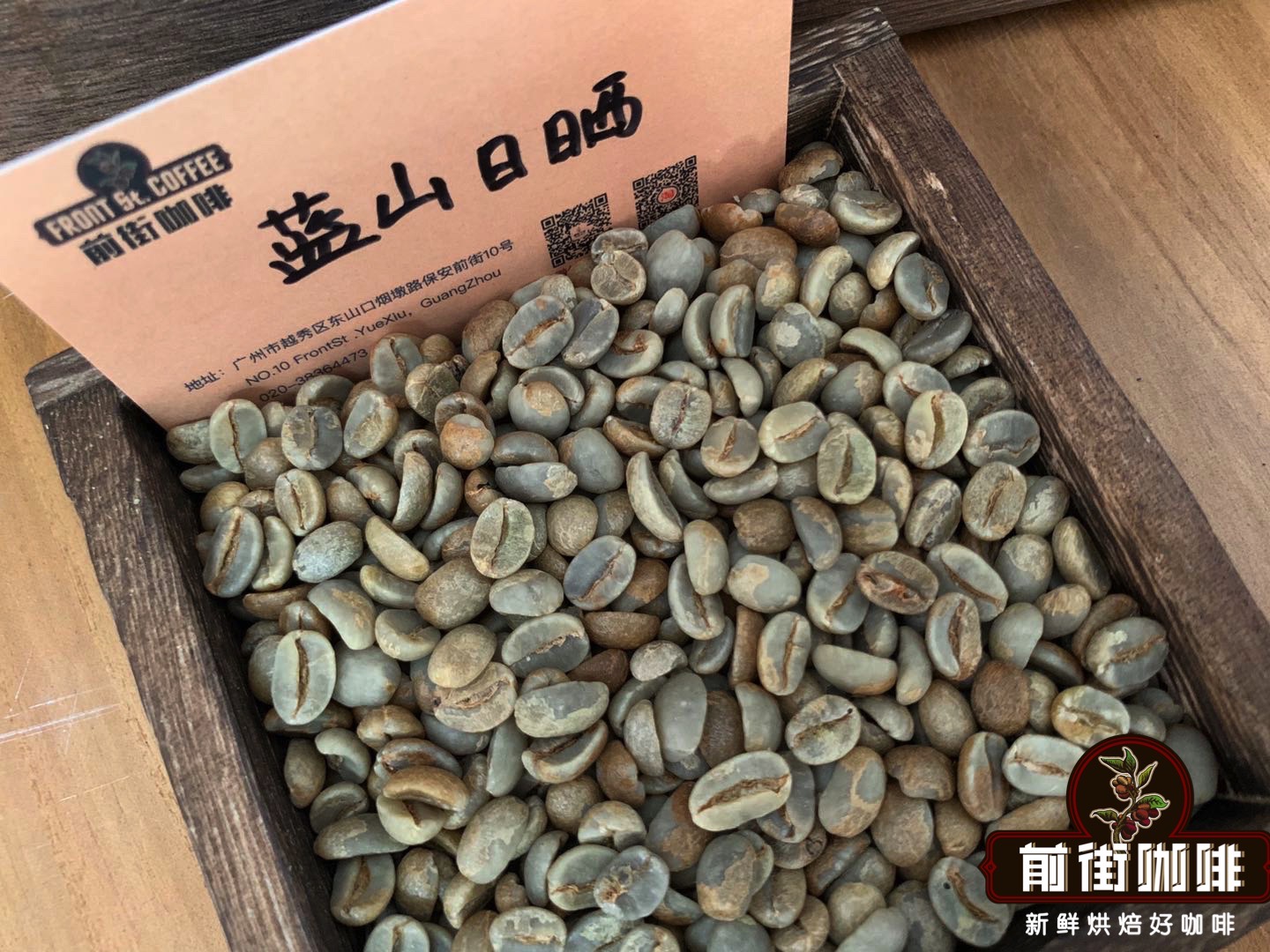
Authentic Blue Mountain beans on the market today are all washed-processed — though that monopoly is about to end (more below). After hand-harvesting, the cherries are first screened to remove underripe and overripe fruit before pulping, with pulping completed within 12 hours. Traditional washed fermentation follows, then slow sun-drying on cement platforms; prolonged gentle drying deepens the flavor. Beans are dried to 11%–13% moisture, bagged, and rested in warehouses held at 24–25°C with dehumidifiers controlling humidity. Only after 2–3 months of stable maturation are they shipped.
When an order comes in, small batches are hulled at low temperature, polished, and cleared of silver-skin dust. Defective beans — broken, discolored, mold-damaged — are removed by hand; each skilled worker can sort only about 75 pounds of green beans per day. Beans travel between stations in wooden basins to avoid breakage. Finally they are sealed in Jamaica Blue Mountain's distinctive wooden barrels, and the CIB's Regulatory Section tastes each batch before air export to confirm it meets standard.

Jamaica is the last country still using wooden barrels to package and ship coffee. Only coffee that passes this chain of CIB standards receives the government's certificate of guarantee and may officially bear the name "Blue Mountain."
Jamaica's Four Major Blue Mountain Estates
The four major Blue Mountain estates are Clifton, Stoney, Gold Cup, and RWS.
Clifton is the only Blue Mountain estate in Jamaica with Rainforest Alliance certification, and FrontStreet Coffee's Blue Mountain beans are selected from this estate — a perfectly balanced cup of acidity, body, and aroma with an endlessly lingering finish. The estate has a 200-year history.
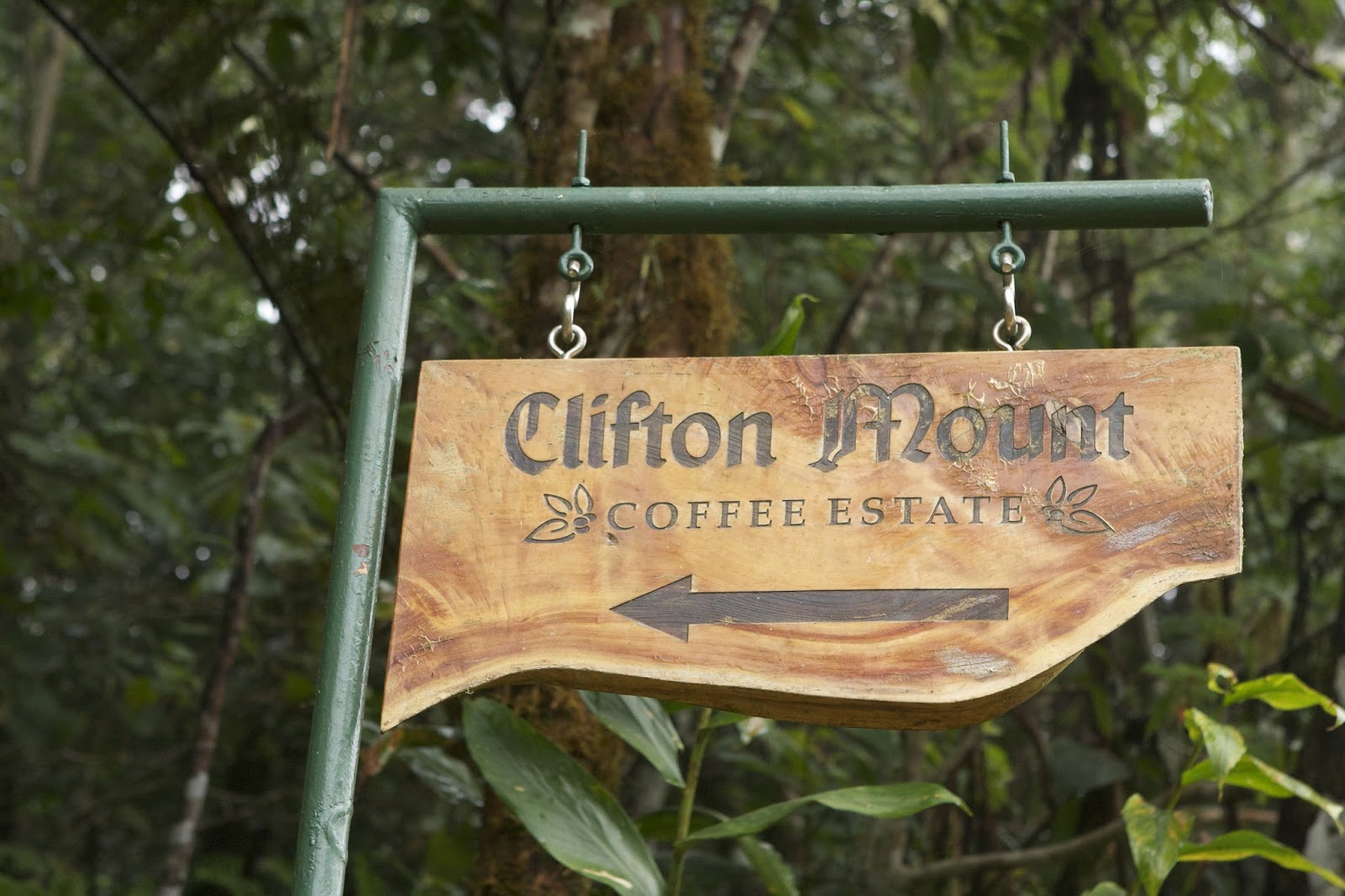
Stoney Estate works primarily with Japanese companies, so it is less well known outside Japan; it has about 80 years of history and was later acquired by the JCC company.
Gold Cup Estate is younger still — about 20 years — but was formed by merging two century-old estates and runs on more advanced management. It operates two brands: Amber Estate and BMCP (Blue Mountain Coffee Processors LTD), with the independent Amber Estate as its flagship.
RWS Estate also merged three century-old estates to develop Blue Mountain coffee; the name gathers its three farms: Resource, Sherwood Forest, and Whitfield Hall.
Clifton is arguably the most innovative estate in the entire Blue Mountain region. In 2019–2020 it launched a natural-process Blue Mountain No. 1 and a Blue Mountain Geisha — before that, every Blue Mountain coffee sold commercially had been washed-processed Typica.
Authentic Jamaica Blue Mountain Comes with Certification
The Jamaican government once insisted that all Blue Mountain coffee be roasted in Jamaica to ensure consistent quality. But roasting is a refined craft requiring experience, training, and expensive equipment — and from a consumer's standpoint, beans should be consumed soon after roasting, which Jamaica-roasted coffee cannot deliver. Green beans may now be exported.
FrontStreet Coffee imports its Jamaica Blue Mountain directly from the origin, and the CIB can issue certificates for all exported Blue Mountain coffee on the market.
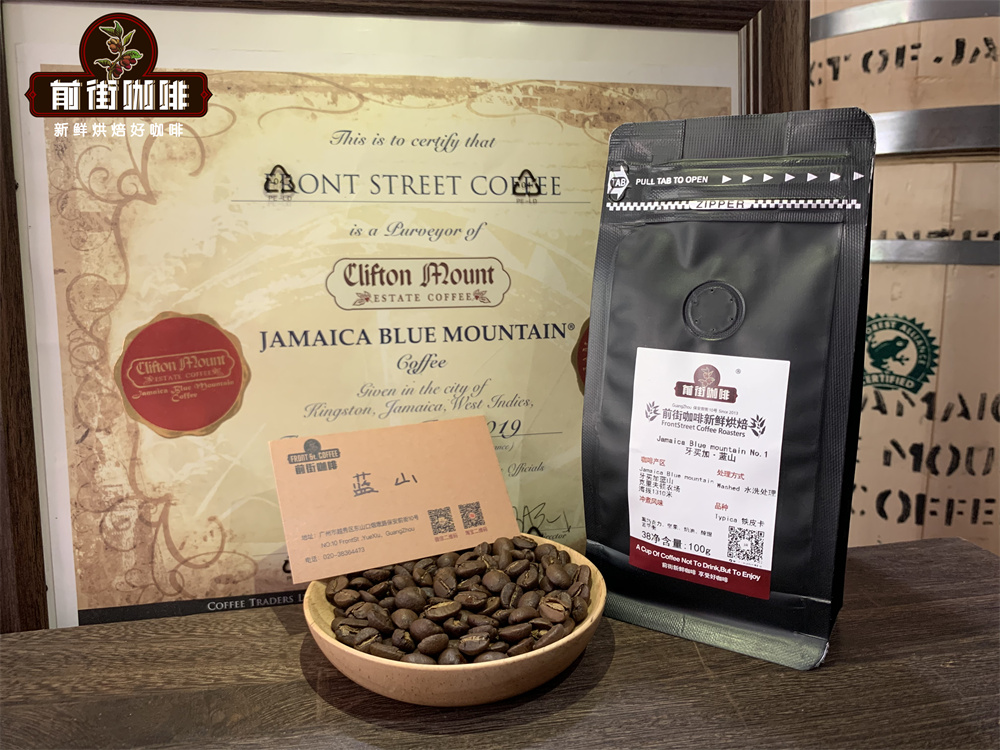
Certificates come in three types:
(1) Quality Certificate issued by the Jamaica Coffee Industry Board
(2) Authorized Sales Certificate issued by Blue Mountain manufacturers (Blue Mountain coffee is distributed by 4 Jamaican government-approved processing manufacturers and exported by 16 licensed exporters)
(3) Certificate of Origin for Jamaica Blue Mountain Coffee
Quality certificates specify the time and quantity. The CIB randomly selects a package from submitted Blue Mountain coffee for inspection; if it passes, the certificate is issued.

FrontStreet Coffee Roasting Analysis
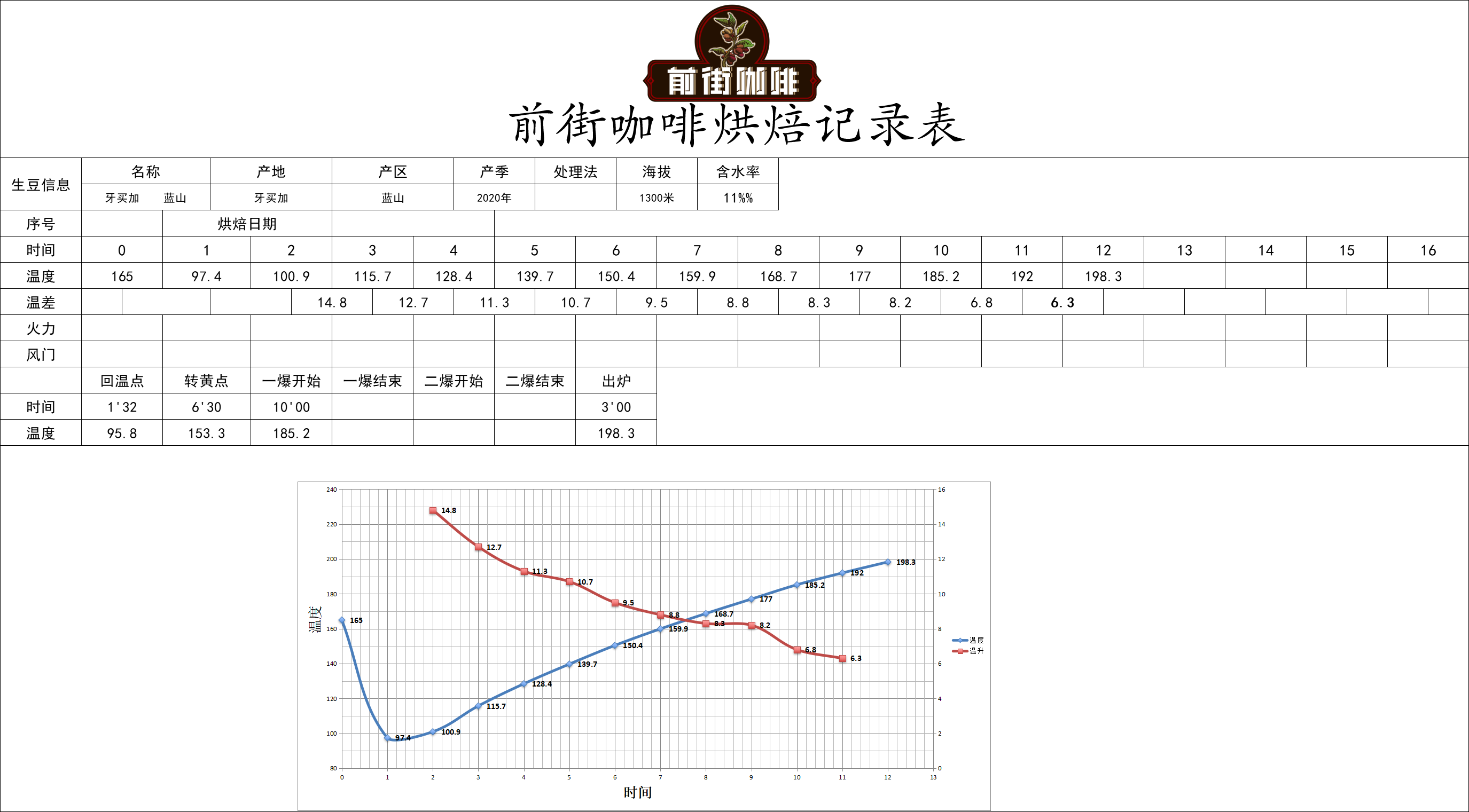
FrontStreet Coffee roasts its Blue Mountain No. 1 to a medium-dark level to highlight the coffee's balanced richness. As an example, on a Yangjia 600N semi-direct-fire roaster with a 500g green charge:
Charge the drum at 165°C with heat power at 130 and the damper at 3; the turning point arrives at 1'32" with drum temperature at 95.8°C, heat unchanged. At 3 minutes the damper goes to 4; at 4 minutes heat increases to 140. When the drum reaches 153.3°C the bean surface yellows, the grassy smell disappears completely, and the drying stage ends. At 8'36" the beans show uneven wrinkles and dark speckles, and the toast smell clearly shifts toward coffee aroma — the prelude to first crack. Listen carefully from here. First crack begins at 10'06"; the roast develops for 3 minutes past first crack, and the beans drop at 198.5°C.
FrontStreet Coffee Brewing Recommendations
Parameters: 15g of coffee, 86°C water, a 1:15 ratio, medium-coarse grind (75% pass rate on a Chinese-standard 20-mesh sieve)
Dripper options generally include the V60, Kalita wave, and Kono. FrontStreet Coffee brews this coffee mainly on a Kono, for a simple reason: Blue Mountain No. 1 is a darker roast, and high water temperatures risk over-extraction — hence the moderate 86°C. But at that temperature a fast-flowing dripper like the V60 can under-extract. The Kono has fewer, shorter ribs, which restricts the gap between filter paper and wall, slowing the flow and adding an immersion element — exactly right for a medium-dark Blue Mountain. After testing, the Kono won.

We also recommend brewing with freshly roasted beans to capture the coffee at its fullest. Every bag FrontStreet Coffee ships was roasted within the past 5 days, because freshness governs flavor. Our philosophy is "Freshly Roasted Good Coffee": the beans' resting period runs about 4–7 days, so coffee arrives right at its flavor peak.
For technique, use segmented, three-stage pouring. Bloom with 30g of water for 30 seconds. First stage: a small, circular pour up to 125g, then stop; resume when the liquid level is just about to expose the coffee bed. Stop at 225g. Total extraction time, bloom included, is 2'00".

Flavor Profile
Body: full, balanced, rich
Flavor: chocolate and nuts, with sweetness, acidity, and bitterness in perfect equipoise
FrontStreet Coffee Recommendation
Blue Mountain No. 1 sits at the very top of Jamaica's Blue Mountain grading, with strict standards for bean size, defect rate, and overall quality. FrontStreet Coffee's Jamaica Blue Mountain No. 1 comes from the historic Clifton Estate — growing coffee since roughly 1750 — with complete origin certification on file and the traditional wooden shipping barrels (packed in 15, 45, and 70kg formats) on display, so every bag can be traced back to its source. Our medium-dark roast lets the classic Blue Mountain balance shine: nut, dark chocolate, cream-caramel, and a soft sweetness unfolding in layers, with acidity, sweetness, bitterness, and aroma in harmony. It is the kind of coffee that explains its own legend — equally rewarding as an everyday specialty brew or a high-end gift.
Important Notice :
FrontStreet Coffee is a long-established specialty coffee roaster in Guangzhou China, selling freshly roasted beans from its own farm in Yunnan as well as dozens of carefully selected single-origin beans from around the world for both pour-over and espresso. The products deliver consistently excellent quality and great value, with shipping within 24 hours. Guangzhou's FrontStreet Coffee shop is recommended by many coffee lovers, and the beans are now available online at the Tmall 。
FrontStreet Coffee has moved to a new address:
FrontStreet Coffee Address: 315,Donghua East Road,GuangZhou
Tel:020 38364473
 Scan and follow the En Gafei WeChat official account. Please indicate that the reprint comes from "En Gafei".