Jamaican Blue Mountain Coffee RSW: What are the Characteristics and Taste of Blue Mountain Coffee

Professional Coffee Knowledge Exchange
Blue Mountain Coffee is a premium Caribbean coffee that, like coffee from other countries, suffers damage from natural hurricanes. We have seen too many damaged beans that, when cupped, taste like kale. In years when hurricanes strike, prices are always affected, and sometimes the coffee becomes completely unsellable. The hot, humid environment of island nations also often causes beans to suffer insect damage or develop white spots. Truly flawless beans are always rare. On top of that, Japan purchases 70-80% of Blue Mountain Coffee, keeping prices high. Genuine high-altitude 100% pure Blue Mountain is produced entirely by official Jamaican processing plants. The coffee is packed in special wooden barrels, and each barrel comes with a certificate.
RSW Blue Mountain Coffee
RSW Blue Mountain Coffee is composed of three local estates from Jamaica's Blue Mountain region: Resource, Sherwood Forest, and Whitfield Hall. It represents the most stable and highest-quality Blue Mountain. Each estate has more than 180 years of history. The owners joined forces, and several years later created the legend of barrel-aged Blue Mountain estate-brand coffee. RSW processes only coffee from its own estate group and never buys beans from other estates. It uses mainly the Sherwood Coffee Processing Plant (built before 1800) as its exclusive processing facility, where cherries from all three estates are sent. Freshly harvested cherries are placed in a humidity-controlled storage room. Every detail of the process is handled with extreme care to provide buyers with the finest Blue Mountain.
The Unique Geography of Blue Mountain
The uniqueness of the Blue Mountain region is tied to its exceptional geographical location and climate.
Jamaica's Blue Mountain region has fertile new volcanic soil, fresh air, and almost no pollution. It experiences year-round rainfall with significant day-night temperature differences. Because of the special environment here, clouds envelop the entire Blue Mountain peak every afternoon, which not only shades the coffee trees but also brings abundant moisture. It is precisely these favorable natural conditions that make Blue Mountain Coffee's taste and aroma unparalleled among coffees produced worldwide.
Not all coffee produced in the Blue Mountain region can be called Blue Mountain Coffee. Only coffee grown in the Blue Mountain region above 1,800 meters can be called "Blue Mountain Coffee." Beans produced at lower altitudes in the Blue Mountain area, due to quality differences, may only be named "Jamaica High Mountain Coffee" and cannot be called "Jamaica Blue Mountain Coffee."
Authentic Blue Mountain Experience
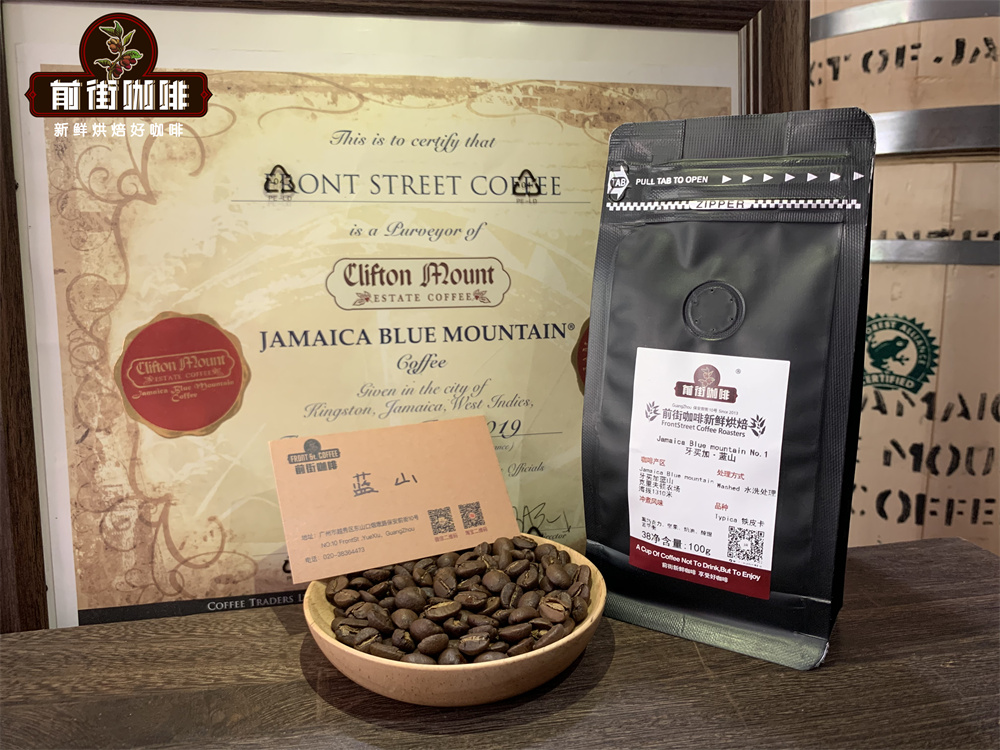
Most Blue Mountain Coffee consumed by the general public is blended, using only a small amount of Blue Mountain beans mixed with other varieties. Even if you are willing to buy beans to grind and brew yourself, a pound of Blue Mountain beans can cost as much as 2,000-3,000 New Taiwan Dollars. FrontStreet Coffee's Blue Mountain comes from Jamaica's Clifton Farm, which has a very long history. The Blue Mountain region is small, with only 6,000 hectares of cultivation area, so it is impossible for all coffee labeled "Blue Mountain" to have been grown there. Today's Clifton Farm is the largest estate in this region, and even by international standards it counts as small-scale cultivation, with many estate owners being small landholders whose families have worked the land for two centuries.
Clifton Farm's coffee cultivation and processing facilities sit at an average altitude of 4,300 feet (1,310.64 meters). Sufficient altitude, gentle afternoon clouds surrounding the mountain forests for shade, ample sunlight, and mineral-rich planting soil give the coffee trees excellent growing conditions and extend the maturation period of the cherries.
Clifton's high altitude and long history, combined with its unique processing methods, give Clifton Coffee not only the characteristic roundness and smooth mouthfeel of Blue Mountain No. 1 but also subtle floral notes and other rich flavors.
Premium Quality at FrontStreet Coffee
This is why Blue Mountain Coffee produced here commands such a premium. At FrontStreet Coffee, however, you can buy authentic Blue Mountain at a price that offers excellent value. To highlight its character, FrontStreet uses a dark roast. Recommended brewing parameters: KONO dripper / 88°C / 1:14 ratio / brew time of one minute and fifty seconds. The taste is rich and balanced, with chocolate flavors perfectly blended with gentle fruit acidity, and the lingering caramel sweetness in the finish is quite persistent.
FrontStreet Coffee Recommendation
If you want to buy genuine Blue Mountain, FrontStreet Coffee's Jamaica Blue Mountain No.1 is the top-grade batch, and it comes from the historic Clifton Estate, where coffee has been grown and processed since the mid-18th century, around 1750. The cultivation and processing area sits at an average altitude of 4,300 feet (1,310.64 meters). The sufficient altitude, the gentle afternoon cloud that winds through the mountain forests and shades the trees, the ample sunlight, and the mineral-rich soil give the coffee trees ideal conditions and lengthen the ripening of the cherries.
How do you tell the real thing from a fake? A genuine Blue Mountain comes from the Blue Mountain range in Jamaica with a certificate issued by the Jamaican government along with proof of origin, so checking whether a shop can show the relevant certificates is the most direct test. Genuine Blue Mountain is also shipped in native-built wooden barrels printed with detailed batch information for the green beans, and the barrel itself is one way to tell the real thing; in traditional packing, Blue Mountain ships in 15, 45, and 70 kg barrels. And you can judge by the green beans themselves: authentic Blue Mountain green beans are neat and full, with the two ends slightly upturned and a greenish color. Finally, taste: genuine Blue Mountain is rich, dense, clean, and free of off-flavors, with an aroma that imitation Blue Mountain simply cannot match.
For brewing, FrontStreet recommends a Kono dripper, which better draws out the coffee's full body. Use a standard single-serving dose of 15 g, and let the beans rest 4-7 days from the roast date, counting the roast date as day one, for the best flavor. Grind a little coarser than you would for a light roast, roughly the texture of granulated sugar, and use 87-88°C water; many bitter, scorched cups come from water that is too hot, though water that is too cool leaves the coffee flat and tasteless. FrontStreet suggests a 1:15 ratio; although some methods use 1:13 or a smaller ratio for a more concentrated cup, shrinking the ratio is often a way to avoid bitterness in the tail, and it affects the aftertaste in turn. With water temperature and grind in hand, 1:15 better expresses the overall flavor. Pour in three stages: a 30 g bloom for 30 seconds, then to 120 g with a slow vertical circling stream, then to 225 g with a slightly quicker stream and circling to avoid clogging the filter and over-extracting. The result is very clean, complex, and gentle, with chocolate sweetness and a very strong body, the sweet, sour, and bitter notes in perfect balance and no bitterness at all, only a moderate, ideal acidity and a persistent fruit finish.
Important Notice :
FrontStreet Coffee is a long-established specialty coffee roaster in Guangzhou China, selling freshly roasted beans from its own farm in Yunnan as well as dozens of carefully selected single-origin beans from around the world for both pour-over and espresso. The products deliver consistently excellent quality and great value, with shipping within 24 hours. Guangzhou's FrontStreet Coffee shop is recommended by many coffee lovers, and the beans are now available online at the Tmall 。
FrontStreet Coffee has moved to a new address:
FrontStreet Coffee Address: 315,Donghua East Road,GuangZhou
Tel:020 38364473
 Scan and follow the En Gafei WeChat official account. Please indicate that the reprint comes from "En Gafei".