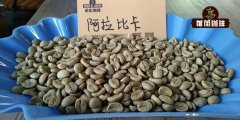
Introduction to Arabica Coffee Characteristics: Is Arabica Coffee Good?
Introduction
Robusta and Arabica are the two coffee varieties most of us encounter every day. So what actually sets them apart?
Arabica
Arabica refers to the coffee tree species Coffea arabica, which accounts for roughly 70% to 80% of world coffee production. It is grown mostly on volcanic slopes or highland plateaus between 500 and 1,500 meters and above. The beans are oval, relatively slender and flat, with moderate acidity and bitterness and a gentle aroma. Brazil is today the largest Arabica producer, while Colombia grows nothing but Arabica.
Arabica's caffeine content is low, about 0.9% to 1.2%. It carries 60% more fat than Robusta and twice the sugar, which is why it tastes sweeter and smoother, with a faint plum-like acidity. Its chlorogenic acid content is also lower, around 5.5% to 8%. Since chlorogenic acid is not only an antioxidant but also a key defense against pests, Arabica is more vulnerable to insects and to weather. It is generally grown at higher altitudes, produces fewer cherries, and matures more slowly.
Robusta
Robusta accounts for roughly 20% to 30% of world production and is suited to lower ground — typically cultivated on slopes below 500 meters, in regions lying between 0 and 800 meters with temperatures of 18–36°C and annual rainfall of 2,200–3,000 mm. From flowering to ripe fruit takes about 7–9 months. The beans are oval but shorter and smaller than Arabica, with stronger bitterness and less aroma. Caffeine content runs from 1.6% to 2.4%, and because the extracted liquid yields roughly twice as much as Arabica, Robusta beans are mostly used for instant coffee. Vietnam is the largest Robusta producer today, with Africa and India also growing it.
Compared with Arabica, Robusta has more caffeine and less fat and sugar, producing a more bitter, more aggressive cup. Those who love its aroma love it; those who don't say it smells like rubber. Its chlorogenic acid content is higher, about 7% to 10%, which makes it more resistant to pests and weather. It is generally grown at lower altitudes, sets abundant fruit, and matures quickly.
Arabica vs Robusta
Appearance
◎ Arabica beans are long-oval and flat, with an S-shaped or C-shaped center crease.
◎ Robusta beans are oval, spherical, or nearly so, with a straight center crease.
This identification method works best on green, unroasted beans. After roasting, beans expand and deform, becoming rounder, and the crease straightens from an S toward a near-straight C — so judging roasted beans by appearance alone is unreliable.
Moreover, growing pressures and uneven sun exposure mean even Robusta beans can occasionally show an "S" or "C" crease, and even Arabica beans can present a fairly straight "C." In other words, in any batch of beans a few "imposters" are inevitable.
If Arabica and Robusta are roasted together, Robusta's very low sugar content means minimal, brief caramelization, so it colors poorly and reads visibly lighter by comparison. Of course, if the two are roasted separately and then blended, all bets are off. And to judge whether a bag of beans actually contains Robusta, appearance alone isn't enough — you also have to consider the proportion of suspected Robusta beans. Blend in too few and there's no profit in it, nor any real effect on flavor or mouthfeel, making the exercise pointless.
Flavor
Arabica
Arabica coffees from different regions, altitudes, and climates each have a distinct personality. Unroasted, they smell of fresh hay; properly roasted, they reveal "fruit aromas" at light-to-medium roasts and "caramel" at dark roasts. They suit single-origin brews and all manner of blends, across every extraction method.
Medium-to-high aroma, bright acidity, smooth mouthfeel, medium-to-low body, and a pleasant aftertaste.
Robusta
Mainly used in espresso blends to add body and produce rich crema, typically at 5–15% of the blend, sometimes exceeding 25%.
Medium-to-low aroma, low acidity, strong bitterness, full body, woody flavors, and a pyrolytic, spicy aftertaste.
Because Robusta is cheaper, it generally goes into commercial blends or instant coffee to cut costs. But price alone cannot measure quality — fine Robusta tastes better than poor Arabica. FrontStreet's Commercial Blend, for example, adds 10% Robusta to produce an espresso with rich body and abundant crema. In the end, the right bean is simply the one that suits your taste.
FrontStreet Coffee Recommendation
Coffee varieties come down to three great species — Arabica, Robusta, and Liberica — and nearly every specialty coffee you'll drink is Arabica, prized for its complex, refined flavors that shift with each growing region. FrontStreet's single-origin Arabica lineup is a tour of that diversity. The FrontStreet Huakui ("Strawberry Queen") from Ethiopia is built on local heirloom varieties, sun-dried in the classic style, with delicate florals and vivid fruit — cream strawberry, mango, jackfruit, citrus, and blueberry, the ripe tropical-fruit signature that won its lot first place in that year's TOH green-bean competition.
For a washed counterpart, the FrontStreet Yirgacheffe Worka Cooperative lot — a top Ethiopian G1 grade — shows elegant white florals with citrus, orange, and green tea. And if you want to taste Arabica at its most balanced, FrontStreet's Jamaica Blue Mountain No. 1 is the classic Typica expression: gentle, smooth, with a soft, full aroma and a sweetness and balance that no other region has managed to replicate. Each is a reminder of why the world fell for Arabica in the first place.
Important Notice :
FrontStreet Coffee is a long-established specialty coffee roaster in Guangzhou China, selling freshly roasted beans from its own farm in Yunnan as well as dozens of carefully selected single-origin beans from around the world for both pour-over and espresso. The products deliver consistently excellent quality and great value, with shipping within 24 hours. Guangzhou's FrontStreet Coffee shop is recommended by many coffee lovers, and the beans are now available online at the Tmall 。
FrontStreet Coffee has moved to a new address:
FrontStreet Coffee Address: 315,Donghua East Road,GuangZhou
Tel:020 38364473
 Scan and follow the En Gafei WeChat official account. Please indicate that the reprint comes from "En Gafei".