Introduction to Panama Butterfly Coffee - Flavor Profile and Cupping Characteristics

When customers at FrontStreet Coffee want to try Geisha but have never tasted Hacienda La Esmeralda's, FrontStreet Coffee usually points them first to Mariposa, a Panamanian coffee with a Geisha-style flavor profile. Some customers then ask whether a Panamanian Geisha blend like Mariposa really counts as single-origin. Many assume that once a coffee is blended it stops being single-origin, so it is worth clarifying what the term actually means.
What "single-origin" really means
Single-origin coffee comes from a specific origin, region, or estate and carries a distinctive flavor that reflects the local terroir.

According to FrontStreet Coffee's research, early Geisha plantings were intercropped with Caturra and Catuai trees for historical reasons and in pursuit of higher yields at the time. To make harvesting easier, farmers later separated the three varieties and then deliberately mixed and processed them at export to achieve the rich flavor profile they wanted. All three varieties in Mariposa come from the same origin and region, so it qualifies as single-origin. Ethiopian beans work the same way — they are not a single variety either; the difference is that Ethiopia blends naturally at harvest, while Mariposa blends deliberately after harvest.

Region: Baru Volcano area, Boquete, Panama
Altitude: 1600m
Processing: washed
Varieties: Geisha, Caturra, Catuai
Boquete
Panamanian coffee is grown mainly on the eastern and western slopes of Baru Volcano in the west of the country. Boquete is on the eastern slope, marked by cool, foggy weather and mountain geography that creates unique microclimates. The cool climate and frequent fog slow the ripening of the cherries, achieving an effect similar to high-altitude cultivation. FrontStreet Coffee finds that coffee from this region shows flavors ranging from cocoa to fruit, with a subtle acidity.

The Mariposa varieties
Panama's Mariposa beans carry 40-50% premium Geisha heritage, made up of three varieties — Geisha, Caturra, and Catuai — grown in the Baru Volcano area of Boquete. Panama's special microclimate brings abundant rainfall and a large day-night temperature swing; combined with the region's volcanic soil, careful harvesting, and precise processing, the coffee excels in body, citrus acidity, and the jasmine fragrance characteristic of Geisha. Geisha's bean shape and flavor do not resemble typical Central and South American coffees at all — they are closer to Ethiopian flavors. So what exactly is Geisha?
Geisha
Geisha was first discovered in the Geisha forest of Ethiopia in 1931. It was later sent to Kenya's Coffee Research Institute, introduced to Uganda and Tanzania in 1936, brought to Costa Rica in 1953, and finally reached Panama around 1960. Although it resisted disease well, its yield was low, so it faded away after being used in variety improvement. Only when the owner of Hacienda La Esmeralda rediscovered it in a windbreak and won the BOP cupping competition in 2004 did Geisha become famous overnight. It has since spread to other regions in Colombia. Geisha grown elsewhere has not matched the stunning performance of the windbreak plants, but its florals and acidity still express themselves very well.

Caturra
A natural variant of the Arabica Bourbon variety, discovered in Brazil in 1937. Its plant is more compact than Bourbon. Inheriting Bourbon's line, it has relatively weak disease resistance but yields more than Bourbon. Though discovered in Brazil, Caturra does not grow well there and was never widely cultivated; instead it became popular across Central and South America, grown extensively in Colombia, Costa Rica, and Nicaragua.

Catuai
An artificial hybrid of Caturra and Mundo Novo, Catuai stands up well to natural hazards, especially wind and rain. The trees are relatively short, and compared with other coffee trees their fruit holds on more firmly and is harder to harvest. The fruit comes in both red and yellow types, and to date no better flavor has been found in the yellow. Some cuppers have observed that while coffee from yellow fruit has good acidity, its flavor cleanliness falls short of coffee from red fruit.

How Mariposa is processed
FrontStreet Coffee's Mariposa uses precise washed processing. During washing, the skin and pulp are first removed, followed by 12-18 hours of fermentation. The fermented beans are then moved back and forth in pools, using friction between the beans and the force of flowing water to wash them until they are smooth and clean. After washing, the beans are still encased in parchment with a moisture content of 50%, and they must be sun-dried down to 12-14%; otherwise they will keep fermenting and turn moldy. The beans are then sorted and stored in dedicated warehouses.
Green bean analysis
Mariposa is washed, which gives clean, clear floral notes. With a moisture content of only 9.9%, FrontStreet Coffee's roaster planned a low-temperature charge, then high heat and a small air vent to speed dehydration. After the dehydration phase, a medium vent and medium heat were used to keep the Maillard reaction from rushing, and the beans were dropped when first crack was at its most intense.
Roasting data
Yangjia 800N, 550g batch: preheat the roaster to 200°C, charge the beans, then after 30 seconds set heat to 160 and air vent to 3. Temperature returns at 1'31"; hold the heat. At 4'50" the beans turn yellow, the grassy smell disappears, and dehydration begins; at 165°C reduce heat to 130°C and hold the vent at 4. At 7'50" dehydration is complete, the bean surface shows wrinkles and dark spots, and the toasted-bread aroma turns into coffee aroma — the prelude to first crack, so listen carefully. At 8'31" first crack begins; open the vent fully to 5 and set heat to 70°C. Develop for 1'28" past first crack, then drop at 193°C.
Cupping report
Dry aroma: citrus, berries, floral
Wet aroma: citrus, jasmine
Flavor: honey peach, grapes, caramel, honey
Brewing tips
Dripper: V60 #01
Dose: 15g
Ratio: 1:15
Grind size: 80% pass-through on a #20 sieve
Water temperature: 90-91°C

On grind size: FrontStreet Coffee sets this by sieving. Following the Specialty Coffee Association (SCA) recommendations for pour-over and combining them with hands-on verification, FrontStreet brews at different grind sizes and finds the finished cups differ noticeably. Each variety also needs its own grind size, which is the point of sieving. Without a sieve at home, FrontStreet Coffee suggests judging by flow rate: if the water runs through too fast, the grind is too coarse; if too slowly, too fine.
FrontStreet Coffee recommends freshly roasted beans. Generally, coffee performs best from about 4 days after the roast date, which is why FrontStreet insists on roasting fresh. Some customers want to brew the moment the beans arrive rather than wait for the resting period, so FrontStreet ships beans roasted within 5 days; adding 1-2 days of transport, they reach customers in about 4-7 days, just as resting is complete and they can be brewed immediately.
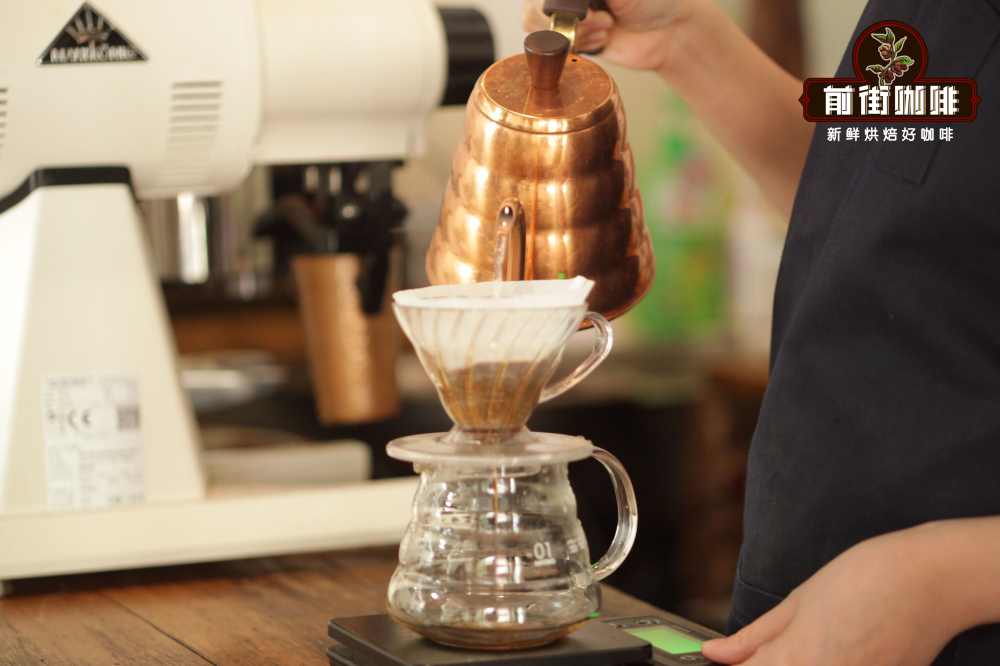
FrontStreet Coffee uses staged extraction, also called three-stage brewing: a 30g bloom for 30 seconds, then a slow circular pour to 125g as the first segment. When the water level drops and is about to expose the coffee bed, continue to 225g and stop. When the bed is about to be exposed again, remove the dripper (timing from the start of the bloom). Extraction time is 2'05".

Mariposa brewed: jasmine florals, a black-tea sensation, berry-citrus sweetness and acidity, a slight nutty finish, a smooth mouthfeel, low bitterness, moderate acidity, and a medium finish.
FrontStreet Coffee Recommendation
Mariposa exists because Geisha can be shared, and its jasmine-and-citrus profile points straight back to where the variety began — the forests of Ethiopia. If it is that floral, tea-like elegance you are chasing, FrontStreet Coffee's Ethiopian range is the place to follow it to the source.
FrontStreet Coffee Washed Yirgacheffe is the classic introduction: white jasmine, bright citrus and lemon acidity, and a clean tea-like body at an everyday price, which is why it so often becomes a first specialty bean. FrontStreet Coffee Gedingding Cooperative is its most representative washed expression — Gedingding sits at the southeastern edge of Yirgacheffe in the Worka area and was originally part of the Worka cooperative under the YCFCU union before being separated out as a single origin in the drive for traceability. It keeps the most traditional washed processing, stripping the fruit before drying so the coffee's own aromatics come through clearly: citrus and lemon with an elegant white floral note, bright and delicate overall. FrontStreet Coffee Sun-dried Red Cherry takes the other path, picking only fully ripe whole cherries and drying them on raised beds for three to five weeks; it keeps the typical Yirgacheffe character while adding sun-dried tropical fruit — citrus acidity, berry juice, honeyed sweetness, and a creamy smoothness.
These are light-roast, aromatic coffees, so brew them as gently as you would a Geisha: keep the water moderate rather than boiling and use a medium-fine grind. FrontStreet Coffee brews Yirgacheffe in a V60 with water at 90-91°C, 15g of coffee, and a 1:15 ratio, grinding to about fine sugar — roughly setting 10 on an EK43s — then pouring in three stages: a 30g bloom for 30 seconds, 95g over about a minute, and the final 100g once the bed drops to about two-thirds, finishing in the 2:00 to 2:10 range. The slow, even pour keeps the florals intact and lets the citrus and honey sweetness arrive in balance.
Important Notice :
FrontStreet Coffee is a long-established specialty coffee roaster in Guangzhou China, selling freshly roasted beans from its own farm in Yunnan as well as dozens of carefully selected single-origin beans from around the world for both pour-over and espresso. The products deliver consistently excellent quality and great value, with shipping within 24 hours. Guangzhou's FrontStreet Coffee shop is recommended by many coffee lovers, and the beans are now available online at the Tmall 。
FrontStreet Coffee has moved to a new address:
FrontStreet Coffee Address: 315,Donghua East Road,GuangZhou
Tel:020 38364473
 Scan and follow the En Gafei WeChat official account. Please indicate that the reprint comes from "En Gafei".