What Water Temperature Should Be Used for Pour-Over Costa Rica Santa Teresa Estate White Honey Geisha Coffee?
Professional coffee knowledge exchange and more coffee bean information, stay tuned to FrontStreet Coffee.
Coffee Origin Information
Origin: Costa Rica
Coffee Estate: Santa Teresa
Processing Method: Washed
Growing Altitude: 1900m
Variety: Geisha
Flavor Profile: Bergamot, sweet orange, apple, grape juice, fruit candy
The Origin of Geisha Coffee
Geisha coffee originally hails from Geisha Mountain in southwestern Ethiopia. Part of what makes Geisha so expensive is its high growing altitude - but it is also true that, compared with other varieties, its leaves photosynthesize very weakly and its root system is underdeveloped, with limited ability to take up water and nutrients. That very frailty may be the source of its unique flavor.
Santa Teresa is the only coffee processing plant in Costa Rica located at 2,000 meters of altitude. The Geisha comes from the Congo plot at 1,900 meters. The entire Santa Teresa estate covers 60 hectares, but Roger, the owner, uses only 9 hectares for coffee - and all of the Geisha comes from the roughly 2 hectares of Congo.
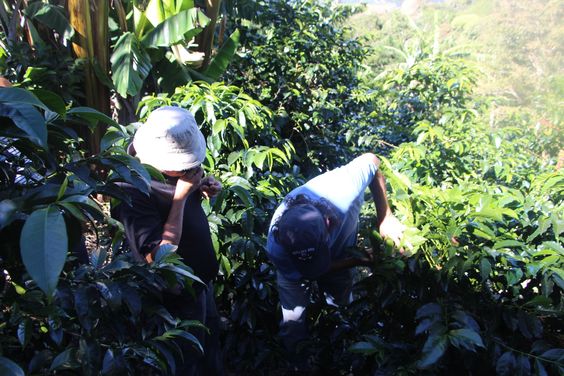
Roger has grown coffee alongside his parents since childhood, fitting his studies around the harvest. Three years ago he decided to build the Santa Teresa micro-mill, convinced that the high-altitude environment, the day-night temperature swings, and the pristine surroundings let coffee cherries develop a more distinctive expression of the Tarrazu terroir.
On March 5, 2018, we rode with Roger and his son Alex in their LC79 (a dream vehicle in the hearts of roasters) up to this 2,000-meter mill. The facility is anything but luxurious. We toured the drying grounds and African beds, and Roger and Alex kindly waited to demonstrate their workflow - how they conserve resources, and their commitment to carbon neutrality and environmental protection.
Roger loves coffee, but he loves the environment just as much. His 2,000-meter washed Geisha is truly impressive.
FrontStreet Coffee's Three-Stage Pour-Over Method for Geisha Coffee
Three-Stage Pour-Over Method
Segmented extraction: one portion of water divided into three pours.
Suitable for light, medium-light, and medium roast coffee beans.
Uses the Kalita wave dripper (cake cup).
Lengthen the bloom or add pour interruptions to enhance richness and intensity.
Three-Stage Pour-Over Segmented Extraction
Advantages: More layered than a single-pour brew, clearly separating the coffee's front, middle, and back-end flavors. After each bloom, increase the water volume, usually pouring when the coffee level is about to drop to the surface of the bed, using small, medium, and large flows across the three stages.
Disadvantages: Demands more skill in controlling flow rate and volume.
FrontStreet Coffee's Geisha Pour-Over Parameter Recommendations
The wave dripper's flat-bottom immersion increases the contact area between grounds and water, improving texture compared with a V60 and giving a thicker mouthfeel.
15g of coffee, water temperature 91-92°C, grind size BG 5R (64% pass rate on the Chinese standard 20 mesh sieve), coffee-to-water ratio close to 1:15-16.
Method: Start with 27g of water for a 30-second bloom, pouring clockwise in circles centered on the middle of the dripper. Start timing as you begin: pour to 27g, stop, and wait 30 seconds before the first main pour.
Pour the first stage in circles as before, slightly slower, speeding up a little as you reach the outer circle. Stop around 1:15 on the timer, wait for the level to drop by 1/3, then pour again. Keep the second pour concentrated in the center, avoiding the seam where grounds meet filter paper to prevent channeling. End extraction around 2:05. Discard the tail (the longer it runs, the more astringency and rough texture build up).
Segments: 30-125-230g
FrontStreet Coffee Recommendation
Falling for high-grown Costa Rican Geisha? FrontStreet's Panama Esmeralda Red Label Gesha ("Esmeralda Special") is the icon: grown at 1,600-1,800 meters, every lot must cup above 90 points, and each lot - such as FrontStreet's Harimiu-plot selection - is traceable to a single small parcel, letting you choose by subtle flavor differences. The Green Label "Private Collection" blends several plots into Esmeralda's signature high-altitude Gesha profile at a friendlier price, making it outstanding value.
Brew either one the way you would this Santa Teresa lot: a three-stage pour in a Kalita wave cup, 15g of coffee, 91°C water, a fine-medium grind (about 78% pass through a #20 sieve - fine granulated sugar), and a 1:16 ratio - 30g bloom for 30 seconds, then to 125g, then to 225g, finishing in roughly 2:10-2:20. Those fragrant florals, juicy fruit acidity, and tea-like sweetness will have you completely captivated.
Important Notice :
FrontStreet Coffee is a long-established specialty coffee roaster in Guangzhou China, selling freshly roasted beans from its own farm in Yunnan as well as dozens of carefully selected single-origin beans from around the world for both pour-over and espresso. The products deliver consistently excellent quality and great value, with shipping within 24 hours. Guangzhou's FrontStreet Coffee shop is recommended by many coffee lovers, and the beans are now available online at the Tmall 。
FrontStreet Coffee has moved to a new address:
FrontStreet Coffee Address: 315,Donghua East Road,GuangZhou
Tel:020 38364473
 Scan and follow the En Gafei WeChat official account. Please indicate that the reprint comes from "En Gafei".