Introduction to the History of Guatemala's San Rafael Urias Estate_How to Brew San Rafael Urias Estate Pour-Over Coffee
Guatemala Antigua San Rafael Urias Estate
In 1739—the fourth year of the Qianlong Emperor's reign—the San Rafael Urias Estate was established, and its owner, Rafael Valdés Quiroa, began planting coffee trees there. More than 200 years later, San Rafael Urias has repeatedly ranked at the top of national competitions (auction awards in 2001, 2005, 2006, and 2008, plus APCA certification as genuine Antigua). While we're not here merely to add to the glory, perhaps when we say Antigua we should also think of San Rafael Urias, a time-honored name with a long history.
Here is an introduction to the San Rafael Urias Estate.
Rafael Valdés Quiroa founded the San Rafael Estate in Antigua in 1739. 260 years later, it has placed among the winners in national competitions four times. When talk turns to fine Antigua coffee, you never overlook San Rafael. Over the years, international judges' cupping notes for San Rafael read: clean citric acidity, sweet, transparent, crisp acidity with backbone, smooth rich body, a nice long sweet finish, dark chocolate, raspberry. Comparing these with the fresh batch that arrived in September 2011, cupping revealed an almost identical flavor profile—evidence of the estate's rigorous standards and consistent quality. Truly remarkable.
San Rafael Estate sits in the highlands of Antigua at an altitude of nearly 1700 meters. The volcanic soil is fertile and sandy, with good drainage. Average annual temperature is 23°C, relative humidity is 60%, and annual rainfall is 1000mm. In Antigua, that is a textbook excellent microclimate. The estate is currently run by the third generation of the Valdés family. It covers 225 hectares, though coffee is cultivated on only about 115 hectares, growing several varieties: Bourbon, Typica, and Caturra. Following the founder's spirit, the third generation still insists on producing high-quality coffee. Because of the estate's highland location and the Guacalate River running through it—bringing abundant water—the owner cleverly built a wet processing mill powered by a waterwheel. I have seen two such hydraulically powered wet mills in Central America. Not only are they environmentally friendly, but their components are all ingeniously crafted and well worth studying. The farm has multiple water treatment and filtration systems, supplying drinking water, irrigation water, and water for washing the coffee after harvest. Besides coffee, the farm also grows berries, sweet potatoes, and various fruits and vegetables, plus dairy products, to add income. San Rafael is a typical centralized-processing farm, with growing, harvesting, washing, and drying all handled on site.
How to Brew Guatemala Coffee [San Rafael Urias Estate] Well
FrontStreet Coffee pour-over reference: Weigh 15g of [San Rafael Urias Estate] coffee powder and grind it medium. The particles should be slightly coarser than table salt. We use a BG grinder setting of 5R (standard sieve pass rate 60%), water at 89°C, and a V60 dripper.
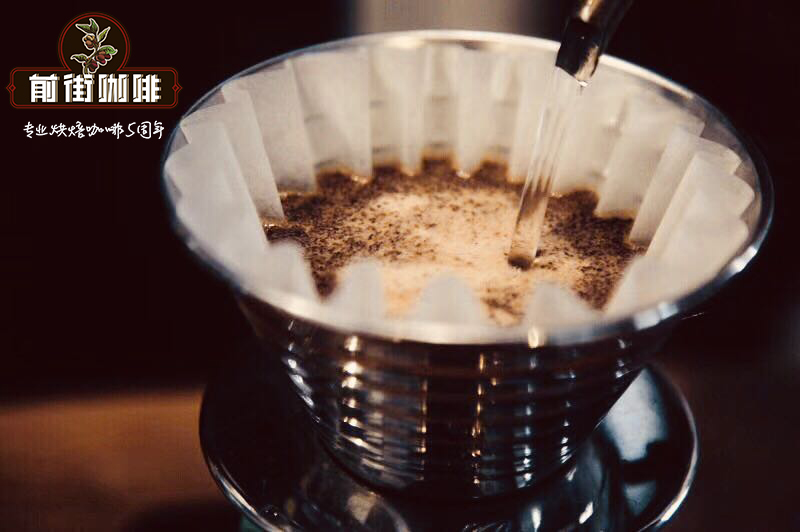
Pour hot water from the kettle in clockwise circles centered on the middle of the dripper. Start timing at the beginning of the brew. Within 15 seconds, brew to 30g, then stop pouring. When the time reaches 1 minute, pour the second time. For the second pour, as before, pour in clockwise circles centered on the middle of the dripper. Avoid pouring water onto the area where the coffee powder meets the filter paper, to prevent channeling.
Leave one circle when pouring to the outermost edge of the coffee powder, then pour back toward the center circle by circle. By 2 minutes 20 seconds, brew to 220g. The brew is complete.
Japanese-Style Ice Pour-Over [San Rafael Urias Estate]
FrontStreet Coffee ice pour-over [San Rafael Urias Estate] reference:
Guatemala Coffee [San Rafael Urias Estate], light-medium roast, BG grinder setting 5M (standard sieve pass rate 67%).
20 grams of powder, 150 grams of ice, 150 grams of hot water. The water temperature should be 1°C higher than the normal pour-over recommendation of 90°C. Normal grinding uses a Fuji 3.5 setting, while ice pour-over uses half a setting finer—Fuji 3.
Bloom with 40 grams of water for 30 seconds.
Pour in stages: first stage 60 grams of water, second stage 40 grams of water. Use a relatively fine but high water column, stirring forcefully so the coffee powder rolls thoroughly. Be careful not to let the liquid level get too high and avoid pouring onto the edge filter paper.
The entire extraction time is approximately 2.5 minutes (close to the normal extraction time for 20 grams of powder).
FrontStreet Coffee Recommendation
For a bright, clean cup like this Antigua lot, FrontStreet Coffee suggests these options for the dripper.
FrontStreet Ethiopia Huakui
A standout specialty lot with an exceptionally prominent tropical fruit aroma—strawberry, passion fruit, jackfruit, even lychee. Sweet with very little bitterness, smooth and full of juice—often described as "the least coffee-like coffee." Great for anyone who dislikes traditional bitterness.
FrontStreet Gotiti Cooperative
A washed single-terroir coffee from Gotiti village in the Worka area. Look for vivid citrus, berry, and floral notes with a green-tea finish; its acidity is soft and bright, more like the natural tang of fruit than anything sharp.
FrontStreet 2013 Yunnan Typica
Grown by FrontStreet in Lincang, Yunnan since 2013 and naturally processed. Roasted medium, it shows clean citrus and caramel aromas with nuts, chocolate, and brown sugar from the roast, medium acidity, and a well-balanced, distinctly Yunnan character.
Important Notice :
FrontStreet Coffee is a long-established specialty coffee roaster in Guangzhou China, selling freshly roasted beans from its own farm in Yunnan as well as dozens of carefully selected single-origin beans from around the world for both pour-over and espresso. The products deliver consistently excellent quality and great value, with shipping within 24 hours. Guangzhou's FrontStreet Coffee shop is recommended by many coffee lovers, and the beans are now available online at the Tmall 。
FrontStreet Coffee has moved to a new address:
FrontStreet Coffee Address: 315,Donghua East Road,GuangZhou
Tel:020 38364473
 Scan and follow the En Gafei WeChat official account. Please indicate that the reprint comes from "En Gafei".