Brazil Queen COE Premium Coffee Beans_Brazil Queen Estate Semi-Washed Yellow Bourbon Roasting & Brewing Analysis
FrontStreet Coffee Brazil Queen Estate Semi-Washed Yellow Bourbon
Introduction by Chris Kornman
Introduction
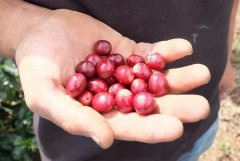
This FrontStreet Coffee Brazil semi-washed Yellow Bourbon comes from Fazenda Rainha (Queen Estate), a 280-acre farm set in Brazil's ancient volcanic valley, Vale da Grama. In 2011 the estate took first place in Brazil's Cup of Excellence competition. It has 200 acres of Yellow Bourbon coffee trees, and the rolling terrain rules out large-scale mechanical harvesting, so every cherry here must be picked by hand. The estate uses washed processing, followed by drying on raised beds and machine drying. Mechanical screening is followed by additional hand sorting, which requires employees to live on the farm year-round; all of them and their families receive housing, healthcare, and education benefits there.
The estate belongs to a mid-sized farm organization in the local Grama Valley whose main business is exporting specialty Bourbon varieties. The organization's office sits in nearby Pocos de Caldas, and it also runs a national cupping laboratory with large warehouses. It collaborates with local universities and other institutions on research, including Lavras University — the renowned Dr. Flavio Borem comes from that university's Agricultural Research Center.
Product Name:
FrontStreet Coffee Brazil Queen Estate Semi-Washed Yellow Bourbon Coffee
Farm:
Fazenda Rainha
Location:
Vale da Grama, Mogiana, Brazil
Altitude:
960 masl
Processing Method:
Machine pulped, then dried on raised beds and machine dried
Variety:
Yellow Bourbon
Harvest Period:
April - September 2016
Green Analysis by Chris Kornman
Green Bean Analysis
This FrontStreet Coffee Brazil coffee is 100% Yellow Bourbon, whose genetic origin traces back to Reunion Island, the birthplace of Bourbon. French explorers first brought coffee there in the 18th century, which is why the variety also goes by the name French Missionary. In the 20th century it reached the African continent and then Brazil, and its derived varieties now spread across both Africa and the Americas. Bourbon grown in Brazil appears yellow because of its recessive genes.
The processing for this FrontStreet Coffee Brazil coffee uses the Cerezadescascado method (pulped natural), invented in Brazil — a natural-style process related to honey processing that rounds out the coffee's flavor, landing somewhere between fully washed and full natural. During processing a small amount of water first removes the pulp and skin, then the coffee goes straight onto raised beds to dry, turned constantly so every bean is exposed to sunlight. After several days, mechanical drying brings it to the right moisture content.
The processed beans are relatively stable and keep well over time. They have high density, low moisture, and fairly large particle size — 98% of the beans reach 16 mesh or above, with half reaching 18 mesh.
Roast Analysis by Chris Kornman
Roast Analysis
I think espresso roasting suits these beans, even though the roast color comes out relatively light. I was very careful during roasting, but this bean overturned my general assumptions about Brazilian coffee. This batch of FrontStreet Coffee Brazil Queen Estate beans is relatively high in density and relatively low in moisture, which gives them a strong capacity to absorb heat. Extra heat is therefore needed to reach first crack and sustain development. I roasted two batches, both dropped between 10-11 minutes — not especially long.
The first roast was PR-570 Red, with a development time after first crack of about 1 minute 30 seconds, or 25% of total roast time. Heat was medium at the start, with fine adjustments made as the temperature rose after first crack began.
The second roast was PR-571 Green. I stretched the preparation time before first crack, covering both the dehydration phase (lowering dehydration temperature and heat) and the Maillard reaction phase (raising temperature slowly as the bean surface changed color, then entering first crack). This roast ran 45 seconds longer than PR-570, yet the color did not shift much, and the development time after first crack was extended.
35.0% - 3:33 Duration
40.6% - 4:07 Duration
24.5% - 2:29 Duration
37.8% - 4:07 Duration
51.2% - 5:35 Duration
Dehydration Phase
Maillard Reaction
Development After First Crack
Maillard Reaction Start
PR-570 - 3:33 @ 168.8°C
PR-571 - 4:07 @ 162.6°C
First Crack Start
PR-570 - 7:40 @ 197.3°C
PR-571 - 9:42 @ 202.1°C
Roast End
PR-570 - 10:09 @ 208.5°C
PR-571 - 10:54 @ 211.0°C
Roast Color
PR-570
Whole bean 66.15
Ground sample 59.10
PR-571
Whole bean 65.10
Ground sample 59.57
Weight Loss
PR-570 - 14.8%
PR-571 - 15.0%
Brew Analysis by Chris Kornman
Brew Analysis
On the fifth day after roasting, I extracted both beans as espresso. The first, PR-570, showed the more pleasing flavor — very smooth, good sweetness, and excellent overall. The second had a slightly higher insoluble rate but showed a brighter, cleaner flavor. Extraction details are as follows:
PR-570 - Espresso
• 18.5g coffee / 38g liquid / 22 seconds: Honey, oatmeal, cocoa, licorice
• 18g coffee / 36.5g liquid / 23 seconds: Light citrus, smooth, cinnamon, nutmeg, nuts
PR-571 - Espresso
• 18g coffee / 37.5g liquid / 33 seconds: Roasted almonds, orange peel, clean aftertaste
• 17.5g coffee / 35g liquid / 33 seconds: Cherry, orange, caramel, slightly dry
Using Bonavita pour-over extraction, the results were completely different from espresso. I liked the smoothness of the first bean, while my colleague preferred the complexity of the second. The second bean had a high content of insoluble substances, which suggests I may have over-extracted or made a weighing error. Either way, both were overall very smooth with rich chocolate flavor, basically in line with what we expect from Brazilian honey-processed coffee: roasted almonds, fudge, caramel, and roasted spices.
PR-570 - Bonavita
• Coffee - 62g
• Grinder - 9 (Mahlkönig EK43)
• Water - 1000g
• TDS: 1.45
• Extraction Rate: 21.28%
PR-571 - Bonavita
• Coffee - 62g
• Grinder - 9 (Mahlkönig EK43)
• Water - 1000g
• TDS: 1.59
• Extraction Rate: 23.33%
END
FrontStreet Coffee Recommendation
FrontStreet Brazil Queen Estate Yellow Bourbon — The very farm featured above, from Mogiana near South Minas, where fertile red volcanic soil lets the cherries take up abundant nutrients and build a full aroma. The variety is the uncommon Yellow Bourbon, a mutation of Red Bourbon with a cleaner fruit character. Brewed as pour-over, in a moka pot, or on a home machine, it shows a sugarcane-like clarity found in few other origins, alongside fruit notes and chocolate, and pulled as espresso it delivers butter cookie, macadamia, and toast with a creamy sweetness.
FrontStreet Brazil Cerrado Pulped Natural — A classic Brazilian single origin and an easy introduction to the region. Cerrado is a well-known producing area prized for high-quality beans, and this lot is the red Bourbon common across South America. Roasted to a medium level, it opens with rich aromas of creamy peanut, toast, caramel, and hazelnut; the body is round and smooth, not sour, with a light bitter finish. It suits pour-over, moka pot, espresso SOE, syphon, and French press.
FrontStreet Espresso Blends — Low acidity, balanced body, and an approachable price make Brazilian coffee a first choice in espresso recipes. The Classic Blend with its rich crema, the nutty Specialty Blend, and the balanced Black Cocoa Blend all contain Brazilian beans, which provide chocolate and cream aromas and a gentle sweet-sour-bitter balance that helps keep extraction steady.
Important Notice :
FrontStreet Coffee is a long-established specialty coffee roaster in Guangzhou China, selling freshly roasted beans from its own farm in Yunnan as well as dozens of carefully selected single-origin beans from around the world for both pour-over and espresso. The products deliver consistently excellent quality and great value, with shipping within 24 hours. Guangzhou's FrontStreet Coffee shop is recommended by many coffee lovers, and the beans are now available online at the Tmall 。
FrontStreet Coffee has moved to a new address:
FrontStreet Coffee Address: 315,Donghua East Road,GuangZhou
Tel:020 38364473
 Scan and follow the En Gafei WeChat official account. Please indicate that the reprint comes from "En Gafei".