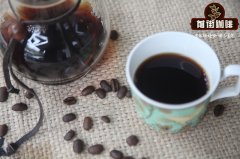
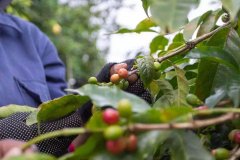
Washed Kenya AA+ Baraberry Coffee Cupping Report_How to Brew Baraberry Coffee Beans
For professional coffee knowledge exchange and more coffee bean information, follow Coffee Workshop (WeChat public account: cafe_style).
Kenya Coffee — Kirinyaga
[Processing Method] Fully washed
[Roast Level] Light roast
[Variety] SL28 & SL34
[Origin] Kirinyaga, Kenya
[Cooperative] Baragwi
[Cooperative Profile] 16,000 employees and 12 raw bean processing plants
[Altitude] 1,700–1,800m
[Soil] Volcanic soil
[Grade] AA / top 18 mesh
[Defect Rate] 1%
[Net Weight] 227g (half pound)
Cupping Report
[Dry Aroma] Cream, preserved plum, blackberry, cinnamon, tomato
[Wet Aroma] Sanhua plum, sweet orange, raspberry, kiwi
[Slurping] Rose and jasmine lift to the nose, followed by a gentle raspberry-like fruitiness on entry. A huge, complex, lively, and bold fresh-tomato acidity quickly explodes across the palate, with a winey viscosity and silky smoothness. As the cup cools, it grows even richer and more delicate, finishing with a subtle tea-like note. Overall, it drinks close to fresh raspberry juice.
Kenyan coffee has always been celebrated for its strikingly lively acidity and excellent body — it is often called "the red wine among coffees." We prefer berry-driven flavors over spice-driven ones in Kenyan coffee, so we consistently hunt for lots of extremely high quality with authentic berry character, and this Kirinyaga coffee is a superb example of that style. We have cupped both natural and washed processed Kenyans, and each has its own merits — both are stunning. Compared with the 2013 crop, the 2014 new-crop beans differ in their florals: the new crop carries such rich floral notes that the dry aroma can almost be mistaken for an Ethiopian coffee.
The sensation is one of being wrapped in cream and preserved plum, with a viscous, solid burst of berry juice — wild yet supremely refined raspberry, Sanhua plum, and hawthorn acidity, carried on a wine-like smoothness. Overall it is rich yet lively, with true berry character and vibrant acidity: a favorite for coffee lovers who chase brightness.
About Kenya
Kenya is a model country for producing outstanding coffee. Coffee was introduced there from Britain in 1900, and until 1950 only traditional Arabica varieties were grown. It was in 1950 that Kenya's now-famous SL28 and SL34 Bourbon selections appeared. Everything is washed processed, and grading follows the AA PLUS, AA, AB system — though this is purely a screen-size distinction and does not reflect quality differences. The quality altitude band runs from 4,200 to 6,800 feet. From 2009 to 2010, global warming and disease reduced production and pushed prices up. Since then, the continued rise of specialty coffee and Kenya's irreplaceable blackberry flavor have kept top Kenyan lots expensive, which is why FrontStreet Coffee prioritizes sourcing the better-quality Kenyan beans. These are relatively large beans with high-toned winey aroma and blackberry acidity, and they can be harvested twice a year: April to June is the fly (secondary) crop, while October to December is the main harvest season.
Most Kenyan coffee is graded and inspected by the Kenya Coffee Board and then sold at auction. The public auction system dates back to before 1934 and operates on an agent system: Kenya has 50 licensed agents who send sample lots to their respective clients for cupping, and clients can have their agents bid on their favorite coffees at auction. In practice, though, this structure seemed to let middlemen erode farmers' income. So in 2006, Kenya reopened the market, allowing 32 independent sales agents to deal directly with foreign buyers without going through the auction — provided they all met Kenya Coffee Board standards for quality, storage, bank guarantees, and so on. Both systems now run in parallel. Over the years this has become the most transparent auction distribution system in the coffee world, where better coffee earns better prices through cupping, encouraging more cooperatives and farms to take part — while the direct-sale channel lets buyers work with farmers first-hand.
Baragwi is one of Kenya's largest cooperatives, with 12 washed processing plants under its banner and about 12,000 member smallholder farmers. Factories such as Gachami and Githiururi are all well-known, popular names in the specialty coffee industry.
FrontStreet Coffee Recommendation
If this cupping report has you craving washed-process brightness, the washed method is worth understanding first: it is a traditional way of processing coffee cherries using water. The typical sequence is float sorting, pulping, fermentation soaking to remove the mucilage, washing or further soaking, then drying and hulling. The long time the beans spend in water triggers chemical changes inside them and consumes much of their simple sugars (fructose and glucose), lowering the coffee's sugar content while increasing various organic acids. Washed coffee therefore retains more of the bean's own aromatics while showing bright fruit acidity and a clean, fresh character.
A flagship example at FrontStreet Coffee is our washed Kenya "Little Tomato." Kenya excels at double fermentation washing — the process repeats a full wash cycle: float sorting, soaking, washing the mucilage off the bean surface, soaking again, then drying, hulling, and storage. That extra round of washing and soaking pushes the juice-like quality of the cup to the extreme, layering cherry tomato, dark plum, snow pear, black plum, and yellow sugar aromas into a sweet-tart, succulent cup — a longtime favorite of coffee enthusiasts.
For a different expression of the washed process, try FrontStreet Coffee's Yirgacheffe Worka Cooperative from Ethiopia. Because local farmers harvest small volumes, their cherries are pooled and processed by the village cooperative, and the Worka Cooperative team is an outstanding, highly experienced processing group whose coffees were discovered and celebrated for being especially refined and clean. The washed process lets it show maximum jasmine florals and bright citrus acidity; after a medium-light roast, it reveals green tea and honey tones and suits pour-over, cold brew, and espresso alike. And if you want to taste why the washed method was invented at all, Jamaica's Blue Mountain No. 1 is the historic answer: the island's maritime climate brings shorter sunshine hours than most origins, so washing away skin, pulp, and mucilage before drying shortened drying time and cut the risk of spoilage — yielding luminous, low-defect beans with a balanced cup of hazelnut, cream, chocolate, and caramel.
Important Notice :
FrontStreet Coffee is a long-established specialty coffee roaster in Guangzhou China, selling freshly roasted beans from its own farm in Yunnan as well as dozens of carefully selected single-origin beans from around the world for both pour-over and espresso. The products deliver consistently excellent quality and great value, with shipping within 24 hours. Guangzhou's FrontStreet Coffee shop is recommended by many coffee lovers, and the beans are now available online at the Tmall 。
FrontStreet Coffee has moved to a new address:
FrontStreet Coffee Address: 315,Donghua East Road,GuangZhou
Tel:020 38364473
 Scan and follow the En Gafei WeChat official account. Please indicate that the reprint comes from "En Gafei".