An Introduction to the Hand-Drip Flavor Characteristics of Ethiopian Yirgacheffe GOTITI Processing Station Goting Goting Coffee Beans

When coffee drinkers talk about floral and fruity aromas, FrontStreet Coffee immediately thinks of its Yirgacheffe. The roastery's Geisha has floral and fruity notes too, but for sheer distinctiveness, FrontStreet Coffee still ranks its Yirgacheffe aroma first. Yirgacheffe is a premium coffee region of Ethiopia, originally part of Sidamo, that broke away on the strength of its unique flavor profile!

About Yirgacheffe
Yirgacheffe began as a small town in Ethiopia's Sidamo administrative province. It has been wetland since ancient times — in the old language, "Yirga" means "to settle down" and "Cheffe" means "wetland."
Yirgacheffe ranks among the highest-altitude coffee regions on the planet and is synonymous with Ethiopian specialty coffee. At 1700-2100 meters, it enjoys cool, misty, spring-like weather year-round. The terrain and traditional cultivation system make it ideal for growing specialty beans. Strictly speaking, Yirgacheffe is a sub-region of Sidamo — the town lies in Sidamo's northwest, cradled by mountains and lakes — but its singular flavor earned it independence from Sidamo and a name recognized across Africa as the continent's most famous coffee origin.

Coffee trees in Yirgacheffe mostly grow in farmers' backyards or intercropped with other crops, so each household's output is small — the classic "garden coffee" model.
What we call the "Yirgacheffe flavor" means intense jasmine, lemon or lime acidity, plus peach, almond sweetness, and tea notes. FrontStreet Coffee's Yirgacheffe offers layered depth and a delicate body with captivating flavors and a sweet finish. "Flowers bloom as the coffee enters the mouth" describes it perfectly — that pleasant sensation of flowers touching both taste buds and olfactory cells. Beyond the florals, the delicate body feels like silk massaging the palate: a genuinely tactile pleasure.

The Yirgacheffe Gedeo Zone
Gedeb is a town below Kochere, 60 kilometers from Yirgacheffe town, and one of Ethiopia's most celebrated specialty coffee areas. At 1900-2200 meters — much higher than typical Yirgacheffe — its altitude makes it exceptionally suited to coffee, and it is an emerging micro-region steadily winning recognition. Though classified under Kochere in the ECX auction markets, it holds the same administrative rank as Kochere town.
Within the specialty industry it is distinguished from Kochere as a Yirgacheffe sub-region of equal standing. The town includes coffee-producing villages such as Worka Sakaro, Halo Bariti, Banko Gotiti, and Banko Dahato.

Talking about Yirgacheffe means first explaining how the region is classified. Under the ECX regional system, Yirgacheffe is divided into four areas: Wenago, Yirgacheffe, Kochere, and Gelana Abaya. Administratively, Kochere covers two woredas — Kochere in the west and Gedeb in the east. In recent years Gedeb has increasingly been recognized as a micro-region in its own right, and the Banko Gotiti cooperative sits in the Worka Kebele of Gedeb, at the southern end of Yirgacheffe.

The Banko Gotiti cooperative was originally part of the Worka cooperative under the Yirgacheffe Union (YCFCU) and became independent in 2012; it now counts about 300+ smallholder members. In the past, direct exports from Ethiopia could only happen through:
(1) the private processing station system, with exports via ECX bidding
(2) the cooperative system
(3) single estates/farms
From 2018, however, the ECX system was reformed and no longer conceals the origin of coffee lots: private processing stations can now export directly to buyers. Beyond improving transparency and traceability, this lets buyers and sellers build closer partnerships. For cooperatives it may have changed little — or perhaps sharpened competition with private stations — but overall the reform is another step forward for specialty coffee.

The Banko Gotiti Cooperative
The Banko Gotiti cooperative sits in the Worka area at the southeastern tip of Yirgacheffe. It was once part of the Worka cooperative under the Yirgacheffe Union (YCFCU), but as the market demanded traceable green coffee, "single regions" were gradually discovered one by one by coffee hunters worldwide. So in 2012, with about 300 farmer members, Banko Gotiti founded its own independent cooperative.
Banko Gotiti village was among the earliest to break away. Many of its small farmers were longtime members of the Worka cooperative, so their processing skills are beyond question. Known as "the last pure land of Yirgacheffe," the cooperative still processes its green beans in the most traditional ways (washed and natural).

Washed Processing
Ethiopia's washed technology arrived from Central and South America in 1972. The process is complex and demanding, requiring large volumes of fresh water — costlier than natural processing, and thus less common in water-scarce Africa.
The washed sequence: after picking, cherries go into water, where buoyancy separates out underripe fruit. A pulper strips the skin and pulp, and the beans rest in fermentation tanks for 18-36 hours until the mucilage layer decomposes. The parchment is then washed in channels for 30-60 minutes, where the channel design and flowing water carry away low-density, poor-quality beans. The premium beans are drained and spread on African raised beds to dry.

Because the pulp is removed before drying, FrontStreet Coffee's Yirgacheffe shows its intrinsic aromas with greater clarity: citrus, lemon, and elegant white florals in a bright, delicate cup. Once washed-processed beans reached the market, Yirgacheffee became a byword for world specialty coffee.
Heirloom Varieties
Most Ethiopian varieties are simply labeled "Heirloom" because the country has too many to catalogue. Ethiopia is a natural gene bank for Arabica: on one hand the sheer number of varieties makes identification and classification difficult; on the other, the Ethiopian government — for reasons of protection — is unwilling or unable to release detailed information about them.

In Ethiopia most coffee grows wild or semi-wild, in fields, backyards, or under forest shade. When cherries ripen, farmers gather them for processing — in reality a grand mixture of many natural variants. Because these cherries share the same terroir, they form a similar flavor profile: the foundation of regional coffee character. Ethiopia has nearly 2,000 recorded coffee varieties — 1,927 native and 128 introduced. Judged purely by looks, Ethiopian beans are a "grand garden" containing everything: long, short, thin, fat. That's why Ethiopian coffee beans come in all shapes and sizes.
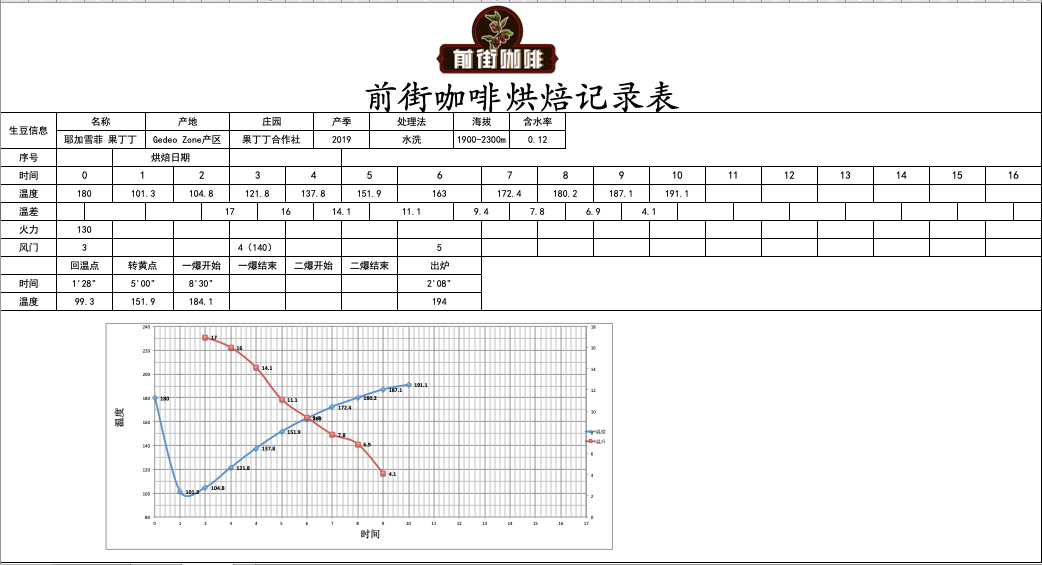
Roasting Profile Analysis
For a bean like this, FrontStreet Coffee's roasters favor a light roast to showcase its florals and fruit. For this Natural Banko Gotiti, we again use low heat to extend the drying (dehydration) phase.
Yangjia 800N roaster (300g batch)
Preheat to 175°C, air damper at 3, heat at 120. Turning point at 1'32"; when the probe reads 140°C, heat stays unchanged and the damper opens to 4. The beans now yellow, the grassy aroma fully fades, and the drying stage ends. At 166°C heat drops to 100; at 176°C to 80, damper unchanged.
At 8'28", ugly wrinkles and dark spots appear on the bean surface and the toast aroma clearly turns to coffee aroma — the prelude to first crack. Listen carefully now. First crack begins at 9'38"; set the damper to 5 (adjust heat very carefully — never so low that the cracking stops). Develop 1'30" after first crack and drop the beans at 193.5°C.
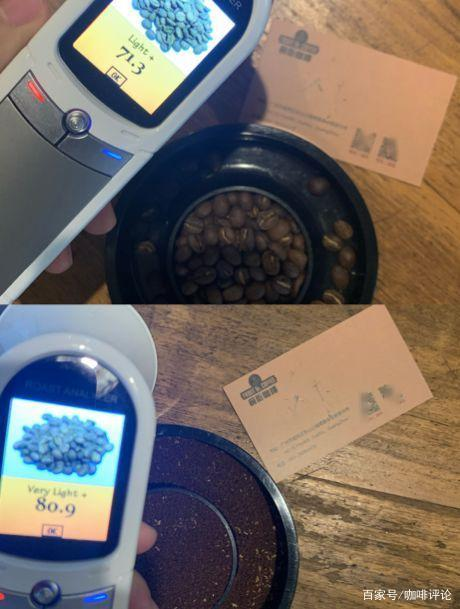
Agtron bean color 74.6 (upper image), Agtron ground color 79.8 (lower image), roast delta 5.2.
Cupping Profile
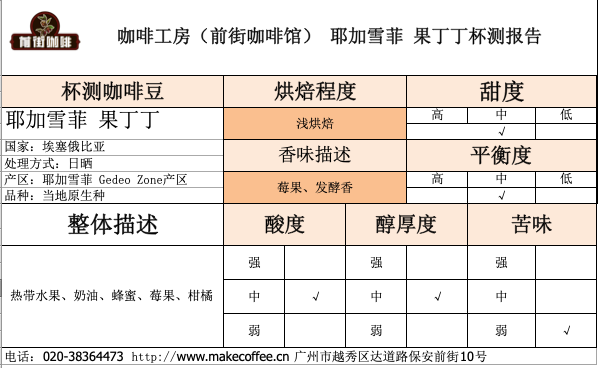
[FrontStreet Coffee Natural Banko Gotiti] Flavor: tropical fruit, cream, honey, berries, citrus.
FrontStreet Coffee Brewing Guide

Ethiopia Yirgacheffe Banko Gotiti
FrontStreet Coffee: Banko Gotiti Cooperative Coffee Beans
Country: Ethiopia
Region: Yirgacheffe, Gedeo Zone
Altitude: 1900-2300m
Variety: Heirloom
Processing: Natural
Grade: G1
Dripper: Hario V60
Water Temperature: 91°C
Dose: 15g
Ratio: 1:15
Grind: Medium-fine (80% pass-through on the Chinese standard #20 sieve)
Brewing Method: Step infusion

Bloom with 34g of water for 36 seconds. Continue pouring in small circles up to 120g, then pause. When the level drops and the coffee bed is about to expose itself, pour again up to 229g and stop. Once the level drops and the bed is about to show through, remove the dripper. (Timer starts at the bloom.) Total extraction time: 2'00".

[FrontStreet Coffee Natural Banko Gotiti] Flavor: a substantial mouthfeel with a prominent fermentation note and tropical fruit; as the cup cools, berry and cream flavors emerge, and the aftertaste leaves a lingering citrus sweet-tart sensation on the lips and teeth.
FrontStreet Coffee Recommendation
If Banko Gotiti's natural, fruit-forward style captivates you, FrontStreet Coffee's washed Yirgacheffe Guodingding is its crystalline counterpart: the same Worka-area craft, but washed. Known to many as the first specialty bean every beginner should try, it offers white jasmine florals, bright citrus and lemon acidity, and a green-tea-like sweetness at an everyday price — and since it is roasted within 5 days of shipping, it reaches you at full flavor.
Brew it on the V60 with 15g of coffee at a 1:15 ratio and 90-91°C water: bloom 30g for 30 seconds, pour to about 125g, then finish with the remaining 100g once the bed draws down two-thirds, completing the drip in 2'00"-2'10". The result is the definitive "Yirgacheffe flavor" — jasmine, lemon, tea — in the cleanest possible frame.
Important Notice :
FrontStreet Coffee is a long-established specialty coffee roaster in Guangzhou China, selling freshly roasted beans from its own farm in Yunnan as well as dozens of carefully selected single-origin beans from around the world for both pour-over and espresso. The products deliver consistently excellent quality and great value, with shipping within 24 hours. Guangzhou's FrontStreet Coffee shop is recommended by many coffee lovers, and the beans are now available online at the Tmall 。
FrontStreet Coffee has moved to a new address:
FrontStreet Coffee Address: 315,Donghua East Road,GuangZhou
Tel:020 38364473
 Scan and follow the En Gafei WeChat official account. Please indicate that the reprint comes from "En Gafei".