How to Drink Indonesian Sumatra Tiger Mandheling G1 Coffee Beans - Characteristics of Tiger Mandheling
The endangered Sumatran tiger has always been seen as majestic and composed. On the island of Sumatra there is a Mandheling coffee that shares the tiger's commanding aroma along with a smooth, rich taste. When FrontStreet Coffee recommends Mandheling, it often puts it this way: for high clarity, choose PWN Gold Mandheling; for rich body, choose Aged Mandheling; and for abundant aroma, choose Tiger Mandheling.

FrontStreet Coffee — Tiger Mandheling Coffee Beans
Origin: Aceh, Sumatra, Indonesia
Variety: Typica, Caturra
Processing: Wet-Hulling
Altitude: 1500m
Sumatra · Aceh Region
Aceh Province sits at the northwestern tip of the Indonesian archipelago. Straddling the equator, it has a typical tropical maritime climate, hot the year round with an average annual temperature of about 27°C and abundant rainfall. From October to March, influenced by Asian and Pacific air currents, it is Indonesia's rainy season, marked by heavy rain and a cooler climate; from April to October, influenced by the Australian continental current, the air carries less moisture and the climate turns hot and dry—the dry season. FrontStreet Coffee has cupped many beans from Aceh, including Long Berry Dragon Fruit Mandheling, PWN Gold Mandheling, Aged Mandheling, and this Tiger Mandheling. Herbal notes, dark chocolate, high body, a clean taste, and distinct sweetness are all hallmarks of coffee from this region.

Why Is It Called Tiger Mandheling?
This Tiger Mandheling comes from the homeland of the Sumatran tiger—the island of Sumatra. It uses 19-screen beans (strictly filtered through a 19-screen sieve so that every bean has nearly the same diameter), then passes through three rounds of hand selection of ripe cherries before the green beans are processed. That is why local people use "Sumatran Tiger" to describe the nobility and rarity of these carefully chosen 19-screen beans. In FrontStreet Coffee's cupping, the coffee shows high viscosity, a smooth mouthfeel, rich agarwood notes, high sweetness, and a long-lasting aftertaste that inevitably calls to mind a Sumatran tiger creeping forward.
The Wet-Hulling Process
Wet-hulling first removes the skin and pulp of the cherry, followed by a brief fermentation and drying, then removes the mucilage and parchment layer, and continues the final drying stage until the moisture content reaches 12%. Wet-hulled Mandheling beans clearly show compression cracks of varying degree—a phenomenon that leaves beans shaped like horseshoes, hence the name "horse hoof beans"—and the beans take on a dark greenish-blue color.

This method shortens drying to just two to four days, cutting the fermentation period, significantly lowering acidity while raising body. Caramel and fruit aromas come forward, sometimes carrying herbal or grassy notes and woody scents as well, and together they form Sumatra's unique regional flavor.
Coffee Bean Varieties
This Tiger Mandheling uses two varieties with distinct sweetness: Typica and Caturra. Typica has bronze-colored young leaves and elliptical or slender-pointed beans, with elegant flavors but a weaker constitution, poor disease resistance, and low yield. From cupping Typica across many origins, FrontStreet Coffee has found its particular subtle, clean flavor and balanced character to be consistently evident. Caturra is a Bourbon variety with curved bean ends, round and slender, showing better yields and disease resistance than Bourbon, with a bright overall flavor and good sweetness.

FrontStreet Coffee's roaster observed that the Tiger Mandheling green beans are round, green with yellow tones, uniform, and high in moisture. The roasting goal is medium-dark, to eliminate excessive acidity while enhancing body and balance.
FrontStreet Coffee Roasting Record
Heat the roaster to 200°C and load the beans with the damper set at 3. After 30 seconds, adjust the heat to 160°C, keeping the damper unchanged. The temperature return point comes at 1'45". Maintain the heat, and at 5'18" the bean surface turns yellow and the grassy aroma disappears completely, entering the dehydration stage. Reduce heat to 140°C and set the damper to 4.

At 7'30" dehydration is complete; reduce heat to 140°C. At 8'55" ugly wrinkles and black spots appear on the bean surface, with an obvious transition from toast aroma to coffee aroma that can be defined as the prelude to first crack. At this point, listen carefully for the sound of first crack. First crack begins at 9'00"; reduce heat to 110°C and fully open the damper to 5 (heat adjustments must be made very carefully, not so small as to silence the crackling). Develop for 4'00" after first crack, then discharge at 203°C.
FrontStreet Coffee Cupping Report
Dry Aroma: Herbal, nuts
Wet Aroma: Herbal, caramel
Flavor: Herbal, nuts, cream, dark chocolate

FrontStreet Coffee Brewing Insights
For medium to dark roasted beans, FrontStreet Coffee chooses the Kono dripper to highlight richness. The Kono's defining feature is its immersion function, which extracts more from the coffee and builds up the rich mouthfeel. Its few ribs sit at the bottom, letting the filter paper fit tightly against the dripper, restricting airflow, slowing the flow, and increasing the contact time between water and grounds.

Dripper: Kono Meimon
Dose: 15g
Ratio: 1:15
Temperature: 88°C
Grind: Medium-coarse (about 73% retention on a 0.85mm standard sieve)

FrontStreet Coffee uses segmented extraction, blooming with 30g of water for 30 seconds. With a small flow, pour in a circular motion to 125g, then pause. When the water level drops and is about to expose the coffee bed, continue pouring to 225g and stop. Wait for the level to drop until it is about to expose the bed, then remove the dripper. (Timing starts from the bloom.) Extraction time is 2'05".
Brewing Flavor: Nuts, cream, dark chocolate, caramel, and Chinese herbal medicine, with distinct sweetness and a relatively clean, clear profile.
FrontStreet Coffee Recommendation
A wet-hulled Mandheling offers a heavy body with distinctive earth and herbal flavors—a taste some seasoned drinkers find themselves unable to resist. Indonesia's rainy season overlaps with the coffee harvest, which makes sun-drying difficult and gave rise to the region's own Sumatra-style method: wet-hulling. Since it rains so often, growers remove the skin and pulp, rinse briefly, and dry the beans; once they are half dry and half wet, a machine strips away the parchment so the green bean is exposed to the air, speeding the whole process. Practiced this way since the 1970s, the method creates Mandheling's singular flavor. To taste it, try FrontStreet Lintong Mandheling: rich and fragrant, sweet-bitter, strong and bracing on the palate, with clove and woody aromas—a medium-dark roast, low in acidity, with spicy and minty notes and a powerful, lasting, full sweetness.
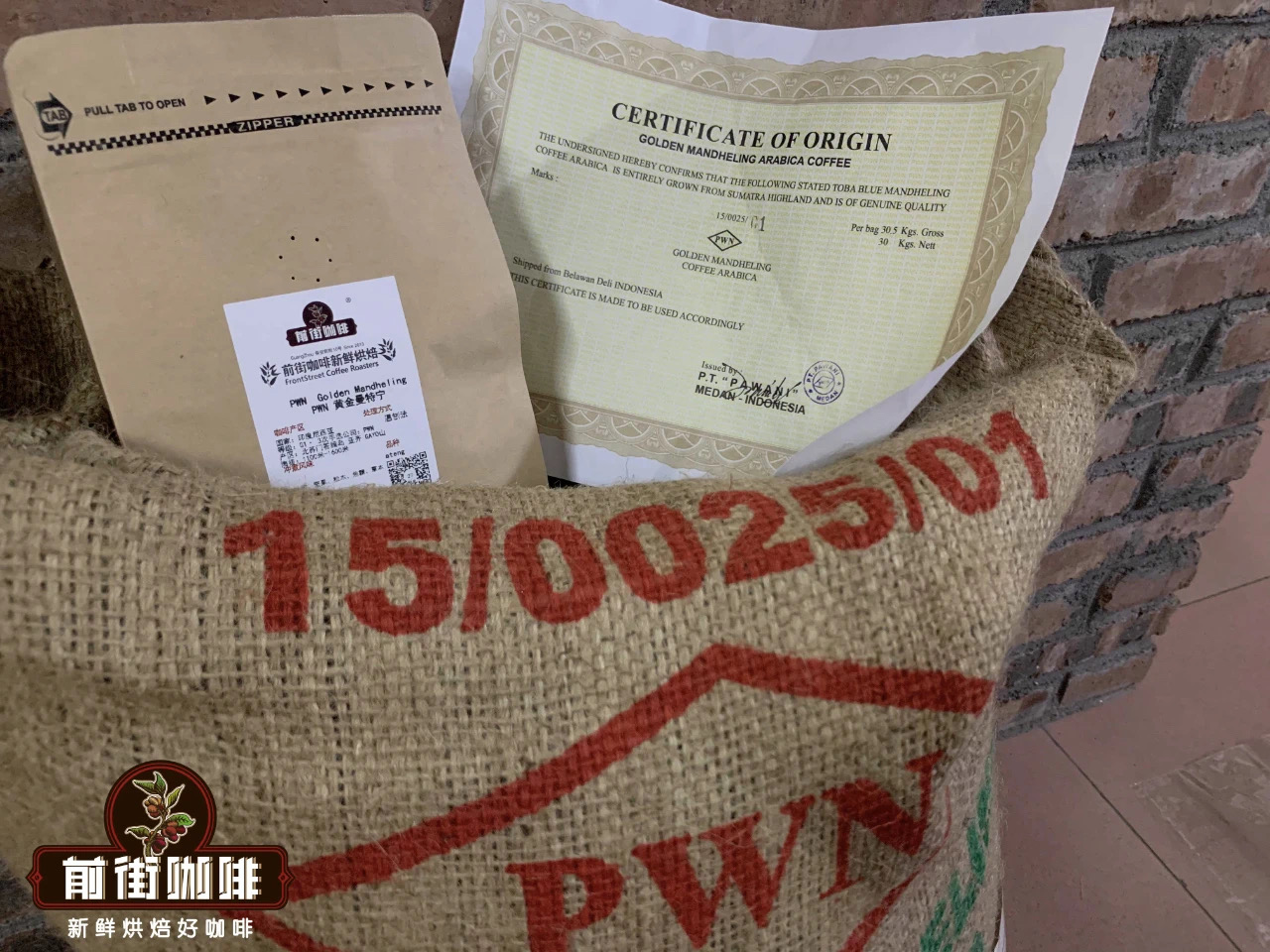
Among Mandheling beans, Golden Mandheling best satisfies the most exacting drinker, and FrontStreet Golden Mandheling comes from Indonesia's PWN company, which applies extremely strict standards in producing it: beans of 18-screen size or larger, with fewer than 3 defective beans per 300g sample to meet the top G1 grade, then three rounds of hand sorting to remove every defect—raising the cup's cleanliness and the intensity of its sweetness. Those standards alone show both the quality of FrontStreet PWN Golden Mandheling and its limited supply, which together make it a leader among Mandheling beans. It is even, plump, large, and translucent with a low defect rate; after a medium-dark roast it carries abundant roast aroma, and the brewed black coffee has a clean taste and full body—ideal for anyone who dislikes acidic coffee.
Pour-over shows FrontStreet PWN Golden Mandheling at its best. FrontStreet suggests a water temperature of 87-88°C, 15g of grounds, a 1:15 ratio, a coarse-sugar grind, and a three-stage pour, which better expresses the coffee's full body and caramel sweetness: the first stage, a 30ml bloom pour that wets all the grounds and lets them degas for better extraction to follow; the second stage, 100ml, which washes out the golden foam and lifts the bed; and the final stage, a gentle 95ml pour down the center, which lifts the sweetness and rounds out the whole cup with a substantial body, caramel sweetness, and chocolate and nut flavors. If you want this Mandheling's flavor on an espresso machine, consider FrontStreet Classic Blend, the house's most repurchased coffee: it adds a medium-dark Mandheling to the creamy nuttiness of Brazilian coffee, so butter, roasted chestnut, and caramel stand out, while the Mandheling lifts the cup's body and lends it sandalwood, herbal, and spice notes; a small amount of Robusta is added to enrich the crema, making latte art or a layered Dirty effortless.
Important Notice :
FrontStreet Coffee is a long-established specialty coffee roaster in Guangzhou China, selling freshly roasted beans from its own farm in Yunnan as well as dozens of carefully selected single-origin beans from around the world for both pour-over and espresso. The products deliver consistently excellent quality and great value, with shipping within 24 hours. Guangzhou's FrontStreet Coffee shop is recommended by many coffee lovers, and the beans are now available online at the Tmall 。
FrontStreet Coffee has moved to a new address:
FrontStreet Coffee Address: 315,Donghua East Road,GuangZhou
Tel:020 38364473
 Scan and follow the En Gafei WeChat official account. Please indicate that the reprint comes from "En Gafei".