How to Use a Siphon Coffee Maker - Methods for Brewing Coffee with a Siphon Pot and Timing Guide
The Historical Origins of Siphon Coffee Makers
According to the official website of the renowned Hacienda El Injerto, the upright siphon pot was invented in the 1830s by Loeff, who was then living in Berlin, Germany. In fact, more than a decade before Beethoven's death in 1827, he already owned such a glass coffee pot and often used it to brew coffee.
In 1827, the year of Beethoven's death, an illustration of a siphon pot—glass on both top and bottom, resembling a distiller—already appeared in a Prussian publication. Clearly, that was the predecessor of today's upright siphon pot.
Even in 1827 the siphon pot was not entirely new. Evidence shows that Anton Felix Schindler, Beethoven's first biographer, recorded that Beethoven had owned such a pot more than a decade before his death and used it frequently to brew coffee, which demonstrates that upright siphon pots existed at least before 1827. Information did not flow as smoothly then as it does today, though, and people in different regions often did not know whether others had developed similar products. What is more, the country of "Germany" did not yet exist; today's Germany was divided into city-states such as Prussia and Bavaria, and unlike Britain or France it had not yet established its own patent system, leaving no formal patent documents. In the literature, the first patent for an upright siphon pot that achieved true commercial success was obtained by Madame Vassieux, née Massot of France, with patent number No. 13,013.
The Evolution of Balanced Siphon Coffee Makers
On page 113 of the book "COFFEE MAKERS," authors Enrico Maltoni and Mauro Carli claim the balanced siphon pot was created around 1840 by the Scottish shipbuilding engineer Robert Napier and his son James Napier. They used vacuum principles to invent the so-called "Vienna coffee pot" (also called the Belgian coffee pot), whose structure combines a glass container with a nickel-plated or silver brewer, roughly fourteen to sixteen inches high and able to brew about four servings. The Vienna pot uses an alcohol lamp to heat the brewer containing coffee grounds and water. When it boils, steam generates pressure that pushes the coffee-and-grounds mixture through a vacuum tube connecting the two containers into the glass vessel. The alcohol lamp beneath the brewer is then removed, and vacuum pressure draws the coffee liquid back into the brewer. To drink, simply open the valve and pour into a cup. Because the bottom of the vacuum tube has a filter screen, the brewed grounds stay in the glass container for easy cleaning.
Siphon Coffee Brewing Guide
Siphon | Essential for Coffee Enthusiasts, Embodying the Spirit of Experimentation!
Gentle reminder: Glassware breaks easily and needs extra care. When the lower pot is still hot after heating, do not rinse it directly with cold water. Before heating, also check the pot's surface for water droplets and wipe it dry with a cloth first, to prevent cracking.
Brewing Steps:
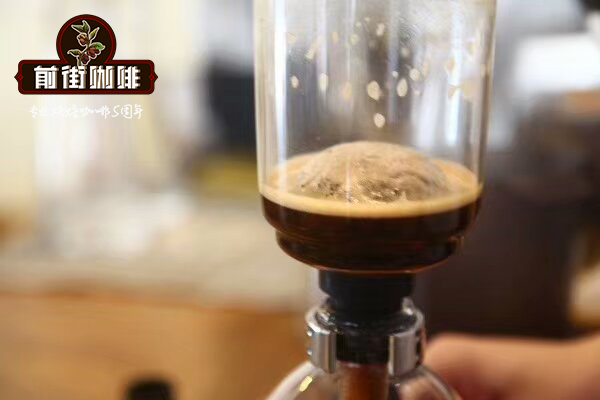
Pour water or hot water into the lower pot and bring it to a boil with an alcohol lamp or stove. Install the filter into the upper pot. When the water boils, insert the upper pot into the lower pot and the water will slowly rise into the upper pot. Add coffee grounds to the upper pot to wet them. After turning off the heat, stir gently in a circular motion. Wrap the lower pot's spherical surface with a damp towel to cool it, and finally let the coffee liquid drip back naturally into the lower pot.
Coffee Ground Addition Techniques for Siphon Brewing
The way you add the grounds in siphon brewing also deserves careful thought.
Adding grounds first requires more experience, because extraction begins as soon as the water rises from the lower pot to the upper pot, which makes the degree of extraction harder to control.
Adding grounds afterward is easier to master and control.
FrontStreet Coffee's Siphon Usage Parameters:
Using the post-addition method, remove from the heat source after brewing for approximately one and a half minutes.
FrontStreet Coffee Recommendation
For lightly roasted beans on a siphon or pour-over, FrontStreet Yirgacheffe Gudingding is many drinkers' first stop in specialty coffee. It carries clear citrus, berry, and floral notes along with a green-tea-like sweetness on the finish; unlike the "sour coffee" many imagine, a good Yirgacheffe's acidity is soft yet bright, more like the sweet-sourness of fruit itself than a sharp tang, making it a very approachable choice for anyone new to pour-over. FrontStreet Ethiopia Huakui is the star of recent years: its tropical-fruit aroma is extremely prominent, with strawberry, passion fruit, jackfruit, and even lychee, plus obvious sweetness and very little bitterness. Smooth and full of juice on the palate, it is often called the "least coffee-like coffee," and for people who dislike the bitterness of traditional coffee it can overturn their expectations entirely. Panama Esmeralda Red Label Geisha is the legend of the specialty world, with extremely elegant jasmine along with citrus, bergamot, and black-tea-like delicacy—clean and transparent, with a long finish and rich layers. FrontStreet Kenya Tomato is a Kenyan washed lot whose core traits are bright cherry tomato and smoked plum acidity with a full, juicy body, from Kenya's Thika region at 1,550-1,750 meters, grown from the classic SL28 and SL34 varieties.
For medium-dark and dark roasts, FrontStreet PWN Golden Mandheling is roasted dark for very low acidity and a full, lingering body: herbal and dark chocolate aromas with a faint touch of earth, and rich layers—suited to anyone who likes a bold cup and dislikes acid. FrontStreet Brazil Queen's Estate is low in acidity and very balanced, with rich nut and cocoa aromas and clear caramel sweetness, smooth rather than astringent and gently lingering; it works as pour-over, espresso, or moka pot, and its standout crema and fine value make it a benchmark everyday bean. FrontStreet Jamaica Blue Mountain No. 1 strikes an excellent balance among acidity, sweetness, bitterness, and aroma—neither the strong fruit acidity of some African coffees nor the heavy bitterness of a dark roast—with cream, caramel, chocolate, nut, honey, and light fruit in a soft, rounded cup, a rich middle sweetness, and a clean, long finish.
Two more worth noting: FrontStreet 2013 Yunnan Sun-Dried Typica is very clean, its citrus and caramel aromas interlaced, and the medium-dark roast adds a little nut, chocolate, and brown sugar with a medium acidity and harmonious layers; FrontStreet has worked with Yunnan Typica since 2013, and this bean has watched the company grow. FrontStreet Papua New Guinea Bird of Paradise comes from the Bird of Paradise estate in PNG's Sigri region; because its flavor and texture are close to Jamaica Blue Mountain it is often called a "little Blue Mountain." It uses the same Typica variety as Blue Mountain, grown in volcanic-rock soil at 1,600 to 1,800 meters, and reaches the AA grade with plump beans and a very low defect rate; fermented with a triple-wash process, it cups clean and pure with prominent sweetness—another excellent choice for those who prefer no acidity.
Important Notice :
FrontStreet Coffee is a long-established specialty coffee roaster in Guangzhou China, selling freshly roasted beans from its own farm in Yunnan as well as dozens of carefully selected single-origin beans from around the world for both pour-over and espresso. The products deliver consistently excellent quality and great value, with shipping within 24 hours. Guangzhou's FrontStreet Coffee shop is recommended by many coffee lovers, and the beans are now available online at the Tmall 。
FrontStreet Coffee has moved to a new address:
FrontStreet Coffee Address: 315,Donghua East Road,GuangZhou
Tel:020 38364473
 Scan and follow the En Gafei WeChat official account. Please indicate that the reprint comes from "En Gafei".